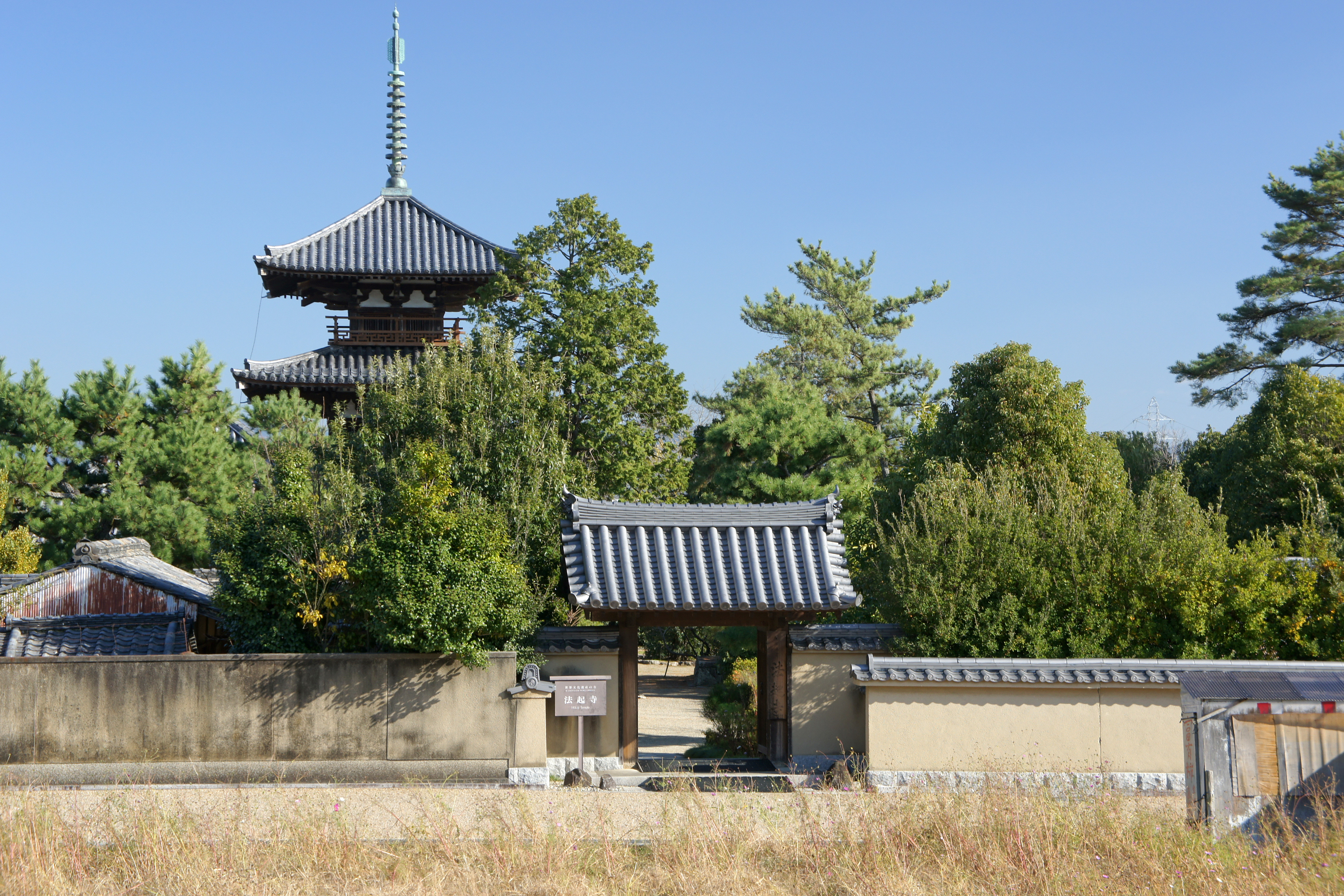
Hokki-ji: Japan's Oldest Three-Story Pagoda
Between 1972 and 1975, restorers did something remarkable to one of Japan's oldest wooden buildings. They took it apart completely -- every beam, every column, every balustrade of the three-story pagoda at Hokki-ji -- and then put it all back together again. Where ancient mortise and tenon joints had decayed beyond saving, they carved new modules and burned the date "Showa 48" into the fresh timber, so that restorers centuries from now would know exactly which pieces were original and which were replacements. The pagoda they rebuilt had stood since 706 AD, making it the oldest three-story pagoda in Japan. The temple it belongs to claims an even deeper lineage: a connection to Prince Shotoku, the patron saint of Japanese Buddhism, and a palace where he once lectured on the Lotus Sutra.
A Prince's Last Wish
Hokki-ji stands in the Okamoto district of Ikaruga, the town that is also home to the great Horyu-ji, and the two temples share a tangled history. Legend holds that the site of Hokki-ji was once Okamoto Palace, where Prince Shotoku lectured on the Lotus Sutra. According to tradition, the prince's last will and testament instructed his son, Prince Yamashiro no Oe, to rebuild the palace as a temple. The work began, a Miroku Bosatsu statue was installed during the reign of Emperor Jomei in 638, and a main hall was completed. But the temple was not finished during the prince's lifetime -- the three-story pagoda that survives today was completed in 706, decades after Shotoku's death. The temple was originally a nunnery, and by 747 it appeared in the Horyu-ji Engi under the name Ikego-niji, listed as one of the Seven Temples Built by Prince Shotoku.
A Layout in Reverse
Archaeological excavations conducted after 1960 revealed the original plan of Hokki-ji's temple complex, and it contained a surprise. Like the western precincts of neighboring Horyu-ji, Hokki-ji arranged its main hall and pagoda side by side on an east-west axis. But the positions were reversed: at Hokki-ji, the main hall sits to the west and the pagoda to the east, the mirror image of Horyu-ji's arrangement. This distinctive configuration is known as the Hokki-ji style temple complex layout. Even more telling, excavation uncovered post-hole buildings and a stone-paved rain gutter that predate the temple entirely, built along an axis tilted about 20 degrees west from north-south. This tilted orientation matches the remains of the Wakakusa temple complex, the predecessor of Horyu-ji, confirming that some earlier structure -- likely Okamoto Palace -- stood on this ground before the temple was founded.
The Pagoda That Survived Everything
The three-story pagoda of Hokki-ji is a National Treasure, completed in 706 AD, standing 24 meters tall. It is the oldest and the largest three-story pagoda in Japan, excluding the unique East Pagoda of Yakushi-ji. Its construction is unusual: while most Japanese wooden pagodas are built with uniform three-bay pillar spacing on every floor, Hokki-ji's pagoda has three bays on the first and second floors but only two bays on the third. Scholars have noted that the first, second, and third floors of this pagoda are nearly identical in size to the first, third, and fifth floors of Horyu-ji's five-story pagoda, suggesting the two structures were designed by related builders working from shared proportional systems. The pagoda was repaired in 1262 and extensively remodeled during the Enpo era of the 1670s, when restorers changed the third-floor spacing from two bays to three. The 1972-1975 restoration reversed this, returning the pagoda to its original form based on traces left in the ancient timber.
Decline, Revival, and World Heritage
Hokki-ji flourished during the Nara Period but fell into decline during the Heian Period, eventually absorbed by the more powerful Horyu-ji. By the Edo Period, only the three-story pagoda remained standing. The pagoda was restored in 1678, and the lecture hall was rebuilt in 1694, but the temple never recovered its former scale. Today the grounds are designated a National Historic Site, and the temple holds two Important Cultural Properties beyond the pagoda itself: a wooden eleven-faced Kannon statue carved in the latter half of the tenth century, the primary object of worship, and a copper bodhisattva image from the latter half of the seventh century, now entrusted to the Nara National Museum. In 1993, Hokki-ji was registered alongside Horyu-ji as a UNESCO World Heritage Site under the name Buddhist Monuments in the Horyu-ji Area. The temple built on a prince's last wish, with its reversed layout and its ancient pagoda rebuilt piece by piece, stands quietly in the shadow of its more famous neighbor.
From the Air
Located at 34.623°N, 135.746°E in the town of Ikaruga, Nara Prefecture, northeast of the famous Horyu-ji temple complex. From altitude, the area appears as a mix of small-town development and agricultural land in the western Nara Basin. The three-story pagoda is visible as a distinctive vertical element among the low temple buildings. Nearest major airports are Osaka Itami Airport (RJOO), approximately 15 nautical miles to the northwest, and Kansai International Airport (RJBB), about 35 nautical miles to the southwest. The Yamato River flows through the basin to the south, and the hills of western Nara rise to the east.