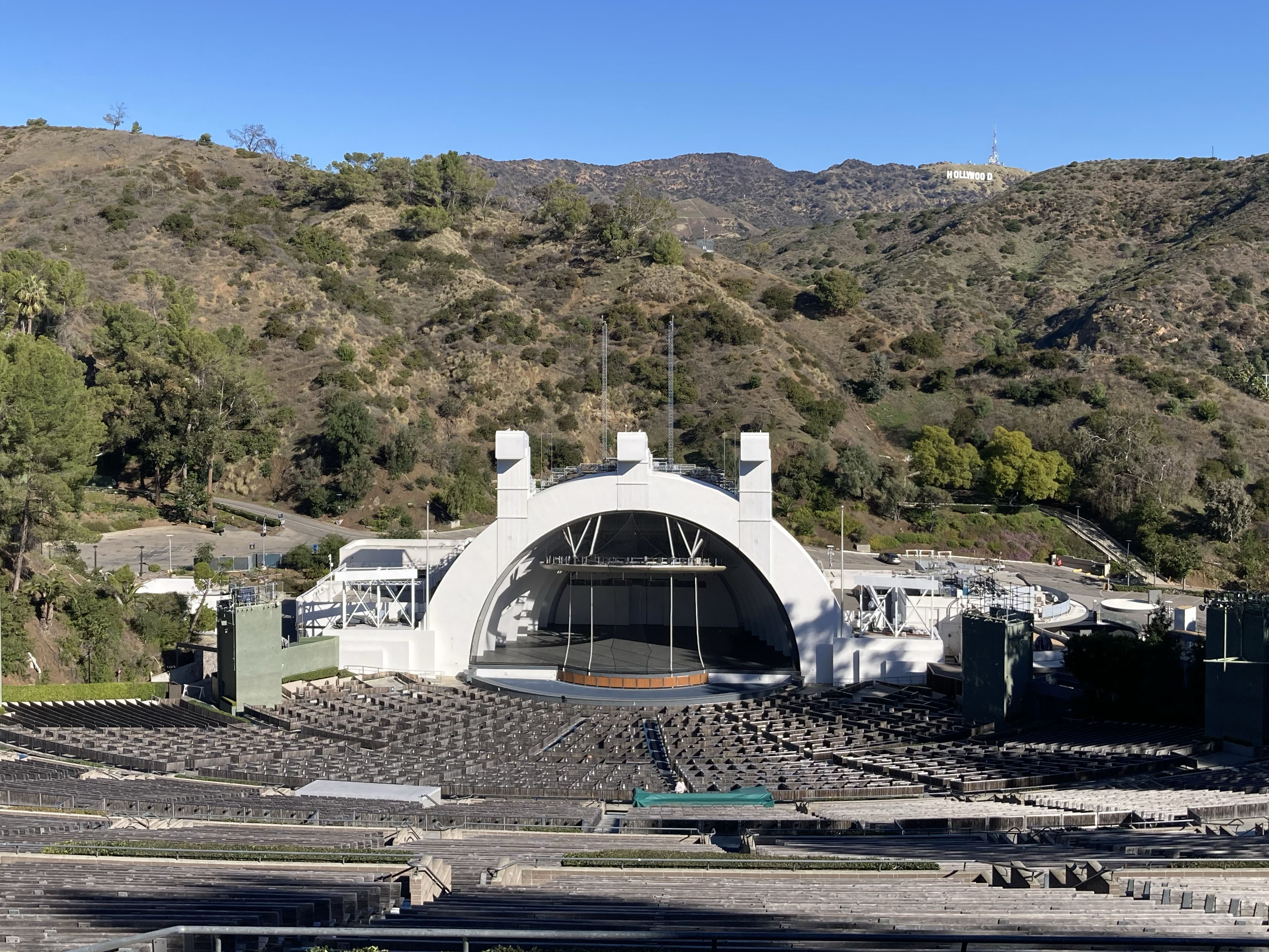
Hollywood Bowl
On August 15, 1956, Louis Armstrong, Ella Fitzgerald, Art Tatum, and Oscar Peterson took the stage together at the Hollywood Bowl for a Jazz at the Philharmonic concert that became the best-attended event in the venue's history. The amphitheater, carved into a natural hollow that locals once called Daisy Dell, has witnessed a century of such moments. From the Beatles' legendary 1964 and 1965 performances (preserved on an album where you can barely hear the music over the screaming) to the final show of Tom Petty's career in September 2017, the Bowl has been California's living room for live music.
Daisy Dell to Concert Hall
In 1919, William Reed and his son H. Ellis Reed were dispatched to find a site for outdoor performances. They discovered a shaded canyon in Bolton Canyon, a popular picnic spot with natural acoustics and proximity to downtown Hollywood. The Theatre Arts Alliance secured the land with donations of $21,000 each from Christine Wetherill Stevenson and Marie Rankin Clarke. The Bowl opened as a community space where tickets cost 25 cents under the slogan "popular prices will prevail." Children performed with the Los Angeles Philharmonic from the beginning, starting with Sibelius's Finlandia in 1921.
The Search for Perfect Sound
Lloyd Wright, son of Frank Lloyd Wright, designed the Bowl's second and third bandshells. His 1927 pyramidal shell, influenced by Southwest Indigenous architecture, was acoustically the finest in Bowl history, but audiences found it ugly, and it was demolished after one season. His 1928 wooden shell introduced the iconic concentric ring design but was ruined by water damage. The 1929 shell that became famous worldwide actually had inferior acoustics. Frank Gehry tried to fix the problems in the 1970s with cardboard tubes, then fiberglass spheres. Finally, in 2004, a new shell incorporated the best elements of all its predecessors.
Legendary Performances
The roll call of performers reads like a history of American popular music. The Doors played on July 5, 1968, with Steppenwolf and the Chambers Brothers opening. Jimi Hendrix appeared that September. Monty Python filmed their 1980 concert film here. Depeche Mode became the first band to sell out four consecutive nights. Avicii was the first EDM artist to headline. In 2021, Burna Boy became the first African artist to headline the venue. The film-and-orchestra concert Bugs Bunny on Broadway has played the Bowl 21 times, more than any other production.
Women Who Built the Bowl
The Hollywood Bowl owes its existence largely to women. Pianist Artie Mason Carter's connections with Los Angeles arts patrons proved essential in the early years. Stevenson and Clarke provided the funds to purchase the land. E.J. Wakeman, Leiland Atherton Irish, Harriet Clay Penman, and composers Gertrude Ross and Carrie Jacobs Bond raised the money to build it. The Bowl's founding as a community space rather than a commercial venture reflected their vision of accessible arts for all of Los Angeles.
Under the Stars
Today the Bowl is owned by Los Angeles County and serves as the summer home of the Los Angeles Philharmonic. Rolling Stone named it one of the ten best live music venues in America in 2018, and it joined the National Register of Historic Places in 2023. The Hollywood Bowl Museum offers free admission and documents the venue's history through vintage photographs, sound equipment, and recordings. George Stanley, designer of the Oscar statuette, created the Muse Fountain that has welcomed visitors since 1940. The Bowl continues what it has always done: bring people together under the California stars to share in music.
From the Air
Located at 34.113N, 118.339W in the Hollywood Hills, the Bowl is a distinctive terrain feature visible from the air as a white shell set into a hillside. The Hollywood Sign is visible to the northeast. The venue is adjacent to US Route 101 (Hollywood Freeway). Nearby airports: KBUR (Bob Hope Airport) 5nm north, KLAX (Los Angeles International) 13nm southwest. Approximately 1 mile from the Hollywood/Highland Metro station.