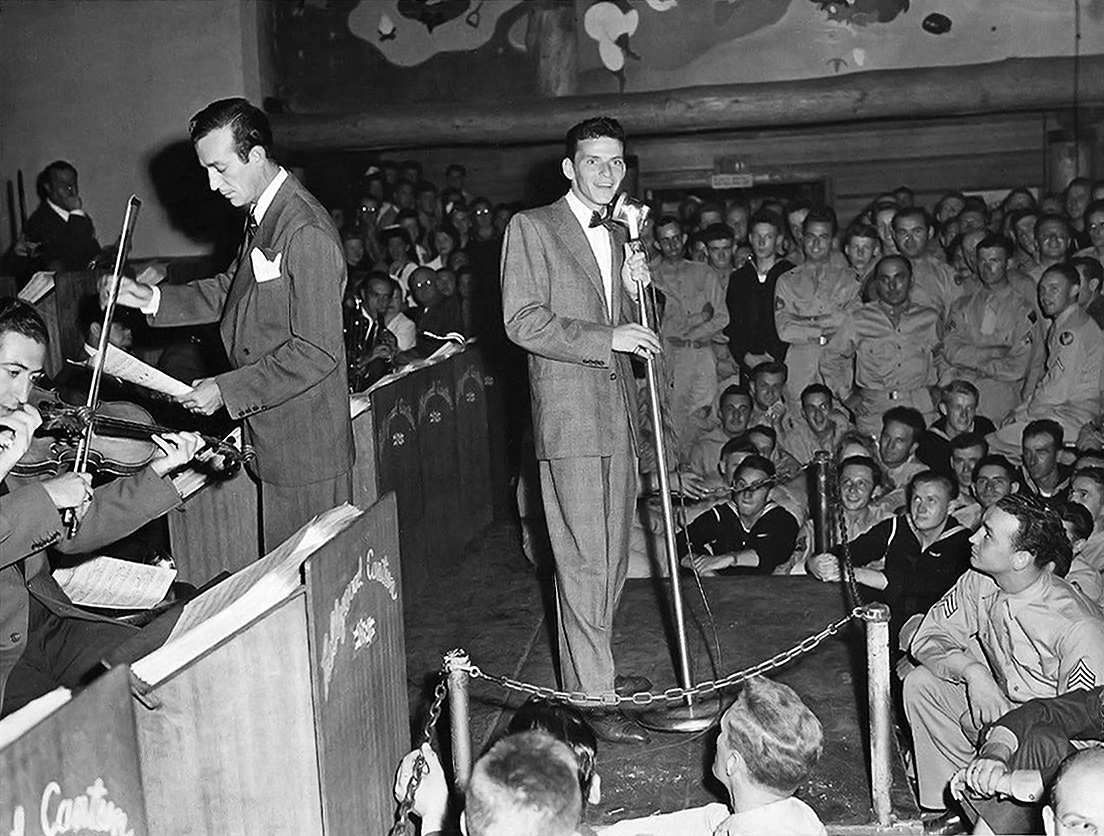
Hollywood Canteen
The sign outside read: 'Free to all men and women in uniform of Allied nations.' Inside, on any given evening, a soldier might find himself dancing with Bette Davis, being served coffee by Marlene Dietrich, or watching Lena Horne perform from a stage that, twelve hours earlier, had been scrubbed by Humphrey Bogart. The Hollywood Canteen operated on Cahuenga Boulevard for three years and one month, and it was one of the stranger and more genuine institutions the entertainment industry has ever produced.
Bette Davis and John Garfield
The Hollywood Canteen was co-founded by Bette Davis and John Garfield, both of them major stars who wanted to do something tangible for the war effort that went beyond making patriotic films or selling bonds. Garfield had been trying to enlist but was rejected for medical reasons. Davis was one of the most powerful actresses in Hollywood. Together, in the summer of 1942, they organized the entertainment industry behind a single idea: a club where servicemen could eat, dance, and be entertained for free.
They opened on October 3, 1942, in a converted nightclub at 1451 North Cahuenga Boulevard in Hollywood. The participation was extraordinary—more than 6,000 volunteers from every branch of the entertainment industry, including the craft unions as well as the talent guilds, contributed their labor.
What It Was Like
The Canteen was open seven nights a week. It served food, ran a dance floor, and offered live entertainment. The stars who appeared were not paid; they volunteered their time as part of the war effort. On any given evening, servicemen might see Dinah Shore, Abbott and Costello, or the Andrews Sisters perform from the stage.
But the Canteen was distinctive for something beyond the celebrity appearances. The stars did not just perform—they worked. They washed dishes, served food, mopped floors, and danced with soldiers who had never danced with anyone famous before. The experience of an eighteen-year-old from Iowa being partnered for a dance by a major Hollywood actress, and treated as a person rather than an audience member, was reported by thousands of veterans as one of the most memorable experiences of the war years.
Integration
The Hollywood Canteen was racially integrated—a policy that was not universal among wartime entertainment venues. Black servicemen were welcome to attend and participate alongside white soldiers. Given that the United States military itself remained officially segregated until 1948, this was a meaningful choice, and it occasionally caused friction with military authorities who preferred the Canteen operate along the same lines as the rest of the armed forces.
The Canteen's integration was an imperfect gesture within a deeply segregated society, but it was a gesture nonetheless—one that some of the Black veterans who attended remembered with particular feeling.
Closing Night
The Canteen served its last meal on November 22, 1945, following the end of the war. More than three million servicemen and women had passed through its doors over the three years and seven weeks of its operation. Bette Davis received an award from the War Department for meritorious service on behalf of her work for the Canteen. In 1983, the Department of Defense presented her with the Distinguished Civilian Service Award for her sustained support of the armed forces.
The building at 1451 North Cahuenga was demolished in 1966. Nothing stands on the site to mark what happened there. The Canteen exists now only in veterans' memoirs, in the 1944 Warner Bros. film that dramatized it, and in the historical record of what it took to maintain both the war effort and the idea that the people fighting it deserved to be treated as human beings.
From the Air
The Hollywood Canteen was located at 1451 North Cahuenga Boulevard in Hollywood, one block west of Highland Avenue and a few blocks south of Hollywood Boulevard. The site is in the heart of Hollywood's commercial district, near the intersection of Cahuenga and Sunset. The building no longer exists. Cahuenga Boulevard runs north-south through Hollywood, connecting Hollywood Boulevard to the south with the Cahuenga Pass and the San Fernando Valley to the north. The 101 Hollywood Freeway passes just to the east. Nearest airports: KBUR (Burbank) to the north via the pass, KLAX (Los Angeles International) to the southwest.