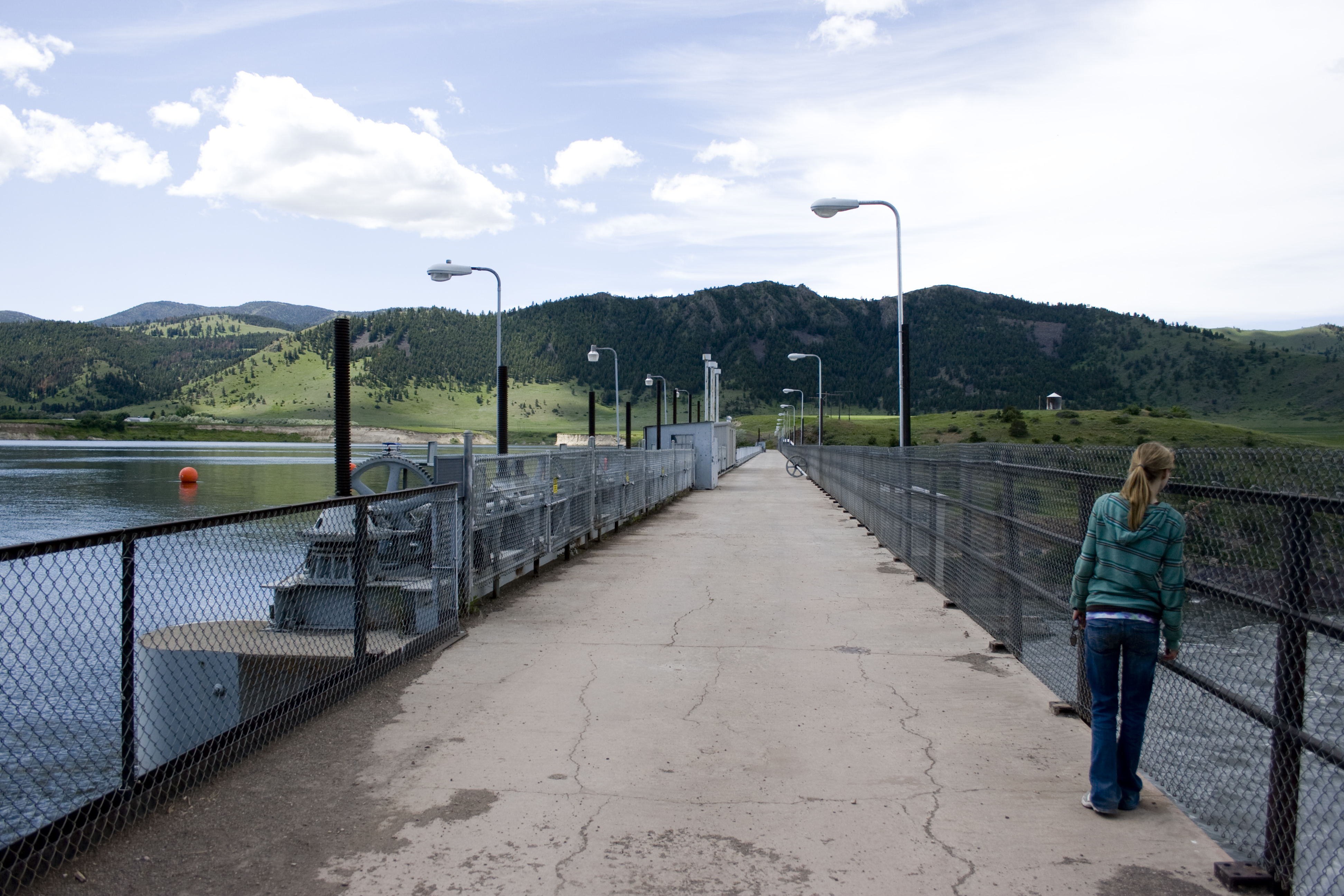
Holter Dam
On July 19, 1805, Captain Meriwether Lewis gazed up at limestone cliffs rising twelve hundred feet on either side of the Missouri River and wrote of rocks that seemed ready to tumble on them. He named the passage the Gates of the Rocky Mountains. Today, those same cliffs are reflected in the still waters of Holter Lake, a reservoir created by a dam that took a decade of financial turmoil and corporate intrigue to complete. The turbulent history below the surface contrasts with the world-class trout fishing above it, making Holter Dam one of Montana's most complex stories of power, politics, and recreation.
Built on Another Man's Failure
Holter Dam exists because Hauser Dam collapsed. When Samuel Thomas Hauser's first Missouri River dam failed catastrophically in April 1908, it derailed his plans for a second dam upstream. Hauser had conceived the project in 1906 to supply electricity to the Amalgamated Copper Mining Company. Construction began with Stone and Webster as contractors and more than five hundred men working amid over 115 buildings, including dormitories, cottages, a hospital, and even a photography studio. The dam was named for Anton Holter, president of the Helena Transmission Power Company. But by late 1910, only part of the foundation had been poured before financial troubles halted work. Hauser sold out to John D. Ryan, who merged several power companies in 1912 to form the Montana Power Company.
A Dam for the Railroads
Montana Power resumed construction for a specific purpose: electrifying the railroads. The Butte, Anaconda and Pacific Railway and the Chicago, Milwaukee, and St. Paul Railroad needed power, and Holter Dam could provide it. Engineers switched from horizontal to vertical turbines, made changes to the wastewater system, and modified the downstream face. Montana Power spent $1.3 million in 1916 and another $1.5 million in 1917 to finish the job. When completed in 1918, the dam stretched across the Missouri capable of generating 40,000 kilowatts. As of 1994, Holter Dam and its associated facilities remained one of Montana's most intact historic hydroelectric complexes, including the original powerhouse, operator housing, railroad switchyard, and remnants of the construction camp.
Through the Gates
Holter Lake divides into upper and lower sections connected by a narrow neck that passes through the Gates of the Mountains. Before the dam, the Missouri ran swiftly through this passage, the same rapids Lewis and Clark navigated in 1805. Now the water sits still, raised higher than it was when the explorers passed through. The steamboat Rose of Helena once carried tourists through the gates between 1886 and 1906. Today, kayakers and motor boats trace the same route beneath Madison limestone walls that have watched two centuries of transformation. Lewis first identified the black-and-pink Lewis's woodpecker near here, a bird that still inhabits the surrounding wilderness areas.
Blue Ribbon Waters
The stretch of Missouri River immediately below Holter Dam has earned Blue Ribbon trout fishing status, the most heavily fished body of water in Montana. Rainbow trout thrive in the cold, oxygen-rich water flowing from the dam. State wildlife managers counted 6,034 rainbow trout ten inches or longer per mile in 2011, the second-highest count on record. But the fishery requires constant management. Walleye, a voracious nonnative predator, escaped from upstream reservoirs, prompting regulations that allow unlimited walleye harvest below the dam. Fungal diseases killed large numbers of brown trout in 2009 and 2010. Drought years reduce flows below levels needed to sustain fish populations. Conservation projects funded by dam operators work to restore riverside vegetation that keeps water cool enough for trout.
Wilderness Shores
Holter Lake has been called the most awe-inspiring of the three upper Missouri lakes. Its shores touch the Beartooth Wildlife Management Area, Gates of the Mountains Game Preserve, Gates of the Mountains Wilderness, and the Sleeping Giant Wilderness Study Area. The Bureau of Land Management maintains four campgrounds, one accessible only by boat. After the September 11 attacks, public access across the top of the dam was closed, ending an era when visitors could walk from one side of the river to the other. Japanese photographer Toshio Shibata captured the dam's geometric forms in works exhibited at Chicago's Museum of Contemporary Art in 1997, finding beauty in the concrete and steel that now controls the river Lewis and Clark once followed into the unknown.
From the Air
Holter Dam sits at 46.99N, 112.01W on the Missouri River, roughly 35 miles northeast of Helena, Montana. The dam and Holter Lake are prominent landmarks, with the Gates of the Mountains passage clearly visible as a narrow slot in the limestone cliffs. Helena Regional Airport (KHLN) lies approximately 25 nautical miles southwest. At 4,000-6,000 feet AGL, the contrast between the wild Gates of the Mountains Wilderness to the north and the dam's infrastructure to the south tells the story of how one structure transformed an entire river system. Canyon Ferry Dam is visible upstream, and Hauser Dam downstream, revealing the chain of dams that now control the upper Missouri.