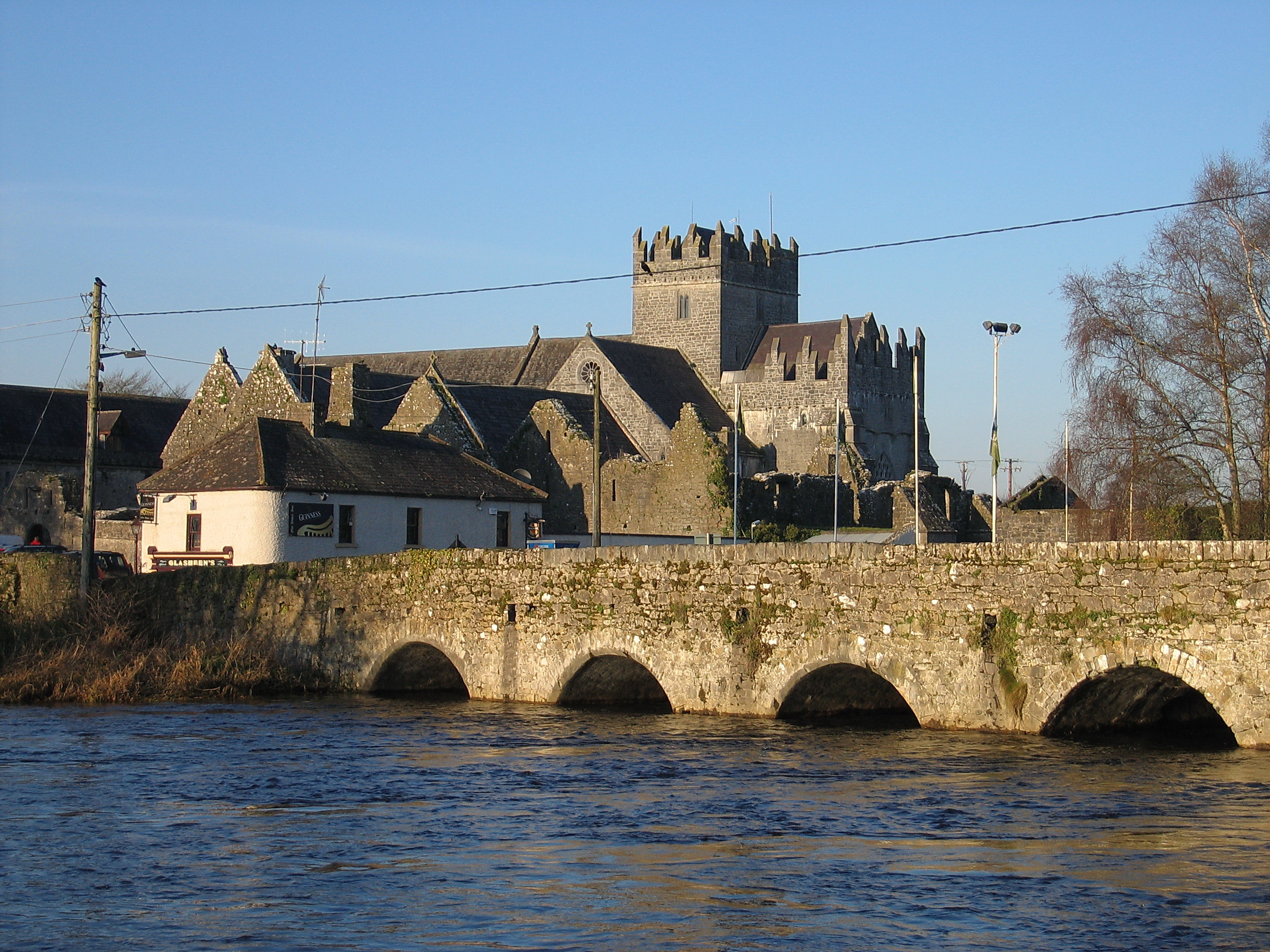
Holy Cross Abbey
On the night of October 11, 2011, masked raiders armed with an angle grinder, a hammer, and a screwdriver broke into Holy Cross Abbey and stole two crosses -- including the one said to contain a fragment of the True Cross that had given this place its name and its purpose for nearly nine centuries. The relics were recovered three months later by An Garda Siochana, relatively undamaged. That someone would still risk prison to possess them says something about what this place means, and has always meant, to the people who come here.
A Queen's Gift
The story begins with a widow and a relic. Around 1233, Queen Isabella of Angouleme -- widow of England's King John -- brought a supposed fragment of the True Cross to Ireland and bestowed it upon the Cistercian monastery at Thurles, originally founded in 1169 by King Donal O'Brien of Thomond. Isabella rebuilt the monastery around the relic, and Holy Cross Abbey as it exists today grew from that act of piety. The abbey sits on the banks of the River Suir in County Tipperary, its name -- Mainistir na Croise Naofa -- declaring its identity in Irish. With the relic came pilgrims, and with pilgrims came power. By the medieval period, Holy Cross had become one of the most important pilgrimage sites in Ireland.
Rallying Point
When the Protestant Reformation swept through Ireland, Holy Cross Abbey became something more than a monastery: it became a symbol. As a visible center of Catholic devotion, it drew a formal complaint from Sir Henry Sidney, Lord Lieutenant of Ireland, to Queen Elizabeth I in 1567. The abbey attracted defiant pilgrims, among them some of the most significant figures in Irish resistance. In September 1583, the fugitive Archbishop of Cashel, Dermot O'Hurley -- one of the 24 officially recognized Irish Catholic Martyrs -- came to venerate the relic shortly before his arrest and execution by hanging outside Dublin's city walls. In November 1601, Hugh Roe O'Donnell, Lord of Tyrconnell, visited the abbey on Saint Andrew's Day to venerate the True Cross before marching to the Battle of Kinsale. It would be his last victory before defeat changed everything.
Ruin and Resurrection
The Holy Rood was last publicly venerated in 1632. After Cromwell's conquest of Ireland, the abbey fell into ruins, and local people used the roofless shell as a burial ground after 1740. In 1880, it was scheduled as a national monument, with orders that the ruins were "to be preserved and not used as a place of worship." That prohibition held for nearly a century. In 1969, special legislation in the Dail marked the foundation's 500th anniversary by allowing Holy Cross Abbey to be restored as an active Catholic church -- an extraordinary exception for a national monument. The Sacristan of Saint Peter's Basilica in the Vatican provided an authenticated relic of the Holy Cross, and the emblem of the Jerusalem Cross was restored for the abbey.
The Living Abbey
Today Holy Cross Abbey is both ruin and resurrection, a working parish church housed within medieval walls that still carry the marks of centuries. The abbey church is roofed and active; mass is celebrated here regularly. The surrounding monastic buildings remain as ruins, their stone walls softened by centuries of rain and wind along the Suir valley. From the air, the abbey reads as a compact rectangle of grey stone against the bright green of Tipperary farmland, the river curving past its eastern edge. The nearest railway station is at Thurles, approximately six kilometres distant. But the real measure of distance here is time -- nine centuries between Isabella's gift and the masked raiders who came to take it back, with the relic surviving both.
From the Air
Located at 52.64N, 7.87W in County Tipperary, on the River Suir approximately 6 km south of Thurles. The abbey complex is visible as a grey stone rectangle against green farmland along the river. Nearest airports: Waterford (EIWF) approximately 70 km southeast, Shannon (EINN) approximately 80 km northwest. Best viewed below 2,500 ft AGL.