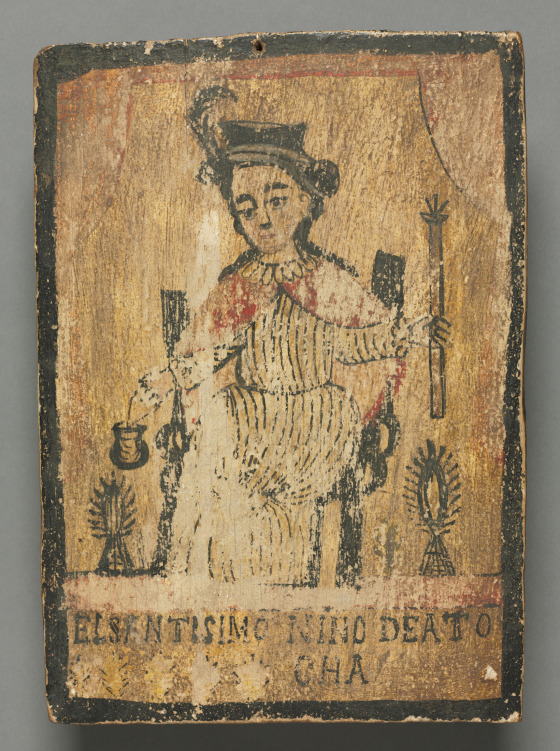
Holy Infant of Atocha
Every Christmas, pilgrims arrive at the shrine of Plateros carrying armfuls of tiny shoes. They leave them at the feet of a small statue dressed as a pilgrim -- a child figure holding a basket of bread, a staff, and a drinking gourd, with a scallop shell pinned to his cape. The shoes wear out, they say, because the Santo Nino de Atocha walks the roads at night, bringing food to the hungry and guiding travelers out of danger. It is a devotion that has persisted for eight centuries, crossing an ocean and adapting to new landscapes without ever losing its essential promise: that help arrives in the form you least expect.
Prisoners and a Prayer in Old Castile
The story begins in 13th-century Spain, when much of the Iberian Peninsula remained under Muslim rule. In the town of Atocha, now absorbed into Madrid's Arganzuela district, Christian prisoners languished in Moorish jails. Their captors refused to feed them; family members brought food instead. Then the caliph tightened the rules -- only children under twelve could enter with provisions. Men without small children began to starve. Their wives turned to a statue of the Virgin Mary in the local parish and begged for intercession. According to pious legend, a young boy dressed as a pilgrim began appearing among the prisoners, offering bread and water from a gourd. No one could explain who he was or where he came from. The faithful concluded that the Christ Child himself had answered the prayer, and the devotion to the Holy Infant of Atocha took root.
Silver, Dynamite, and a Missing Child
In 1554, an image of Our Lady of Atocha -- with the Christ Child on her lap -- arrived in the silver-mining country of Zacatecas, Mexico, and was installed in the church of Saint Augustine near the settlement of Plateros. The timing was no coincidence. Silver had just been discovered at Fresnillo, and mines were opening in the surrounding mountains at a frantic pace. Within weeks of one mine's opening, an explosion trapped miners underground. Their wives rushed to the church to pray and noticed something strange: the child figure had vanished from the Virgin's arms. Simultaneously, trapped miners reported that a boy appeared in the darkness, gave them water, and led them toward safety. When the statue was examined afterward, the child was back -- but his clothes were dirty and torn, his shoes worn through. The pattern repeated whenever disaster struck. Eventually, the child was removed from his mother's arms and placed in his own glass case, where pilgrims could dress him, bring him shoes, and leave offerings of gratitude.
A Devotion Without Borders
The cult of the Santo Nino spread far beyond Zacatecas. In Chimayo, New Mexico, a shrine established in 1911 sits at the foot of the Sierra Blanca range, with an outdoor trail for the Stations of the Cross climbing to a peak. In downtown Los Angeles, an outdoor shrine was erected in 1998 at La Iglesia de Nuestra Senora la Reina de los Angeles. Across the Pacific, Filipino Catholics embraced a local variant called the Santo Nino de Palaboy -- the Holy Child, the Wandering Beggar -- portrayed standing rather than sitting, carrying a staff with an attached bag usually filled with coins or candy. In Filipino homes, the image wears red garments for domestic shrines and green for businesses, though the Philippine Catholic Church has pushed back against the green vestments, arguing they reduce the figure to a good-luck charm rather than a representation of God.
Shoes for a Walking God
What makes the Atocha devotion endure is its intimacy. This is not a distant, enthroned deity but a child who gets dirty, who wears out his shoes on the road, who shows up where suffering is worst. Pilgrims at Plateros still bring toys at Christmas, as though the Holy Child were a neighbor's kid. Filipinos dress their home statues in miniature professional uniforms -- nurse scrubs, police uniforms, teacher outfits -- asking for patronage in the specific work of daily life. The devotion has seeped into popular culture in ways both reverent and casual: Pedro in the film Napoleon Dynamite recommends placing a Santo Nino in the school hallways, and Michael Jackson's Beat It video shows the image above a bed. But at its core, the Atocha devotion remains what it was in a Moorish prison eight hundred years ago -- a belief that compassion arrives on small, persistent feet, wearing shoes that need replacing.
From the Air
Located at 23.23N, 102.84W near Plateros, Zacatecas, Mexico. The shrine sits in the semi-arid highland terrain between Fresnillo and Zacatecas city. Nearest major airport is General Leobardo C. Ruiz International (MMFR/FRS) at Fresnillo, approximately 10 km north. The terrain is high plateau at roughly 2,200 m elevation. Zacatecas International Airport (MMZC/ZCL) is about 25 km southeast. Look for the mining town of Fresnillo and the small settlement of Plateros just to its south.