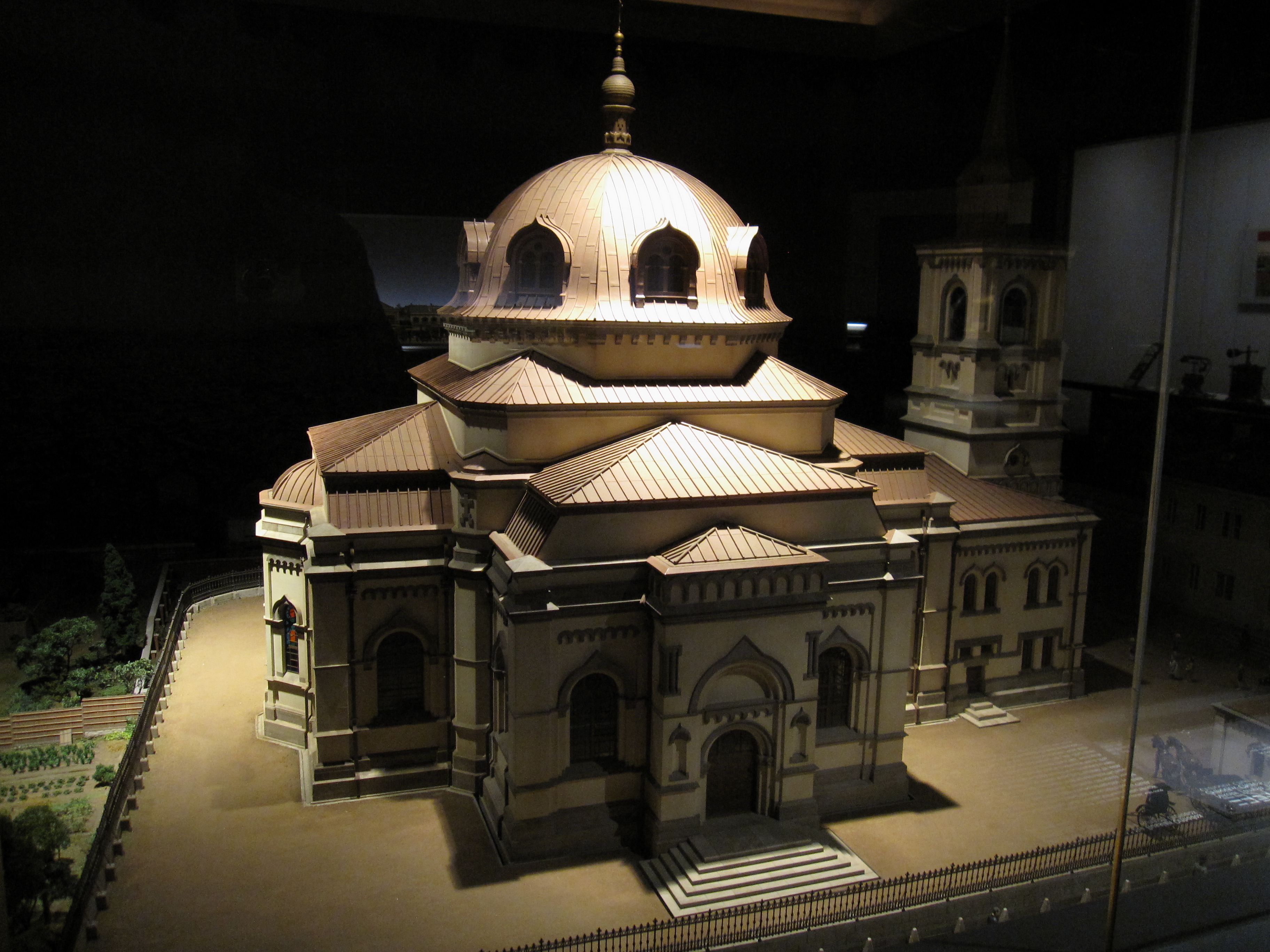
Holy Resurrection Cathedral
In a city of glass and steel, a green dome rises above the Kanda Surugadai hill in Chiyoda, Tokyo -- so unexpected it earned the entire neighborhood a nickname. The Japanese call it Nikolai-do, the Hall of Nicholas, after the Russian missionary who willed it into existence. Holy Resurrection Cathedral is the main cathedral of the Japanese Orthodox Church, and its story is one of cross-cultural devotion, architectural ambition, catastrophic destruction, and quiet resurrection.
The Russian Who Became a Japanese Saint
Ivan Dmitrievich Kasatkin arrived in Japan in 1861 as a young naval chaplain. He never left. Over the next fifty years, he learned the language, translated liturgical texts, and built the Japanese Orthodox Church from nothing. Eventually consecrated as Archbishop Nicholas, he selected the hilltop at Kanda Surugadai for his cathedral -- a site that in the Meiji era commanded sweeping views of the Imperial Palace below. Then he did something audacious: he toured Russia, personally raising the money to build an entire cathedral on the other side of the world. The edifice was planned by Dr. Michael A. Shchurupov, designed by the British architect Josiah Conder -- the same man who shaped much of Meiji-era Tokyo -- and built by the Japanese contractor Nagasato Taisuke. On March 8, 1891, after seven years of construction, the cathedral was consecrated. Its Byzantine dome and bell tower were unlike anything else in Tokyo, and the sound of its bells became famous throughout the city. Nicholas died in 1912 and was later canonized as Saint Nicholas of Japan.
The Earthquake That Brought Down the Dome
On September 1, 1923, the Great Kanto earthquake struck the Tokyo-Yokohama region with devastating force. At Nikolai-do, the massive bell tower collapsed directly onto the dome, crushing it inward and gutting the interior. The cathedral that had taken seven years to build was destroyed in seconds. Archbishop Sergius Tikhomirov, who had succeeded Saint Nicholas, faced a seemingly impossible task: rebuilding a cathedral with no money. Russia, now the Soviet Union, was no longer a source of funding. The Orthodox community in Japan was small. Sergius turned to an unlikely solution -- the cathedral choir. Under the direction of Victor A. Pokrovsky, the choir gave concert after concert across Japan, raising the funds needed to restore their church note by note.
A Quieter Resurrection
The rebuilt cathedral, re-consecrated on December 15, 1929, was designed by Okada Shinichiro. It was not a replica. The new bell tower stood shorter than the original. The dome was modified, simpler. The ornate interior decorations of the 1891 building gave way to a more restrained aesthetic. Yet the spirit of the place endured, and important original elements were preserved within the new structure. The rebuilding represented something rare in Tokyo's architectural history -- a conscious decision to restore rather than replace, to honor a building's meaning even when its physical form had to change.
Hidden in Plain Sight
When Nikolai-do was first built, its hilltop perch made the green dome visible across the city. Today, office towers and apartment blocks press in from every side, and the cathedral that once defined the skyline is nearly invisible from a distance. You have to know where to look -- or stumble upon it -- to find the quiet compound nestled among the modern buildings of Chiyoda. On June 21, 1962, the Agency for Cultural Affairs designated the cathedral an Important Cultural Property of Japan, recognizing both its original architectural significance and the cultural importance of its reconstruction. For visitors who do find it, Nikolai-do offers an unlikely encounter: a piece of 19th-century Russian Orthodox devotion embedded in one of the most densely built urban landscapes on Earth.
From the Air
Located at 35.698N, 139.766E in Chiyoda, Tokyo, on the Kanda Surugadai hill. The green dome is extremely difficult to spot from altitude due to surrounding high-rise development. Look for the Kanda district northeast of the Imperial Palace grounds. Nearest major airport is Tokyo Haneda (RJTT), approximately 15 km south. Narita International (RJAA) is 65 km east. Best viewed at low altitude approaching from the south, where the dome may briefly be visible against the urban fabric.