Holy Saviour's Cathedral (Beijing)
Walk through the door of the Mofan Bookstore in Beijing's Xicheng District and look up. The ceiling belongs to a church. The blonde wood trusses, the cruciform layout, the bell tower rising above the crossing in the shape of a pagoda -- everything about Holy Saviour's Cathedral speaks two architectural languages at once. Built in 1907 as the seat of the Anglican Diocese of North China, this is the oldest surviving Anglican church in northern China, and its current incarnation as a bookstore is only the latest chapter in a story that has wound through empires, revolutions, neglect, and reinvention.
Two Missionaries and a Bishop
English evangelism arrived in Beijing in 1862, carried by missionaries John Shaw Burdon and Samuel Isaac Schereschewsky. The Diocese of North China was formally established in 1880 to serve the city's growing Anglican population. The property where the cathedral now stands was originally owned by Ying Keting, an official in the Criminal Department of the Qing Dynasty. Bishop Charles Perry Scott purchased the land with the intention of building a cathedral for the expanding diocese. The church that rose on the site in 1907 was designed to bridge two worlds: its plan followed the cruciform layout of European ecclesiastical architecture, with a north-south axis arranged as a basilica. But its materials and many of its details were deliberately Chinese.
Grey Brick and Pagoda
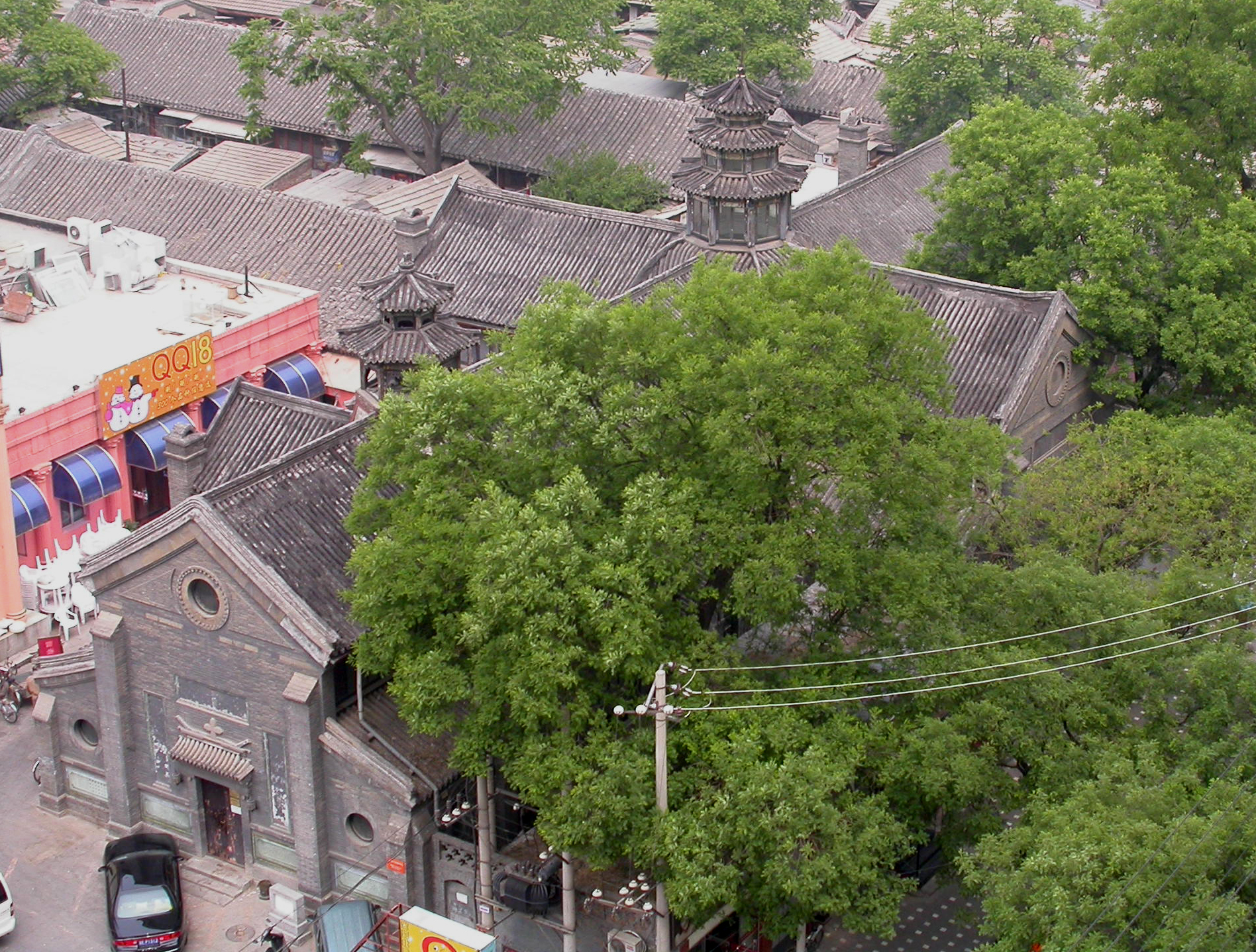
The architectural fusion at Holy Saviour's Cathedral is not a compromise but a statement. The entire building is constructed from typical grey bricks that match the hutong buildings surrounding it, under Chinese roof shingles that blend with the neighborhood's traditional architecture. The bell tower, positioned above the crossing where nave and transept meet, does not rise to a spire as it would in England. Instead, it takes the form of a pagoda, its tiers ascending in a distinctly Chinese silhouette. The entrance features Chinese-style blessings inscribed above the door. Inside, the furnishings continue the fusion: wooden walls and a trussed timber roof in blonde wood create a warm interior that feels neither wholly European nor wholly Chinese but entirely itself. Several memorials to past clergymen remain inside, quiet markers of the building's original purpose.
Silence and Survival
Anglican worship at the cathedral ended with the Communist revolution in 1949. For decades, the building fell into disrepair, suffering the slow deterioration that claimed many of Beijing's religious structures during the latter half of the 20th century. In 1990, the Saiweng Information and Consulting Center funded a restoration that stabilized the structure. The building received official recognition in 2003 when it was listed as a Beijing Cultural Protection Site, ensuring its preservation even as the surrounding neighborhood evolved. The decades of silence between 1949 and 1990 represented a period when the building existed in a kind of architectural limbo, neither active church nor recognized heritage site, simply a structure waiting for someone to decide what it should become.
From Hymns to Literature
In 2019, the cathedral was converted into a branch of Beijing's Mofan Bookstore, a transformation that gave the building new life while preserving its architectural integrity. Bookshelves now line the aisles where congregants once sat. The pagoda bell tower still rises above the crossing, but the sounds below are the murmur of readers rather than the cadences of the Book of Common Prayer. The conversion is both pragmatic and poetic: a building designed to house one tradition of the written word now houses many. For visitors who stumble upon it without knowing its history, the Mofan Bookstore presents a pleasant puzzle, a reading space that feels like a sanctuary, which is exactly what it was.
From the Air
Located at 39.90N, 116.36E in Xicheng District, central Beijing, within a hutong neighborhood southwest of the Forbidden City. The cathedral's cruciform footprint and pagoda-style bell tower are distinguishing features at low altitude. Beijing Capital International Airport (ZBAA) is approximately 28 km northeast. Beijing Daxing International Airport (ZBAD) is about 45 km south. The building is surrounded by traditional low-rise hutong architecture.