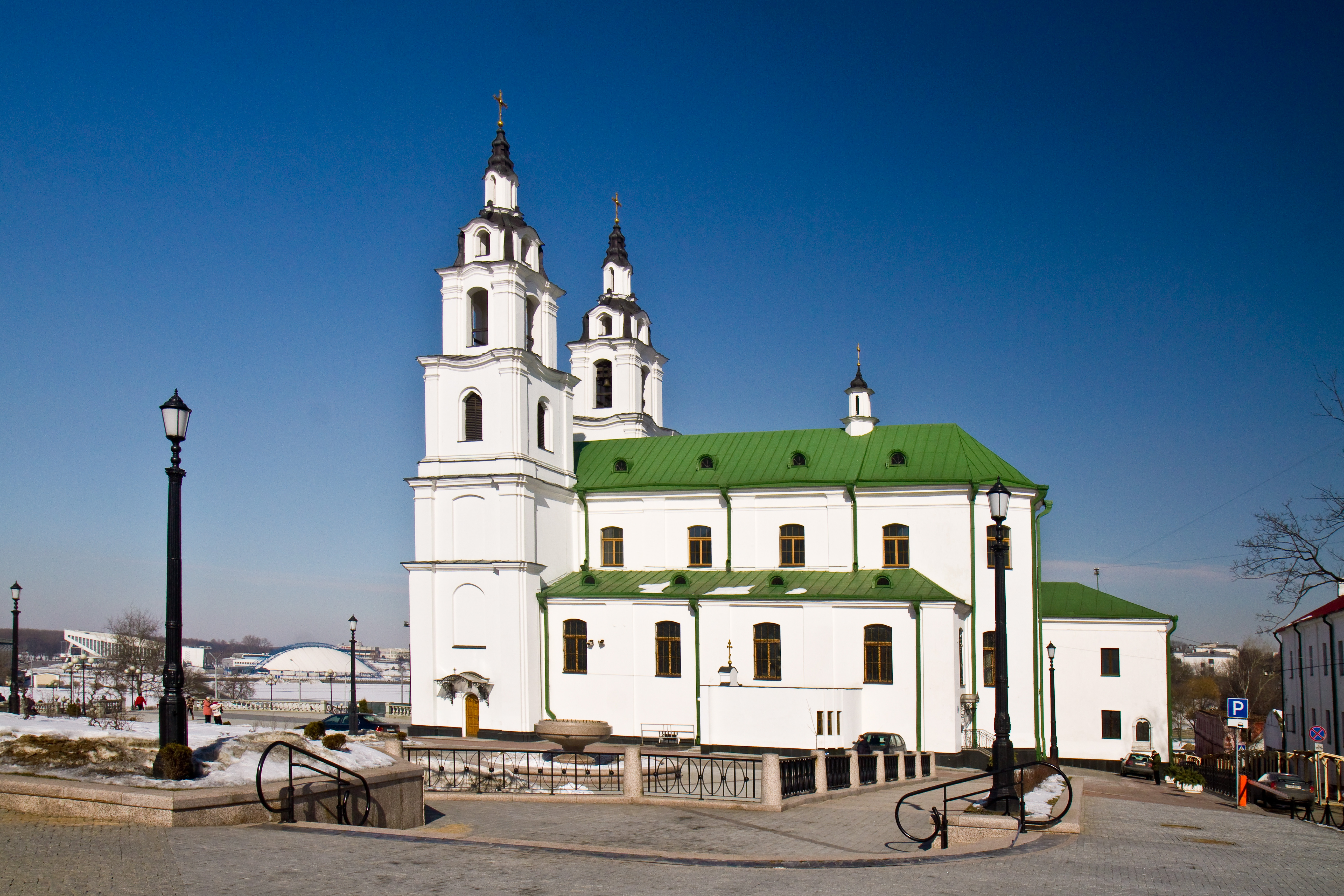
Holy Spirit Cathedral, Minsk
The most striking thing about the white twin-towered cathedral that dominates Minsk's Upper Town is how many religions have used it. It started as an Orthodox monastery dedicated to Cosmas and Damian. It became a Uniate (Greek Catholic) holding briefly in the early 17th century. Then Catholic Bernardine monks built the present stone church between 1633 and 1642, dedicated to the Holy Spirit. The Russian Empire returned it to Orthodox use in 1860. The Nazis allowed it to reopen during their occupation in 1942. The Soviets tolerated it for the next half century. Today, with its baroque silhouette and its 1968 altar, it is the mother church of the Belarusian Orthodox Church - and the religious face of a building that has belonged, in succession, to almost every confession that ever ruled this part of Europe.
Cosmas and Damian
Before 1596, on the same hilltop in what would become Minsk's Upper Town, an Orthodox men's monastery was dedicated to the brother saints Cosmas and Damian - the third-century physicians whose icons hang in churches from Sicily to Siberia. The monastery owned land along the eastern edge of medieval Minsk and doubled as a defensive position for the city, its stone walls absorbing some of the function of an outer fortification. A nearby street carried the name of Cosmas and Damian until 1931. During the German occupation of World War II that street was destroyed entirely - every building on it leveled - and the name disappeared from the map of Minsk along with the road itself.
The Bernardine Builders
In the early 17th century, after the Union of Brest, the monastery and its lands were transferred to the Ruthenian Uniate Church. The transfer did not take. Local residents disliked the Uniates, and the authorities of the Polish-Lithuanian Commonwealth handed the property instead to the Bernardines - a reformed Franciscan order. At that time nearly every building in Minsk was wooden, and the city burned with grim regularity. The Bernardines decided to build in stone. Between 1633 and 1642 they raised the present cathedral, a baroque structure with twin western towers and a single nave. By 1652 they had completed the adjoining stone convent. Then, in the middle of the 17th century, the Russo-Polish War of 1654-1667 swept through Minsk and ruined the complex. The Bernardines rebuilt and reconsecrated the cathedral in August 1687.
The Russian Empire Takes It Back
After the Partitions of Poland in the late 18th century, Minsk passed to the Russian Empire. Catholic property was systematically transferred to the Orthodox Church across the empire's western provinces, and the Bernardine monastery in Minsk was no exception: in 1860 the entire complex was returned to Orthodox use. The city treasury allocated 13,000 roubles for the restoration - a substantial sum. Work was completed in 1869 and the church was reconsecrated on October 22, 1870, this time as an Orthodox cathedral. Monks moved in from another monastery and brought relics with them. The interior was reworked in the manner of a Russian Orthodox church, with an iconostasis replacing the Catholic high altar.
Surviving the Twentieth Century
The Soviet Union was officially atheist after 1917, and most of Minsk's churches were either demolished or converted to secular use - storehouses, gymnasiums, archives. The Holy Spirit Cathedral somehow survived. The Nazi occupation of Belarus, beginning in 1941, was catastrophic for the city - the Minsk Ghetto held more than 100,000 Jews at its peak, almost all of whom were murdered, and roughly 80 percent of Minsk's buildings were destroyed in the war. In a strange irony, the Nazis allowed the cathedral to reopen for Orthodox worship in 1942 as part of their broader policy of permitting limited religious activity in occupied territories. After the war, in the 1950s, the building was restored. In 1961 it was elevated to cathedral of the Minsk diocese; later it was promoted to central cathedral of the Belarusian Orthodox Church. A new altar was installed in the south part of the church in 1968.
Mother Church of Belarus
Today the Holy Spirit Cathedral is the spiritual center of Belarusian Orthodox Christianity. The interior holds important relics - among them an icon of St. Sofia of Slutsk, a 16th-century princess venerated by Belarusian Orthodox believers, and an 18th-century icon of St. Nicholas surrounded by scenes from his life. The white facade with its paired baroque towers looks down across Freedom Square (Plošča Svabody) in Minsk's Upper Town, opposite the Town Hall reconstructed in 2004. The building has changed denominations more often than most cathedrals change pastors, and each transition has left some residue - in the architecture, the iconography, the side chapels, the height of the bell towers. What has stayed constant is the hilltop, the Christianity, and the people of Minsk who keep walking up the steps to a building that has now stood, in some form, for nearly four hundred years.
From the Air
The Holy Spirit Cathedral sits at 53.91°N, 27.56°E in central Minsk, Belarus, on Freedom Square in the Upper Town district above the Svislach River. View from 2,000-4,000 feet for the baroque twin-tower silhouette and the surrounding Old Town reconstruction. Nearest airport is Minsk National (UMMS), about 40 km east; Minsk-1 (UMMM) is closer but largely closed to commercial traffic. Belarusian airspace is restricted; this is a virtual flyover.