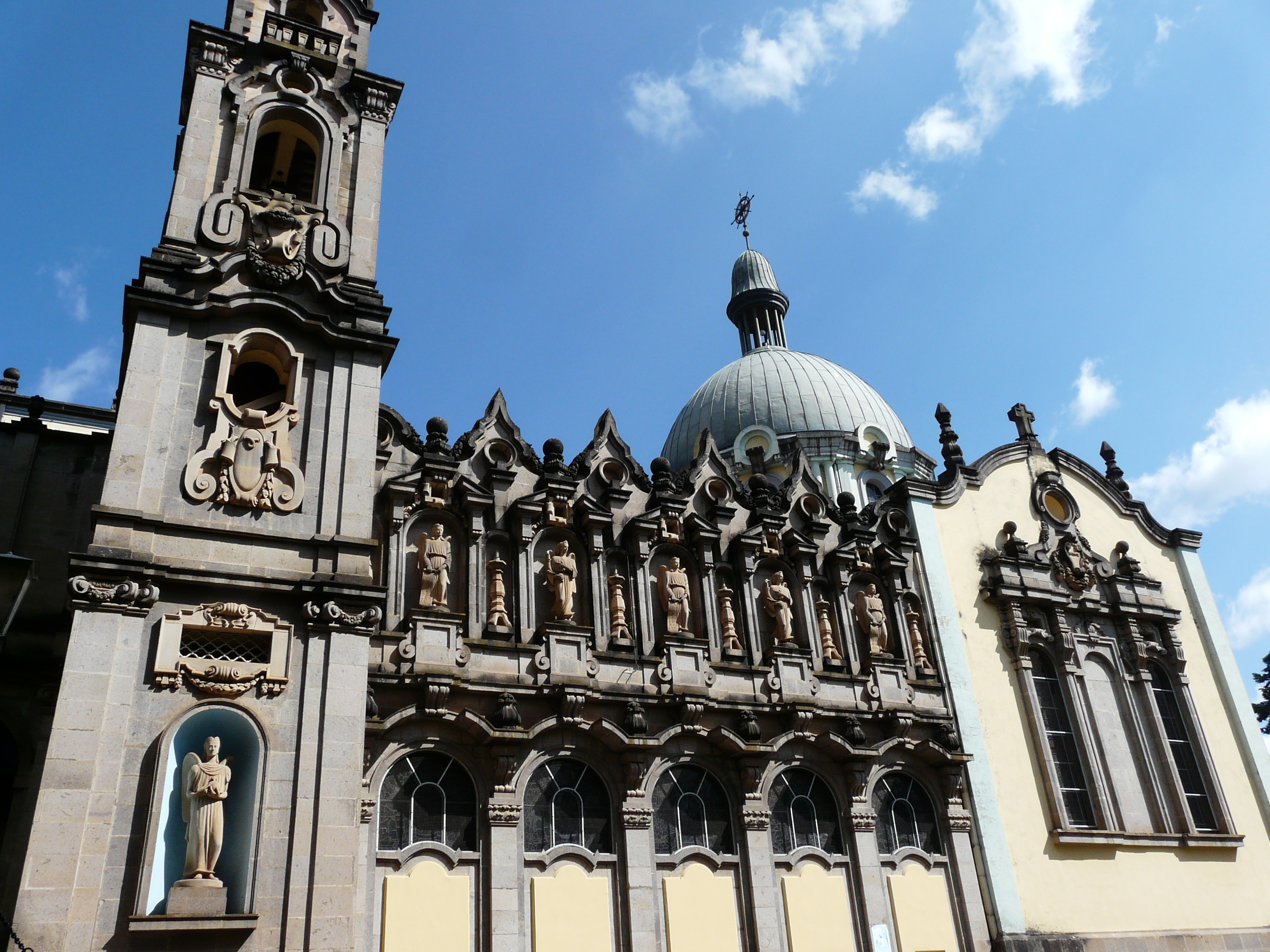
Holy Trinity Cathedral, Addis Ababa
Somewhere between the incense and the marble, between the stained glass filtering equatorial light and the sarcophagi of emperors, Holy Trinity Cathedral holds a contradiction that only Ethiopia could produce. This is the country's most important Orthodox Christian site and its most political burial ground -- a place where the last emperor rests beside resistance fighters, where a British suffragette shares consecrated earth with an Ethiopian prime minister, and where the architecture itself tells a story of liberation. Known in Amharic as Kidist Selassie, the cathedral was built in 1942 to mark Ethiopia's victory over five years of Italian occupation. It stands as a monument not just to faith, but to survival.
A Temple Built on Defiance
Emperor Haile Selassie commissioned the cathedral immediately after returning from exile in 1941, when British and Ethiopian forces drove the Italians from Addis Ababa. The timing was deliberate. Italy had occupied Ethiopia from 1936, and the construction of a grand cathedral was an assertion of sovereignty -- a statement in stone and glass that the nation endured. The cathedral's design broke with Ethiopian tradition. Most Orthodox churches in the country are circular; Holy Trinity is square, modeled on Solomon's Temple with its threefold division: an outer ring for congregational hymns, a middle circle for holy communion, and an innermost sanctum accessible only to priests, where the Tabot -- a replica of the Ark of the Covenant -- resides. The cathedral bears the title Menbere Tsebao, meaning 'Pure Altar,' and serves as the official seat of the Orthodox Archdiocese of Addis Ababa. All patriarchs of the Ethiopian Orthodox Tewahedo Church are enthroned here, and all bishops are consecrated within its walls.
The Emperor's Final Rest
Haile Selassie and his consort Empress Menen Asfaw lie in the north transept, their sarcophagi a focal point for the faithful and the curious alike. The emperor who traced his lineage to King Solomon and the Queen of Sheba -- who inspired the Rastafari movement, addressed the League of Nations, and was deposed by a Marxist military junta -- came to rest here only in 2000, a quarter-century after his death. Other members of the Imperial Family occupy the crypt below. In the south transept, the chapel of Archangel Michael houses a Tabot of St. Michael that traveled a remarkable path: taken from Ethiopia, it was discovered in Edinburgh and returned in February 2002. The altars tell their own geography of devotion -- the High Altar dedicated to the Holy Trinity, the flanking altars to John the Baptist and to Kidane Meheret, Our Lady Covenant of Mercy.
Martyrs, Rebels, and a Suffragette
The cathedral compound doubles as a memorial to Ethiopia's bloodiest chapters. Monuments within the grounds hold the remains of those massacred by Italian forces in February 1937 -- the Yekatit 12 killings, a reprisal after an assassination attempt against Marshal Rodolfo Graziani, the Viceroy of Italian East Africa. Nearby stand the tombs of imperial government officials executed by the Derg, the communist military regime that ruled from 1974 to 1991. Among these Ethiopian stories, one grave stands out for its improbability. Sylvia Pankhurst, the British suffragette and anti-fascist activist, is buried in the churchyard. She spent her final years in Addis Ababa, championing Ethiopian independence and editing a newspaper that advocated for the country's cause. Her presence here, honored alongside emperors and patriarchs, speaks to a bond forged in shared struggle against fascism. Prime Minister Meles Zenawi and Patriarchs Abuna Takla Haymanot and Abune Paulos also rest in the grounds.
A Compound of Living Faith
Beyond the cathedral itself, the complex sprawls across its hilltop site in central Addis Ababa. The older Bale Wold Church -- also called the Church of the Four Heavenly Creatures -- predates the cathedral, tracing back to the reign of Emperor Menelik II. It served as the original Holy Trinity Monastery Church before the grander building rose beside it. The compound includes a primary school, a secondary school, a monastery, and the Holy Trinity Theological College, making it an active center of Orthodox education and community life. This is not a museum frozen in reverence. Worshippers fill the cathedral for services, students cross the grounds between classes, and pilgrims come from across Ethiopia to pray where their emperor prayed. The incense still rises, the hymns still carry through the outer ring, and the Tabot remains hidden in its innermost sanctuary -- seen only by priests, believed by millions.
From the Air
Located at 9.03N, 38.77E in central Addis Ababa at approximately 2,355 meters (7,726 feet) elevation. The cathedral's distinctive square profile and surrounding compound are visible from above. Addis Ababa Bole International Airport (HAAB) lies approximately 7 km to the southeast. Expect high-altitude conditions and potential afternoon convective weather.