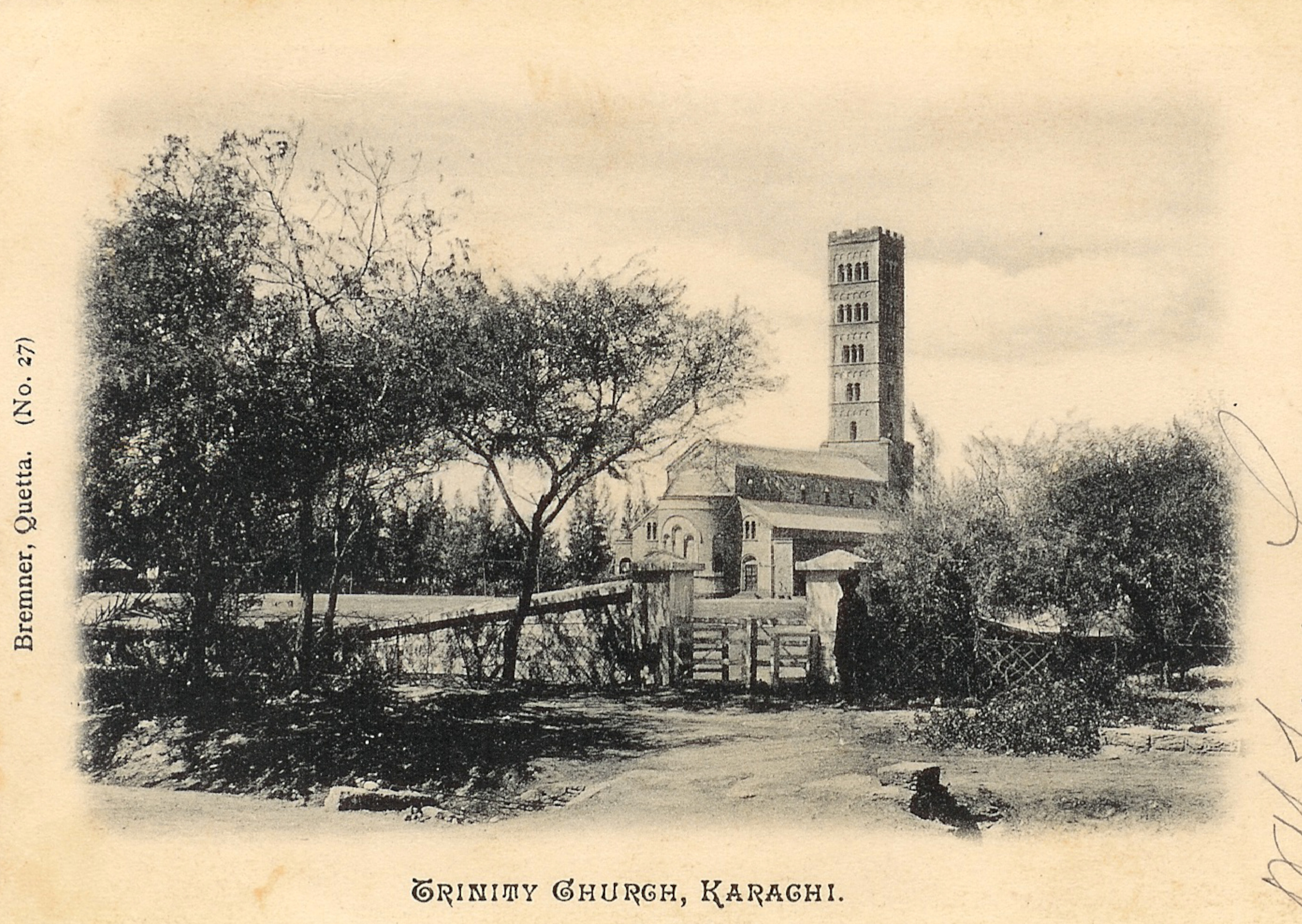
Holy Trinity Cathedral, Karachi
Before Karachi had lighthouses, it had Holy Trinity Cathedral. When the church was completed in 1855, beacons were mounted at the top of its 150-foot tower to guide ships into Karachi Harbour. A house of worship that moonlighted as a navigational aid: the arrangement captures the pragmatism of colonial-era Karachi, where every structure was expected to earn its place in more ways than one.
A Captain's Blueprint
The church was designed by Captain John Hill of the Bombay Engineers, a military engineer rather than an ecclesiastical architect. His design reflected that background. The nave stretched 115 feet, built from buff-colored Gizri stone in a Romanesque layout that made it stand out among the buildings around it. The church was established in 1844 and the building completed in 1855, making it one of the first major churches in the region. As a garrison church for the British military, it was designed to accommodate 800 worshipers and to memorialize British servicemen who died in various campaigns. The memorials remain, carved into stone walls that have watched the congregation change from soldiers of the Raj to Pakistani Christians.
Shortened by Weakness
In 1904, Captain John Hill and Chief Engineer John Brunton reviewed the cathedral and discovered that the foundation was showing signs of weakness. Their solution was dramatic: they removed the top two stories of the tower, reducing its height from 150 to 115 feet. The beacons that had once guided ships were no longer needed, as proper lighthouses had been built elsewhere in the harbour. The tower took on a new role during World War I, when it was converted into a signaling station. In 1970, the original pitched roof was replaced with a barrel-vaulted design, further altering the silhouette that had defined Karachi's skyline for over a century.
Faith in a Changed City
Holy Trinity Cathedral is the seat of the Church of Pakistan, Diocese of Karachi, situated on Fatima Jinnah Road near Zainab Market. The location places it in the heart of modern Karachi's commercial activity, a short distance from Frere Hall and other colonial-era landmarks. The cathedral's stained glass windows, including one titled "Brightening the Faith," filter sunlight into an interior that has served continuous worship for more than 170 years. The building stands as testimony to Karachi's religious diversity, a Christian cathedral on one of the busiest streets of a majority-Muslim city, its stone walls holding the memory of beacons, soldiers, and signal flags.
From the Air
Located at 24.852N, 67.030E on Fatima Jinnah Road in central Karachi, near Zainab Market. The cathedral's shortened tower (115 feet) may be visible at lower altitudes among the surrounding urban structures. Jinnah International Airport (OPKC) is approximately 14 km to the east. Karachi Harbour, which the tower once served as a navigational beacon, lies about 4 km to the southwest.