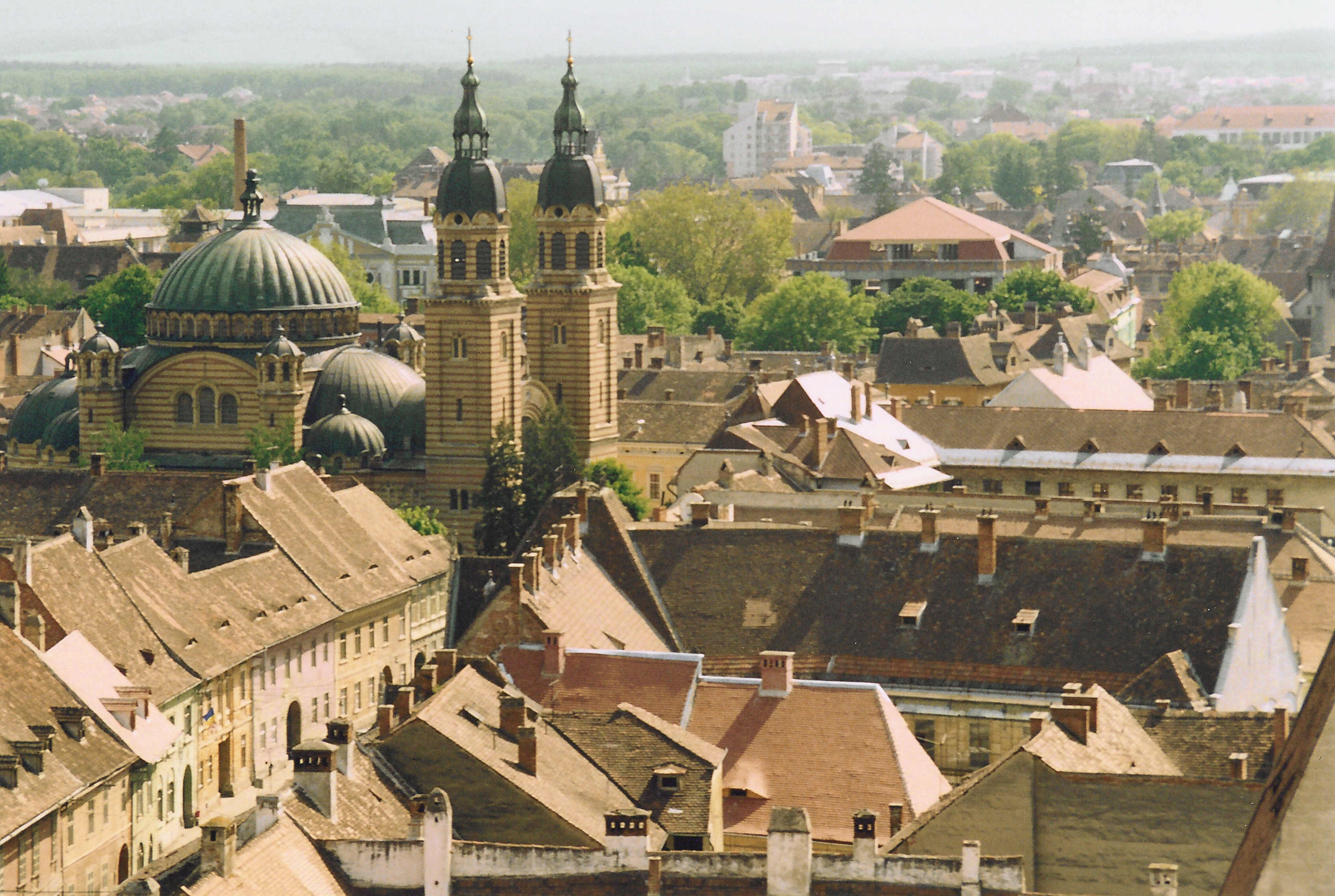
Holy Trinity Cathedral, Sibiu
Thirty-one architects submitted designs. The committee chose plan number seventeen, by Virgil Nagy and Iosif Kamner of Budapest, and in 1902, construction began on what would become the seat of the Romanian Orthodox Archbishop of Sibiu. The Holy Trinity Cathedral was to be a statement -- not just of faith, but of identity. In a city long dominated by German Lutherans and Hungarian Catholics, the Romanian Orthodox community was building its own landmark, and it modeled the design on no less a precedent than Hagia Sophia itself. The Byzantine basilica that rose on Mitropoliei Street would take just two years to complete, its copper roof finished by 1904, its twin spires reaching 43 meters above a city whose skyline they would permanently alter.
Bells Lost to War
On December 13, 1904, four bells were blessed and hoisted into the cathedral's two main spires. They rang over Sibiu for barely a decade. When World War I engulfed Europe, the Austro-Hungarian Army requisitioned metals wherever it could find them, and three of the bells in the western spire were taken down and melted to cast cannons. The cathedral stood partially mute for twelve years. Replacement bells did not arrive until 1926, by which time Transylvania had passed from Hungarian to Romanian sovereignty -- a political transformation that gave the Orthodox cathedral new significance as a symbol of the majority culture in a city that was only beginning to feel fully Romanian.
Smigelschi's Dome
The cathedral's interior owes its visual power to Octavian Smigelschi, a painter from the nearby village of Ludoș who created both the iconostasis and the dome fresco. The iconostasis -- a screen of gilt carved wood separating the nave from the sanctuary -- was manufactured at Constantin Babic's firm in Bucharest, then painted by Smigelschi with images dense in gold leaf and saturated color. Above the nave, his Christ Pantocrator gazes down from the central dome, flanked by angels, the figure rendered at a scale that fills the 15-meter-diameter ceiling. Smigelschi worked in a neo-Byzantine style that honored tradition while introducing a distinctly Transylvanian sensibility. Later, the walls were further decorated by painters Iosif Keber and Anastase Demian, adding layers of sacred imagery that have accumulated over more than a century of continuous worship.
Brick, Stone, and Light
From the outside, the cathedral announces itself in red and yellow brick -- warmer and more approachable than the grey stone of Sibiu's older German churches. Four towers punctuate the roofline: two smaller octagonal ones and two larger structures near the entrance whose bases start square and transition to octagonal in the bell area, topped with double-bulb finials that catch the light. The main entrance passes through a portico with three semicircular doors. Behind them, an ample semicircular vestibule holds a stained-glass window of matching shape, while round mosaics on the exterior depict Jesus and the Four Evangelists. The cathedral measures 53.10 meters long and 25.40 meters wide, its dome rising 24.70 meters inside and 34.70 meters on the exterior. These are precise numbers for a building meant to inspire awe, but the precision is part of the point: this was architecture as cultural assertion, every dimension calculated.
Consecration and Legacy
Metropolitan Mețianu consecrated the cathedral on April 30, 1906, joined by Bishop Ioan Papp of Arad and a procession of priests and deacons. Among those present was Nicolae Iorga, Romania's foremost historian and public intellectual, who marked the occasion by donating a silver engolpion and a valuable icon. The cathedral has been in continuous liturgical use since that day. Divine Liturgy and Vespers take place daily, services that connect the building to its original purpose even as restorations and improvements have modernized it over the decades. Electric lighting was part of the original construction -- a remarkably forward-looking decision for 1904 -- and subsequent additions have included a sound system, new liturgical objects, and vestments. The building has never been merely a museum piece. It remains, as it was designed to be, a working church at the center of Orthodox life in Transylvania.
From the Air
Located at 45.7945N, 24.1482E in the center of Sibiu, Romania. The cathedral's twin spires (43 m) and copper dome are prominent landmarks from the air, distinguishable from the nearby Lutheran Cathedral's single Gothic steeple. Best viewed at 1,500-2,500 feet AGL. The cathedral sits on Mitropoliei Street, south of the Old Town squares. Nearest airport: Sibiu International (LRSB), approximately 3 nm west of the city center.