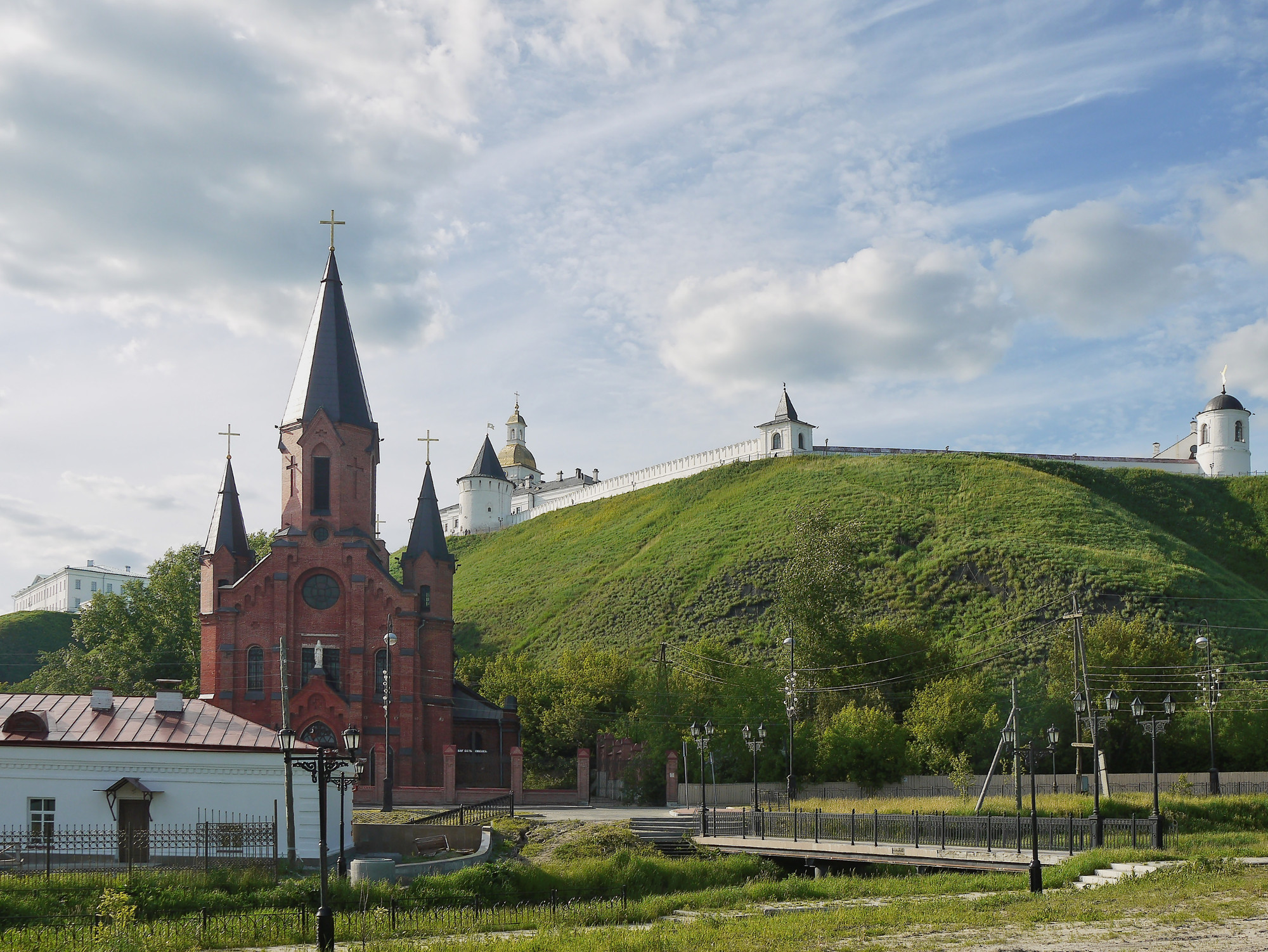
Holy Trinity Church, Tobolsk
On certain evenings, organ music drifts from a Gothic church in western Siberia. This is not a sentence anyone would expect to write. Tobolsk, a city of Orthodox cathedrals and onion domes on the banks of the Irtysh, seems an unlikely home for Catholic architecture, let alone public organ concerts. But the Holy Trinity Church stands here because history sent it the people who would build it -- Polish and Lithuanian exiles, banished to Siberia after the failed November 1830 uprising in Poland, who refused to let distance dissolve their faith.
Born from Rebellion
The November Uprising of 1830 pitted Polish nationalists against Russian imperial rule. When it failed, the consequences rippled eastward. Thousands of Poles and Lithuanians were exiled to Siberia, scattering Catholic communities across a landscape dominated by Russian Orthodoxy. In Tobolsk, these exiles formed the nucleus of a parish. By 1843, the governor granted them permission to build a place of worship. Five years later, in 1848, a modest wooden chapel rose in the city -- small, practical, and unlikely to attract attention. The community was formally established as a parish in 1868, by which point the original exiles' children were raising families of their own in a land their parents had never chosen.
Gothic Spires on Frozen Ground
By 1891, the wooden chapel could no longer accommodate the growing congregation, and the parish priest petitioned for permission to construct a larger church. Approval came six years later, and the community built what still stands today: a stone church in the Gothic style, complete with pointed arches and a bell tower, looking as though it had been transported whole from a Polish town square. The architectural choice was deliberate. Gothic churches were markers of Catholic identity across the Polish diaspora, and building one in Siberia was as much a cultural statement as a religious one. Here, surrounded by the baroque and neoclassical forms of Russian Orthodoxy, the sharp vertical lines of Gothic architecture declared that this community remembered where it came from.
Silenced and Restored
The Soviet campaign against religion reached the Holy Trinity Church in 1923. The building was closed, its bell tower destroyed. For seven decades, the church served purposes its builders never intended -- storage, offices, the generic repurposing that consumed thousands of religious buildings across the Soviet Union. The structure survived, but its identity was erased from the streetscape. When the communist regime fell, the process reversed. The church was returned to the parish in 1993, and a painstaking restoration began. Workers rebuilt the bell tower, restored the interior, and brought the organ back to life. On August 13, 2000, Bishop Joseph Werth reconsecrated the church, completing a 77-year interruption. The organ concerts that now draw visitors to the church are not merely musical events -- they are proof that what was silenced can sound again.
A View from Trinity Cape
From Trinity Cape, the church presents its most striking profile against the Siberian sky. The Gothic lines stand in sharp contrast to the nearby Tobolsk Kremlin, whose white Orthodox walls crown the bluff above the lower town. The juxtaposition tells a story that no single building could tell alone: Tobolsk was never just a Russian city. It was a crossroads of exile and empire, where Decembrists, Polish rebels, and a deposed tsar all passed through, each leaving something behind. The Holy Trinity Church is what the Polish exiles left -- a piece of Warsaw built from Siberian stone, still standing, still holding services, still filling the air with organ music on quiet evenings when the Irtysh flows dark and slow below.
From the Air
Located at 58.197N, 68.253E in Tobolsk, near the base of the Kremlin bluff at Trinity Cape. The Tobolsk Kremlin and St. Sophia-Assumption Cathedral on the hill above are the dominant visual landmarks. The church's Gothic profile is distinctive against the surrounding Orthodox architecture. Tobolsk Airport is approximately 15 km southwest. Best viewed at 2,000-3,000 ft AGL. The Irtysh River provides a clear navigation reference running through the city.