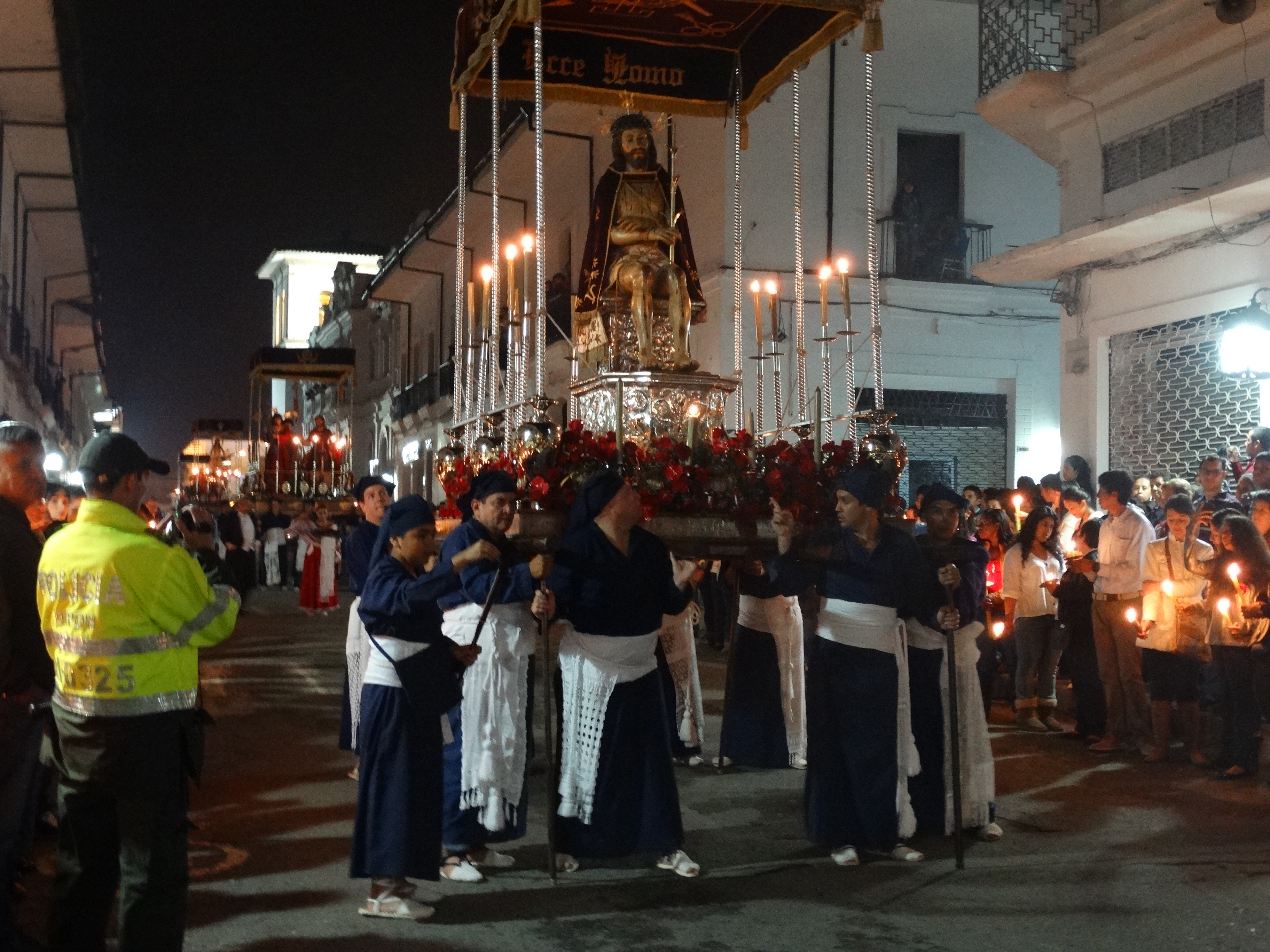
Holy Week in Popayan
In 1556, a group of displaced Andean people climbed the hills around Popayan at dusk, intending to retake the Spanish city. What they saw in the valley below made them turn and flee. An endless line of moving lights was wrapping the city in a slow, silent coil. They assumed it was an army with torches. It was actually a Holy Thursday procession of penitents, described decades later by the chronicler Juan de Castellanos in his Elegies of Illustrious Men of the Indies. The procession scared off a rebellion. Nearly 470 years later, the same procession still moves through the same streets.
The White City
Popayan sits on a plateau in Colombia's Cauca Valley, its colonial core painted a uniform white that gave the city its nickname, la Ciudad Blanca. In 1558, King Philip II of Spain signed a royal decree authorizing the Holy Week processions here. They have run every year since, making them among the oldest continuous Catholic rituals in the Americas. On September 30, 2009, UNESCO added them to the list of Masterpieces of the Oral and Intangible Heritage of Humanity. The processions leave and return to specific churches along a route laid out in the shape of a cross, passing the Cathedral Basilica of Our Lady of the Assumption, the Church of San Agustin, the Chapel of Jesus Nazareno, and others that have stood for most of the city's existence. The geography of the faith has barely moved in four centuries.
The Pasos and the Cargueros
A paso is a wooden platform, four bars forward and four behind, topped with a carved and painted figure depicting a moment from the Passion. Christ falling. Veronica with the veil. Mary Magdalene. The Virgin of Sorrows. Each paso is carried on the shoulders of eight men called cargueros, and some of the heaviest steps weigh enough to crush a man. The images themselves come from the most prestigious colonial art schools of the sixteenth, seventeenth and eighteenth centuries: Spanish, Andalusian, Quiteno, and Italian. The goldsmithing and jewelry, however, are payanesa, made by local hands. The wealth that clothed these figures in gold, silver, and emeralds came from the Popayan Governorate's mines, and those mines came at a cost the processions rarely names aloud. The writings of Bartolome de las Casas, preserved by historian Louis Hanke, record that enslaved Indigenous laborers in those mines had a life expectancy of three years.
The Pigeon
On Holy Tuesday, 1840, two insurgent generals named Jose Maria Obando and Juan Gregorio Sarria walked into the procession wearing the traditional carguero's hood, their faces covered in the Sevillian style. They were wanted men, hunted during the War of the Supremes, and they had come to carry the Virgin of Sorrows. The regional governor, Manuel Jose Castrillon, learned they were in the crowd and ordered the parade stopped. Obando's friends lit candles and began whispering a single word: paloma. Pigeon. It was a signal. At the corner of the Chapel of Jesus Nazareno, the illuminants blew out their candles, the crowd closed around Obando and Sarria, and both generals vanished into the dark. The next day the governor ruled that cargueros must walk with faces uncovered, a rule that has held ever since. The word paloma also survived. Today it still refers to the brief lifts cargueros use at the start and end of each procession.
The Cripple's Step
On March 22, 1951, a Holy Wednesday, Don Arcesio Velasco Iragorri collapsed and died in front of the Church of San Jose. He had been carrying the front right corner of El Prendimiento, The Arrest of Christ, one of the heaviest pasos in the procession. They called him El Cojito, the Cripple. His family had carried that step for generations. Since 1952, when the procession of El Prendimiento reaches the Church of San Jose each Holy Wednesday, the cargueros set it down and call a new movement called El Toque, the Touch. Velasco's descendants take the bars for one minute in his honor. Then his friends and fellow cargueros shoulder the step for a minute more, before lifting it together and moving on. Holy Week in Popayan is stitched together with moments like this, small inherited rituals layered on top of larger ones, each carrying a specific name and a specific memory.
Rain, War, and the Civic Board
Twice in the twentieth century, it looked as if the processions would end. The independence wars of the early 1800s drained money away from ornaments and gold leaf. The Colombian economic collapse of the early 1900s hit the city again. In 1937 the poet Guillermo Valencia founded a Civic Council to save the tradition. Two years later, by Ordinance No. 14, the Assembly of Cauca recognized the body officially as the Board Permanent Pro Easter Popayan. It has run Holy Week ever since. The Board has faced genuine tests. In 1964, rain soaked the city for three days straight, Tuesday through Thursday, and no procession could finish its route. That Good Friday the Archdiocese authorized twenty-two pasos instead of the usual twelve. One hundred and seventy-six cargueros spent the night carrying them home. Some pasos have simply broken in the street. The Judgment paso cracked a bar in 1940. The Logos paso cracked its front-right bar in 1949 outside the Popayan Teatro.
What Persists
During Holy Week, Popayan is also home to the Religious Music Festival, founded in 1960 by Edmundo Troya Mosquera. Choirs arrive from around the world to perform sacred music in the same colonial churches where the pasos pause. Below the balconies, vendors sell embroidered banners. The smell of incense thickens the air near the cathedral. Families who have supplied cargueros for eight or nine generations bring their sons into the practice halls weeks before Friday of Sorrows. Every paso has a story in the families who carry it, a story in the workshop where its gold was beaten, a story in the streets it has crossed since Philip II signed a parchment in 1558. The city wears its history as processional clothing. Every spring it walks the route again.
From the Air
Popayan sits at 2.45 degrees North, 76.60 degrees West, on the plateau of the upper Cauca River valley at roughly 1,760 meters elevation. The article's recorded coordinates (4.62 N, 74.07 W) are closer to Bogota and appear to be placeholder values; the historic city itself is several hundred kilometers to the southwest. Nearest major airport: Guillermo Leon Valencia Airport (SKPP) on the edge of town. Volcanic cones of the Cordillera Central rise to the east, including Purace (4,650 m). Recommended viewing altitude: FL150 to FL200 for the valley and the Purace volcanic chain; lower for spotting the grid of white colonial streets. Best visibility during the region's dry season from December through March.