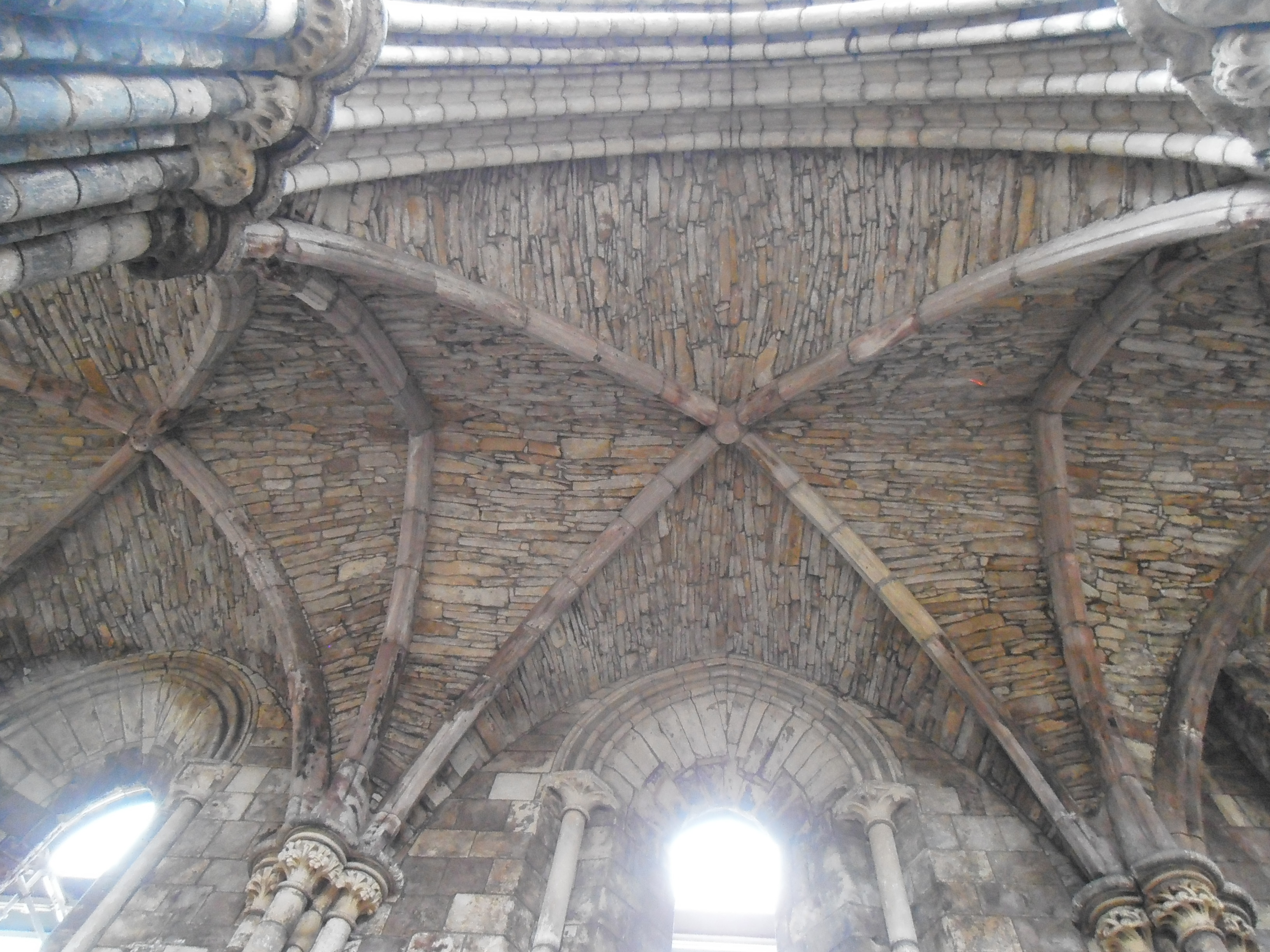
Holyrood Abbey
The story begins with a stag. In 1127, King David I was hunting in the forests east of Edinburgh during the Feast of the Cross when a hart threw him from his horse and charged. According to legend, a miraculous cross appeared between the animal's antlers -- or descended from the sky, depending on who tells it -- and the stag fled. David founded Holyrood Abbey on the spot in 1128, naming it for the Holy Rood, the cross that saved his life. The word "rood" is an old English term for the crucifix. For four centuries, the abbey was one of the most important religious and political sites in Scotland. Today it is a roofless ruin, standing open to the weather beside the palace that grew up around it.
The Black Rood
Among the abbey's treasures was an object said to be a fragment of the True Cross, brought to Scotland by David's mother, St. Margaret, from Waltham Abbey in England. Encased in a golden reliquary, it became known as the Black Rood of Scotland. The relic's presence made Holyrood a place of pilgrimage and royal devotion for two centuries. Then, at the Battle of Neville's Cross in 1346, the Black Rood fell into English hands. It was taken to Durham Cathedral, where it remained until the Reformation, when it vanished. The loss was more than symbolic -- the abbey's claim to spiritual authority was bound up in the relic it could no longer display.
Crowns and Parliaments
Holyrood was not merely a place of worship. The Parliament of Scotland met here in 1256, 1285, 1327, 1366, 1384, 1389, and 1410. Robert the Bruce held parliament at the abbey in 1326. Coronations took place within its walls: James II in 1437, Margaret Tudor in 1503, Mary of Guise in 1540, Anne of Denmark in 1590, and Charles I in 1633. Royal weddings were celebrated here -- James II married Mary of Guelders in 1449, James III married Margaret of Denmark in 1469, and James IV married Margaret Tudor in 1503. Kings were also buried here: David II in 1371, James II in 1460, James V in 1542. Henry Stuart, Lord Darnley -- Mary Queen of Scots' ill-fated second husband -- was interred at Holyrood in 1567.
Reformation and Ruin
The English army under the Earl of Hertford stripped lead from the roof and plundered the abbey in 1544 and 1547. In 1559, a Reformation mob destroyed the altars and looted what remained. The east end of the church was demolished in 1570, and the nave was pressed into service as the parish church of Canongate. Elaborate thrones and stalls were installed for the Knights of the Thistle, carved by the great woodcarver Grinling Gibbons, but in 1688 the Edinburgh mob broke in during the Glorious Revolution and desecrated the royal tombs. The final disaster was an act of well-meaning incompetence: in the 1750s, the Duke of Hamilton commissioned a replacement of the timber roof with stone vaults. The medieval walls and decayed flying buttresses could not bear the weight. By 1766, deformation was alarming enough to close the church.
Open to the Sky
On 2 December 1768, the stone roof collapsed in two stages, leaving the abbey as it stands today -- a roofless skeleton of Gothic arches and weathered tracery, open to Edinburgh's rain and wind. Proposals to rebuild have surfaced periodically: in 1835 as a meeting place for the General Assembly of the Church of Scotland, and in 1906 as a chapel for the Knights of the Thistle. Both were rejected. The French artist Louis Daguerre -- inventor of the daguerreotype -- painted the ruins by moonlight in a work that became one of the 19th century's most celebrated images of romantic decay. The abbey remains in this state, cared for by Historic Environment Scotland, its Gothic tracery framing nothing but sky. The palace next door thrives. The abbey endures as a beautiful, deliberately unrepaired ruin.
From the Air
Holyrood Abbey is at 55.953N, 3.172W, adjacent to the Palace of Holyroodhouse at the eastern end of Edinburgh's Royal Mile. The roofless ruins are visible from altitude alongside the palace. Arthur's Seat rises immediately to the south. Nearest airport: Edinburgh (EGPH), approximately 7 nm west. Best viewed at 1,500-3,000 ft.