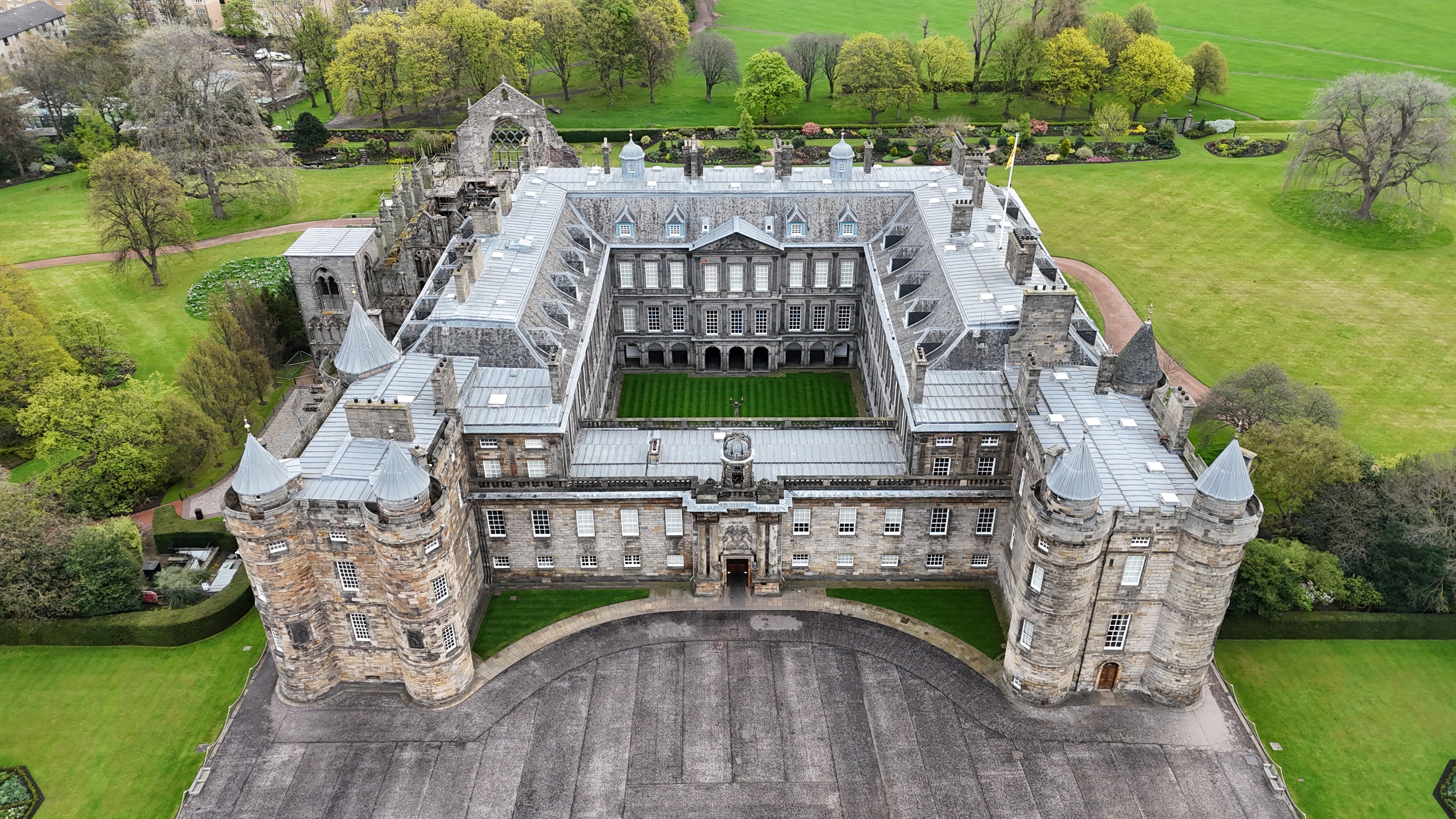
Holyrood Palace
On the evening of 9 March 1566, Mary Queen of Scots was at supper in her private apartments in the Palace of Holyroodhouse with David Rizzio, her Italian secretary, and four other courtiers. Her husband, Lord Darnley, led a group of armed nobles up a private staircase and into the chamber. They seized Rizzio, dragged him through the bedchamber and into the outer room, and stabbed him to death. He received, according to the accounts, fifty-seven dagger wounds. Mary was six months pregnant. The supper chamber, the bedchamber, and the staircase are still there, still shown to visitors, the rooms largely unchanged since the night the murder happened. The Palace of Holyroodhouse has been the official residence of the British monarch in Scotland since the 16th century. But its identity was forged in moments like this -- intimate, violent, and preserved in stone.
From Abbey to Palace
The palace grew out of Holyrood Abbey, founded in 1128. For centuries, Scottish kings used the abbey's guest quarters as lodgings when visiting Edinburgh. James IV built the first proper palace buildings around 1500, but it was his son James V who constructed the massive tower that still anchors the northwest corner -- the oldest surviving part of the palace, and the tower where Mary would later live. James V's Tower was built between 1528 and 1536, its rounded corners and thick walls reflecting a monarch who valued security. The entrance was on the first floor, reached by drawbridge, and possibly protected by a moat. In 1512, a menagerie was added to the grounds housing the king's lion, civet, tigers, lynx, and bears. The English army sacked the palace twice during the 1540s, and the Reformation mob destroyed what remained of the abbey's fittings in 1559.
Mary's Court
Mary arrived at Holyrood in 1561 as a nineteen-year-old widow returning from France. She occupied apartments on the second floor of James V's Tower -- the rooms that would become the most famous in Scotland. She received John Knox here for their celebrated confrontations about religion and a woman's right to rule. She married Lord Darnley in her private chapel in July 1565. And it was here, eight months later, that Rizzio was murdered. The killing was politically motivated -- Rizzio's influence with the queen had alarmed Protestant nobles -- but its mechanics were domestic, almost claustrophobic: the supper table, the private stair, the bedchamber. Mary married her third husband, the Earl of Bothwell, at the palace in May 1567. Within weeks she had been forced to abdicate. She never returned to Holyrood.
Rebuilding and Royalty
The palace burned in 1650 when occupied by Cromwell's troops and was largely abandoned until Charles II ordered its reconstruction in 1670. The architect Sir William Bruce redesigned it in the neo-classical style, adding a second tower to mirror James V's original and creating the symmetrical facade that visitors see today. The Great Gallery, stretching 150 feet along the north range, was hung with 96 portraits of Scottish monarchs commissioned from the Dutch artist Jacob de Wet -- real and legendary kings painted at a rate of roughly one portrait a week. Bonnie Prince Charlie held court at Holyrood during the 1745 Jacobite rising, hosting balls in the Great Gallery. George IV visited in 1822, the first reigning monarch to set foot in Scotland since Charles II, and Queen Victoria made regular use of the palace during her journeys north.
Debtors and Sanctuary
For centuries, the precincts of Holyrood Abbey -- extending to the whole of Holyrood Park -- served as a debtors' sanctuary. Anyone who could not pay their debts could escape imprisonment by taking up residence within the abbey's bounds. A small community of these refugees grew up west of the palace. Known colloquially as Abbey Lairds, they were permitted to leave the sanctuary on Sundays, when no arrests were allowed. The area was governed by a baillie and several constables appointed by the Keeper of Holyroodhouse. Those constables now form a ceremonial guard at the palace -- their origin in debt enforcement largely forgotten.
A Working Palace
Holyrood remains a functioning royal residence. King Charles III spends a week in residence each summer, conducting official engagements and ceremonies. The State Apartments are used for entertaining and formal occasions. Mary's apartments on the second floor of James V's Tower -- the supper chamber, the bedchamber, the outer chamber where Rizzio fell -- are open to the public when the royal family is not in residence. The King's Gallery, converted from existing buildings at the western entrance in 2002, exhibits works from the Royal Collection. The palace sits at the foot of the Royal Mile, at the opposite end from Edinburgh Castle, the two landmarks connected by a single medieval street that runs along the spine of a glacial ridge. The Scottish Parliament building, opened in 2004, stands next door. Between the ancient palace and the modern legislature, power in Scotland has never strayed far from this ground.
From the Air
The Palace of Holyroodhouse is at 55.952N, 3.172W at the eastern end of Edinburgh's Royal Mile, adjacent to the ruined Holyrood Abbey and the Scottish Parliament. The palace complex with its twin-towered facade is identifiable from altitude. Arthur's Seat rises immediately to the south. Nearest airport: Edinburgh (EGPH), approximately 7 nm west. Best viewed at 2,000-3,000 ft.