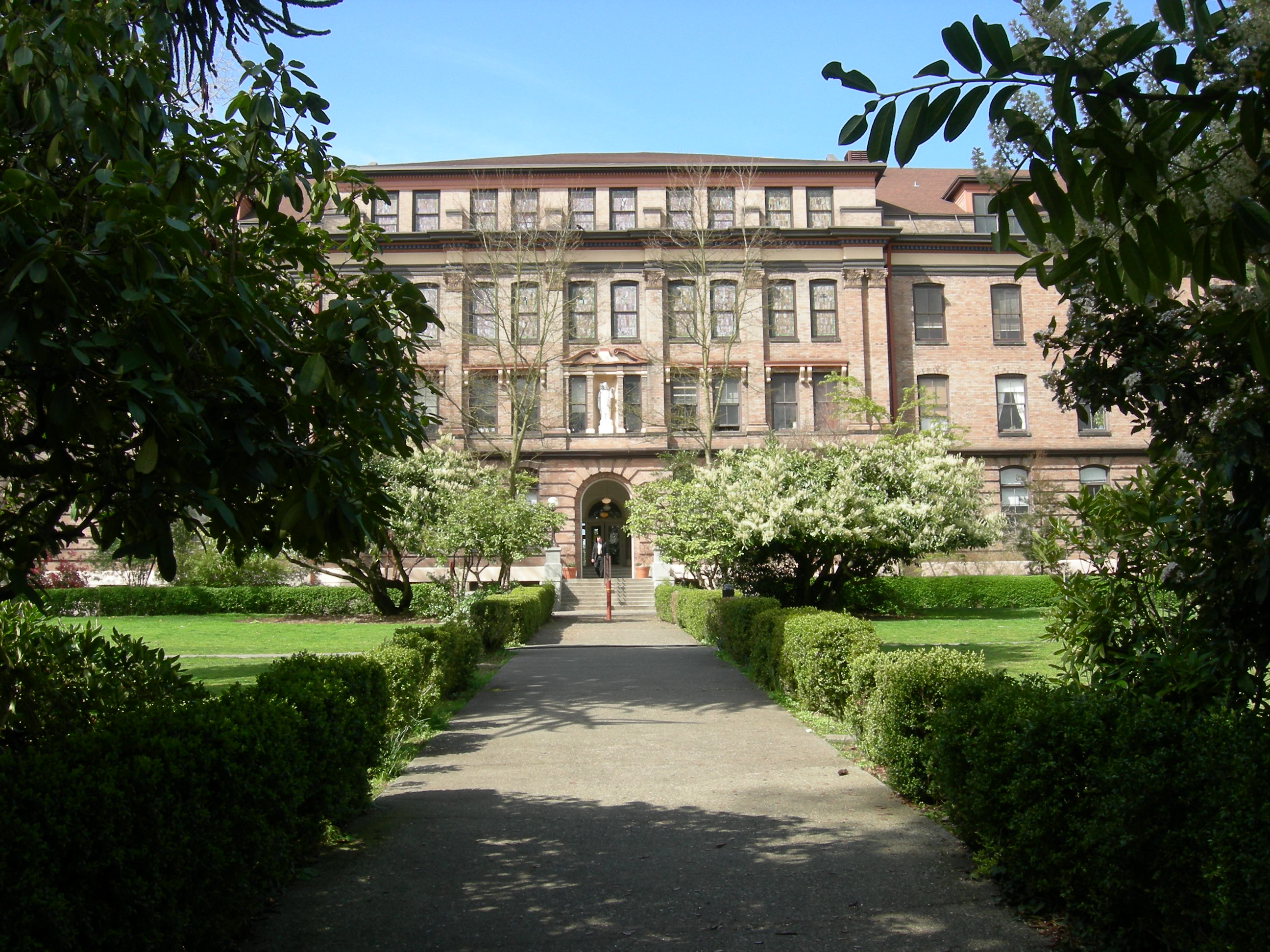
Home of the Good Shepherd
The nuns are gone, but the apple trees remain. In Seattle's Wallingford neighborhood, a stately brick building sits at the center of Meridian Park, surrounded by orchards planted more than a century ago by the Sisters of the Good Shepherd. With its cornerstone laid in 1906 and its doors opened on July 29, 1907, the Home of the Good Shepherd operated for sixty-six years before closing in 1973. What happened next is a story about a city deciding what to do with a building designed for moral correction, and finding in it something far more generous: a place for artists, gardeners, musicians, seniors, and children to share a single compound in one of Seattle's most residential neighborhoods.
A School for Wayward Girls
The Sisters of Our Lady of Charity of the Good Shepherd established the Home in 1906 as part of a network of institutions across the country intended to reform young women who had run afoul of social expectations. The girls who lived here attended classes, tended gardens, and maintained the grounds under the sisters' supervision. An apple orchard spread across the property's south side. A swimming pool served both recreation and discipline. For nearly seven decades, the Home operated quietly in Wallingford, a neighborhood of modest single-family houses north of Lake Union. When the order finally closed the school in 1973, the building and its grounds faced an uncertain future. The question was not whether the site had value but what kind of value a city would see in a place built to contain people society had cast aside.
Second Lives
Historic Seattle, a nonprofit preservation organization, took over stewardship of the building and began transforming it into a community center. The conversion preserved the building's bones while repurposing its rooms. The Wallingford Community Senior Center moved in. So did Meridian School and Tilth Alliance, an urban agriculture nonprofit that now operates a demonstration garden on the south side of the property. Low-cost housing for artists was carved from former dormitory space. The old chapel, occupying the center of the building's top two floors, became a performance venue. Today it hosts the Wayward Music Series, a program of experimental and avant-garde performances whose name acknowledges, with a wink, the building's original purpose. The swimming pool was filled with earth and planted as a garden. The bath house became a picnic shelter. Even the building's listing on the National Register of Historic Places and its designation as a Seattle landmark carry a kind of redemption, honoring a structure whose original mission most people would rather forget.
Orchards and Playgrounds
Walk the grounds today and the layers of history become tangible. The apple orchard still produces fruit each autumn, its trees gnarled and productive after more than a hundred years. Between the rows, a playground and two playfields occupy space where the sisters' students once walked in supervised silence. Sculptures at the playground entrance nod to both past and present: a nun stands before the Good Shepherd Center, and a schoolgirl reaches to pick an apple. At the back of the play area, children's book characters rendered in sculpture watch over swing sets and spinning play structures. A P-Patch community garden occupies the south perimeter, its raised beds tended by neighborhood residents. A niche sculpture of Jesus as the Good Shepherd still watches from above the building's front entrance, a reminder that this compound was built on faith, even as it now runs on something closer to civic optimism.
Where Correction Became Community
The Good Shepherd Center is an unusual place because it does not hide what it was. The architecture is institutional, the hallways long and echoing, the building's scale clearly meant for supervision rather than comfort. But the community that inhabits it has turned those qualities into assets. The long hallways connect organizations that might never otherwise share a roof. The senior center and the school exist side by side. Experimental musicians set up in a chapel where girls once knelt in compulsory prayer. Gardeners tend plots where a swimming pool once enforced routine. The Good Shepherd Center Advisory Board coordinates community involvement, ensuring that the building serves its neighborhood rather than sitting as a relic. In a city transforming rapidly, where old buildings frequently give way to apartment blocks and mixed-use developments, this compound persists as proof that the most interesting conversions happen when a city chooses to keep a building and change its purpose rather than tear it down and start over.
From the Air
Located at 47.664N, 122.331W in Seattle's Wallingford neighborhood, on the north side of Lake Union. The Good Shepherd Center is a large brick institutional building surrounded by green space visible as Meridian Park. The apple orchard and playfields are visible as a green patch amid residential blocks. Nearest airports: Boeing Field (KBFI) 7nm south, Kenmore Air Harbor (S60) 5nm north, Renton Municipal (KRNT) 12nm southeast. Best viewed at 2,000-3,000 feet approaching from the south or west, where the building's institutional scale stands out against the surrounding residential fabric of Wallingford.