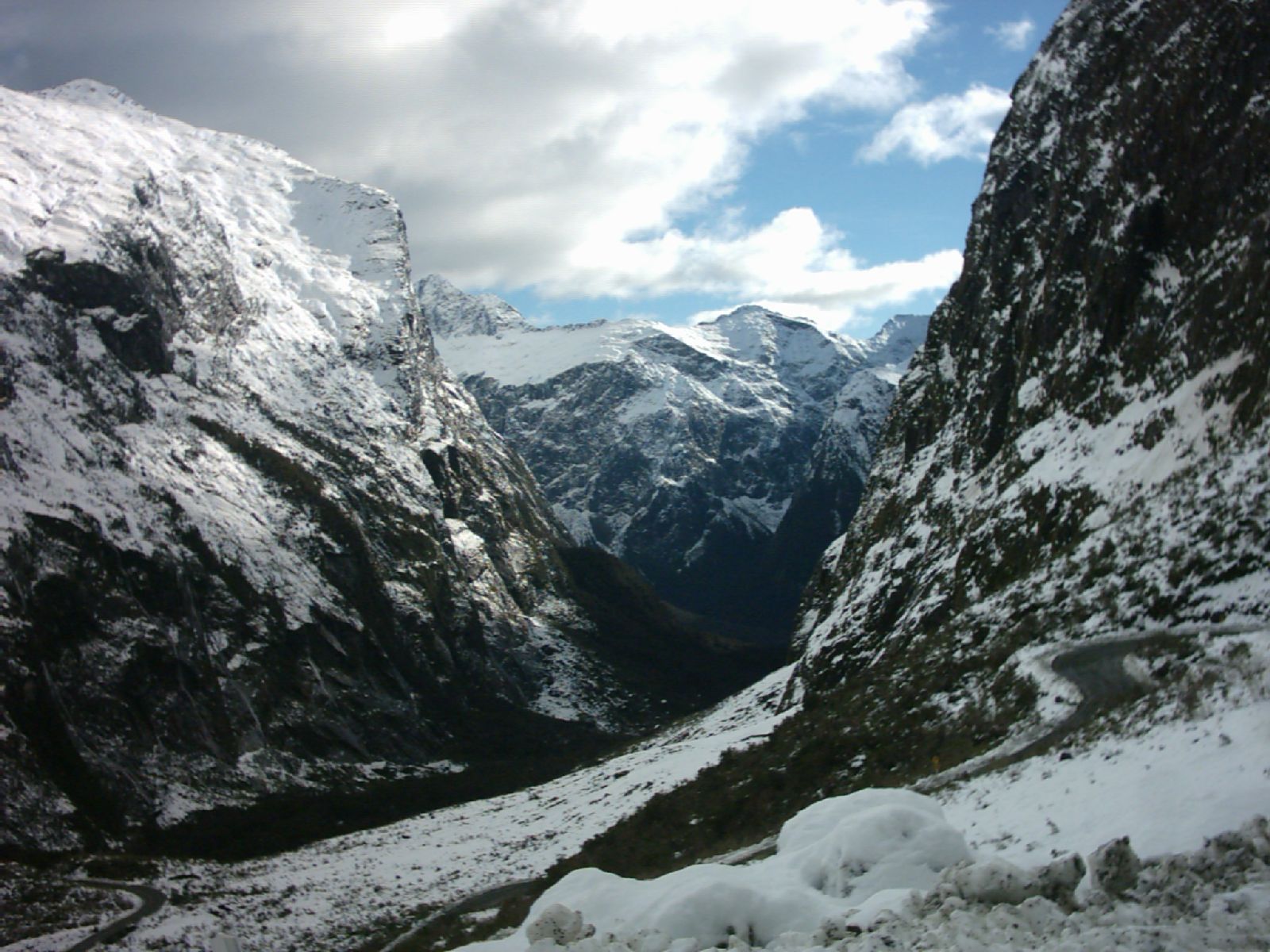
Homer Tunnel
Five men stood at the base of the Darran Mountains in 1935 with picks and wheelbarrows. They were Depression-era relief workers, assigned to bore a tunnel through solid rock to connect Milford Sound with the outside world. The idea had been floating since 1889, when William Homer and George Barber discovered the saddle above and Homer first suggested that a tunnel might work. Nearly half a century passed before anyone tried. The men who finally did lived in tents in a valley so deep between mountains that direct sunlight disappeared for half the year. They chipped at granite by hand. The tunnel they started would not open for another two decades.
Picks Against the Mountain
Progress came in centimeters. The rock was hard, the conditions punishing, and the weather tried to kill the workers with a regularity that suggested personal grudge. In 1936, an avalanche swept into the tunnel entrance and killed 26-year-old Percy Leigh Overton. The following year, another avalanche took Donald Frederic Hulse, the engineer placed in charge after the first disaster, along with overseer Thomas W. Smith. The mountain, it seemed, did not want to be pierced. Compressors and a powerhouse were eventually built near a river to pump out 40,000 litres of water per hour - snowmelt seeped through fractures in the rock and flooded the bore constantly. By 1940, the workers had punched through to the other side, but the war pulled labor away before the tunnel could be finished. Then, in 1945, a massive avalanche destroyed the eastern portal entirely. The reinforced concrete approach vanished under snow and debris. The tunnel sat incomplete, a hole through a mountain leading to rubble on both sides.
The Rough Bore Opens
The Homer Tunnel finally opened in 1953 - eighteen years after those first five men started swinging picks. What they opened was not a polished piece of engineering. It was a rough, unpainted, gravel-floored bore just wide enough for a single lane of traffic. Until it was later sealed and enlarged, it held the distinction of being the longest gravel-surfaced tunnel in the world, a record nobody envied. Water dripped from the ceiling. The walls were raw rock. Drivers entered on one side and emerged, blinking, into a different world - the lush, rain-soaked valley leading down to Milford Sound. State Highway 94 now passes through the tunnel, connecting Milford Sound to Te Anau and Queenstown beyond. Traffic lights control the single-lane flow, and waits of fifteen or twenty minutes are common during summer. The lights operate only during daylight hours in peak season; in winter and spring, the avalanche risk at the portals makes it unsafe for vehicles to queue.
Gateway and Bottleneck
The Homer Tunnel remains the only road access to Milford Sound, and the tension between its historic charm and modern traffic demand has never been fully resolved. Two tourist buses were destroyed by fire outside the tunnel in early 2008, though the fires were unrelated to the tunnel itself. Proposals to widen the bore have surfaced repeatedly. In 2020, the New Zealand Government announced $25 million for safety improvements, but widening was not included in the scope, and by 2021 budget constraints forced even those upgrades to be scaled back. A more ambitious proposal - the Milford Dart tunnel, which would have bypassed the Homer Tunnel entirely and halved the drive from Queenstown - was declined by the government in 2013 over environmental concerns. So the Homer Tunnel endures as it has since 1953: narrow, wet, lit by roof-mounted lights since 2004, and utterly singular. There is no other way to drive to Milford Sound, and the tunnel's constraints impose a pace that the fiord's grandeur deserves.
The Drive That Earns the View
The tunnel is just 1.2 km long, but the road that leads to it is an experience unto itself. From Te Anau, State Highway 94 winds 120 km through some of New Zealand's most dramatic scenery - Mirror Lakes, the Hollyford Valley, The Chasm. The road climbs through beech forest and alpine terrain before descending to the tunnel's eastern portal, where drivers may sit for twenty minutes watching the traffic light and the kea - New Zealand's mountain parrot - dismantling the rubber seals on their windshield wipers. Beyond the tunnel, the road drops steeply through the Cleddau Valley toward the fiord. The whole journey from Te Anau takes two to three hours, and in winter, chains are mandatory on vehicles. High-risk avalanche sections are marked with signs forbidding drivers to stop. When the avalanche risk is rated high, the road closes entirely. None of this discourages anyone. More than 400,000 people make the journey to Milford Sound each year, and the Homer Tunnel is the door every one of them must pass through.
From the Air
The Homer Tunnel is located at 44.76S, 167.98E, piercing the Darran Mountains at the Homer Saddle along State Highway 94. From the air, look for the road switchbacking up the eastern approach and the tunnel entrance cut into the mountainside. The tunnel runs roughly east-west through the mountain. The eastern portal is at higher elevation than the western, creating a descending grade toward Milford Sound. Milford Sound Airport (NZMF) is approximately 20 km to the northwest. Te Anau Airport (NZTZ) lies to the southeast, and Queenstown Airport (NZQN) is the main international gateway. The surrounding Darran Mountains reach over 2,000 m and create severe turbulence and downdrafts. Avalanche debris fields are visible on the slopes above both tunnel portals. Weather changes rapidly - clear skies can close to cloud in minutes. The Hollyford Valley is visible running north from the tunnel area.