Homestead Steel Works
Twelve smokestacks rise from the parking lot of a suburban shopping center along the Monongahela River in Homestead, Pennsylvania. They belong to no building. They heat nothing. They are the last vertical remains of the Homestead Steel Works, which was, for decades, the largest steel mill in the world. Where 15,000 workers once poured molten steel into ladles and rolled structural beams for skyscrapers, shoppers now browse big-box retail at The Waterfront. The transformation is so complete that you could spend an afternoon there without knowing that the ground beneath your feet produced the steel for the Panama Canal locks, that workers and Pinkerton agents died here in a pitched battle in 1892, or that Andrew Carnegie built his fortune on this spot and then tried to buy his way out of the guilt.
Carnegie's Crown Jewel
The Homestead Steel Works was first constructed in 1881 for the Pittsburgh Bessemer Steel Company. Andrew Carnegie bought the two-year-old mill in 1883 and folded it into his Carnegie Steel Company. The location on the Monongahela River was strategic - the river connected the mill to tributary coal and iron fields, to the Union Railroad, and to a fleet of lake steamships that moved raw materials and finished product. Carnegie expanded the works aggressively. Like its sister plant, the Edgar Thomson Works downstream, Homestead was fed by a vertically integrated supply chain that Carnegie controlled from mine to rail. For many years, the Homestead Works was the most productive of the Mon Valley's many mills, and it became the crown jewel of an empire.
The Battle of Homestead
On June 30, 1892, the Homestead Works became the site of one of the most violent labor confrontations in American history. A series of disputes over wages, working hours, and contracts had been building for years. When the Amalgamated Association of Iron and Steel Workers refused to accept new terms, Carnegie's manager Henry Clay Frick locked out the workers and called in 300 Pinkerton agents by barge up the Monongahela. On July 6, the Pinkertons attempted to land at the mill. Workers and townspeople fought back. By the end of the day, the battle had killed strikers and guards alike, in one of the deadliest clashes in U.S. labor history. The union was crushed. Steelworkers across the country remained largely unorganized for the next four decades. In 1896, Carnegie built the Carnegie Library of Homestead in nearby Munhall - though whether the library was truly a concession to the workers or a project Carnegie had planned before the strike remains disputed.
The Arsenal of Democracy
In 1901, Carnegie sold his steel operations to J.P. Morgan and the financiers who formed U.S. Steel. On January 6, 1906, the company announced seven million dollars in upgrades and expansions. The works grew into a colossus. During World War II, its workforce peaked at 15,000, producing the steel that fed America's war machine - armor plate, structural members, slabs, and beams. The mill's sheer scale was staggering: the 45-inch mill and the 160-inch mill were connected by a Dinky Locomotive that shuttled slabs between them. A gantry crane on the Monongahela riverbank loaded barges with finished steel. The works were a small city unto themselves, with their own railroad, their own water system, their own rhythms of shift whistles and molten pours.
The Silence After Steel
The Homestead Steel Works closed in 1986, a casualty of the severe downturn in the domestic steel industry that gutted the Monongahela Valley. The closure was not unique - mills across the region went dark - but the loss of Homestead hit with particular force because of the mill's historic importance and immense scale. Most of the structures were demolished. The Carrie Furnaces, blast furnaces across the Monongahela that had fed the Homestead works, survived and became a heritage site. But the main mill site was leveled. In 1999, The Waterfront, an outdoor shopping center, opened on the land. The twelve smokestacks from the 45-inch mill soaking pits were preserved in the development, standing in a traffic median like monuments to a vanished civilization.
What Remains
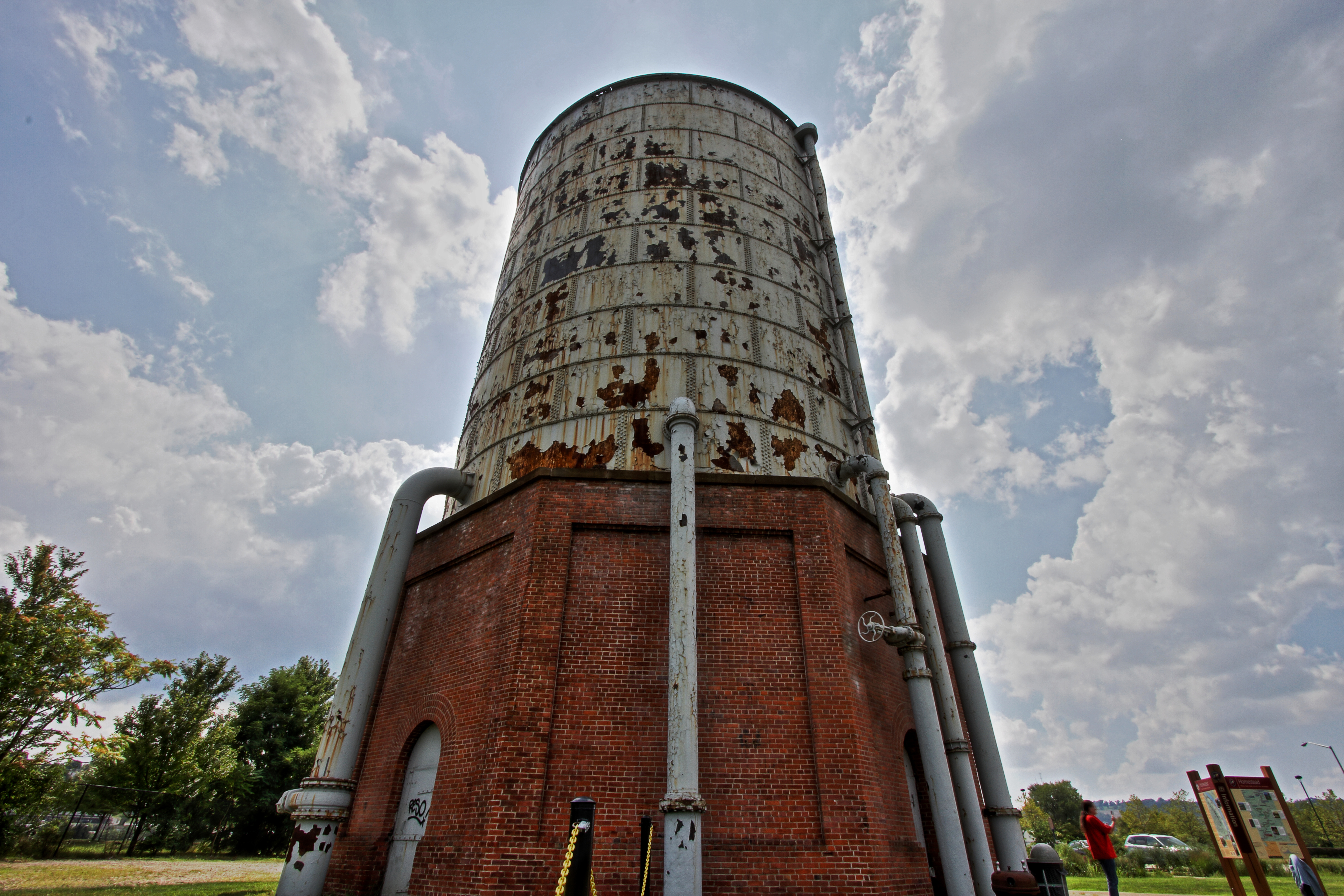
The pumphouse water tower, one of the few structures surviving from the 1800s, still stands along the riverbank. It now provides restrooms for visitors and cyclists traveling the Great Allegheny Passage trail. A Dinky Locomotive sits in a traffic circle, once used to haul slabs between mills. These fragments are all that remain of a mill that shaped American labor history, armed a nation in two world wars, and employed generations of families in Homestead and the surrounding boroughs. From the air, the site reads as a shopping center beside a river, unremarkable except for those twelve smokestacks standing in a row, pointing at the sky where furnace smoke once hung thick enough to blot out the sun.
From the Air
Located at 40.411°N, 79.897°W on the Monongahela River in Homestead, Pennsylvania. From altitude, the former mill site is now The Waterfront shopping center, identifiable by its large parking lots and commercial buildings along the river's south bank. The twelve preserved smokestacks may be visible at lower altitudes as a distinctive row amid the development. The Carrie Furnaces heritage site is across the river in Rankin. The Hot Metal Bridge, named for the ladles of molten iron once carried across it, crosses the Monongahela nearby. Allegheny County Airport (KAGC) is approximately 4 miles south. Pittsburgh International Airport (KPIT) is approximately 18 miles west. Downtown Pittsburgh is visible about 7 miles to the northwest where the Monongahela meets the Allegheny River.