Homfreyganj Massacre
The cruelest betrayals are the ones wrapped in promises of liberation. When Japan occupied the Andaman Islands in March 1942, they presented themselves as allies of Indian independence, handing nominal control to Subhas Chandra Bose's Azad Hind government and renaming the islands with patriotic titles. Behind this performance, the Japanese military retained absolute power, and the people they claimed to be freeing became their victims. On January 30, 1944, at the settlement of Homfreyganj near Port Blair, that contradiction reached its starkest expression: 44 Indian civilians, most of them members of the Indian Independence League, were lined up and shot dead at point-blank range, accused of spying for the British.
An Indefensible Paradise
By early 1942, the Andaman Islands held a population of roughly 40,000 people -- between 3,000 and 5,000 indigenous inhabitants, several hundred Europeans, and a large Indian majority. The British had recognized the islands' strategic value. Sitting on the eastern edge of the Indian Ocean, they could serve as a base for air raids and naval operations against Japanese-occupied Burma and Malaya. But after Japan's swift conquests of Singapore and the Malay Peninsula, British command reached a grim conclusion: the Andamans were indefensible. On March 10, 1942, Hindu priests, British women, and children were evacuated. Thirteen days later, a Japanese invasion force led by Captain Kawasaki Harumi arrived from Penang. They landed at Ross Island and Port Blair without meeting resistance. What followed was not the conduct of a liberating army.
Occupation Without Mercy
The Japanese wasted no time establishing terror. Eight senior British officials in Port Blair were arrested and forced to dig pits until only their heads remained visible, then stabbed and shot. An Englishman was publicly beheaded for the crime of speaking to one of his clerks after being detained. Remaining British officers were shipped to prison camps in Singapore. Local women were forced into sexual slavery. The Japanese established a seaplane base at Port Blair and deployed patrols in motorboats, though their noisy engines made them largely ineffective. Meanwhile, they staged a political theater: Subhas Chandra Bose visited in 1943, appointed governors, and gave the islands new names. But the Japanese Navy transferred no real authority to the Azad Hind administration. Even during Bose's visit, the occupiers were arresting and torturing members of the very movement he led. The Japanese ensured Bose never learned of the atrocities committed in his name.
Thirty Seconds at Homfreyganj
On January 30, 1944, the accumulating paranoia of an occupying force far from home reached its breaking point. Forty-four Indian civilians were accused of espionage -- of passing information to the British about Japanese military positions and movements. The majority were members of the Indian Independence League, the civilian organization that was supposed to be Japan's partner in the project of Asian liberation. There was no trial worthy of the name. The accused were taken to Homfreyganj, lined up, and executed by gunfire at point-blank range. The massacre exposed the hollowness of Japan's co-prosperity rhetoric. These were not enemy combatants or foreign agents. They were the very people whose freedom Japan had claimed to champion, killed because the occupation's real logic was control, not liberation.
The Final Days
The worst was yet to come. As Japan's military position deteriorated and food supplies dwindled in 1945, the occupation authorities turned to a solution of appalling simplicity: eliminate those who could not work. On August 13, 1945 -- just two days before Japan's surrender -- 300 Indians were loaded onto three boats, taken to an uninhabited island, and forced to jump into the ocean hundreds of yards from shore. Roughly a third drowned. Those who reached land found no food or fresh water. When British rescuers arrived six weeks later, only 11 were still alive. The following day, 800 more civilians were taken to another uninhabited island. Nineteen Japanese soldiers came ashore after them and shot or bayoneted every one. By the time the occupation ended, approximately 2,000 of the islands' inhabitants had perished as a result of the occupation -- representing roughly 10% of Port Blair's pre-war population. The Homfreyganj massacre was not an isolated event but part of a systematic destruction of an entire civilian population.
From the Air
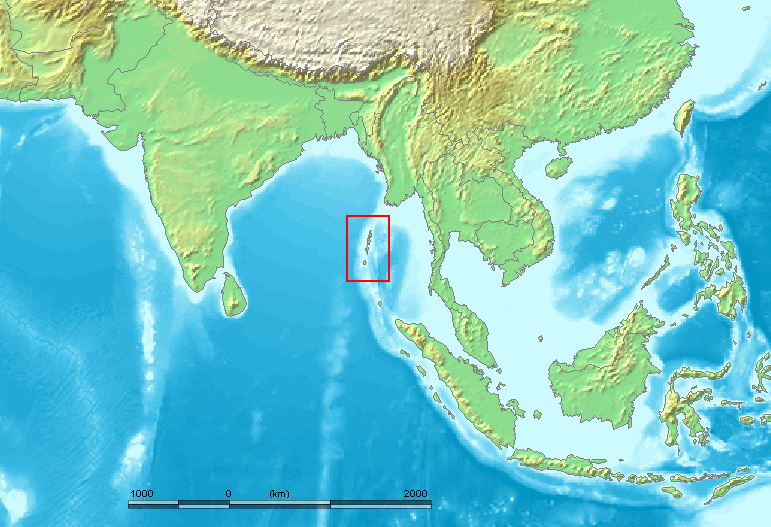
Located at approximately 11.68N, 92.77E near Port Blair, South Andaman Island. Homfreyganj is a settlement area southeast of central Port Blair. Nearest airport is Veer Savarkar International Airport (VOPB). The area is part of the broader Port Blair urban landscape visible at 2,000-4,000 ft AGL. Ross Island and the harbor serve as orientation landmarks from the air.