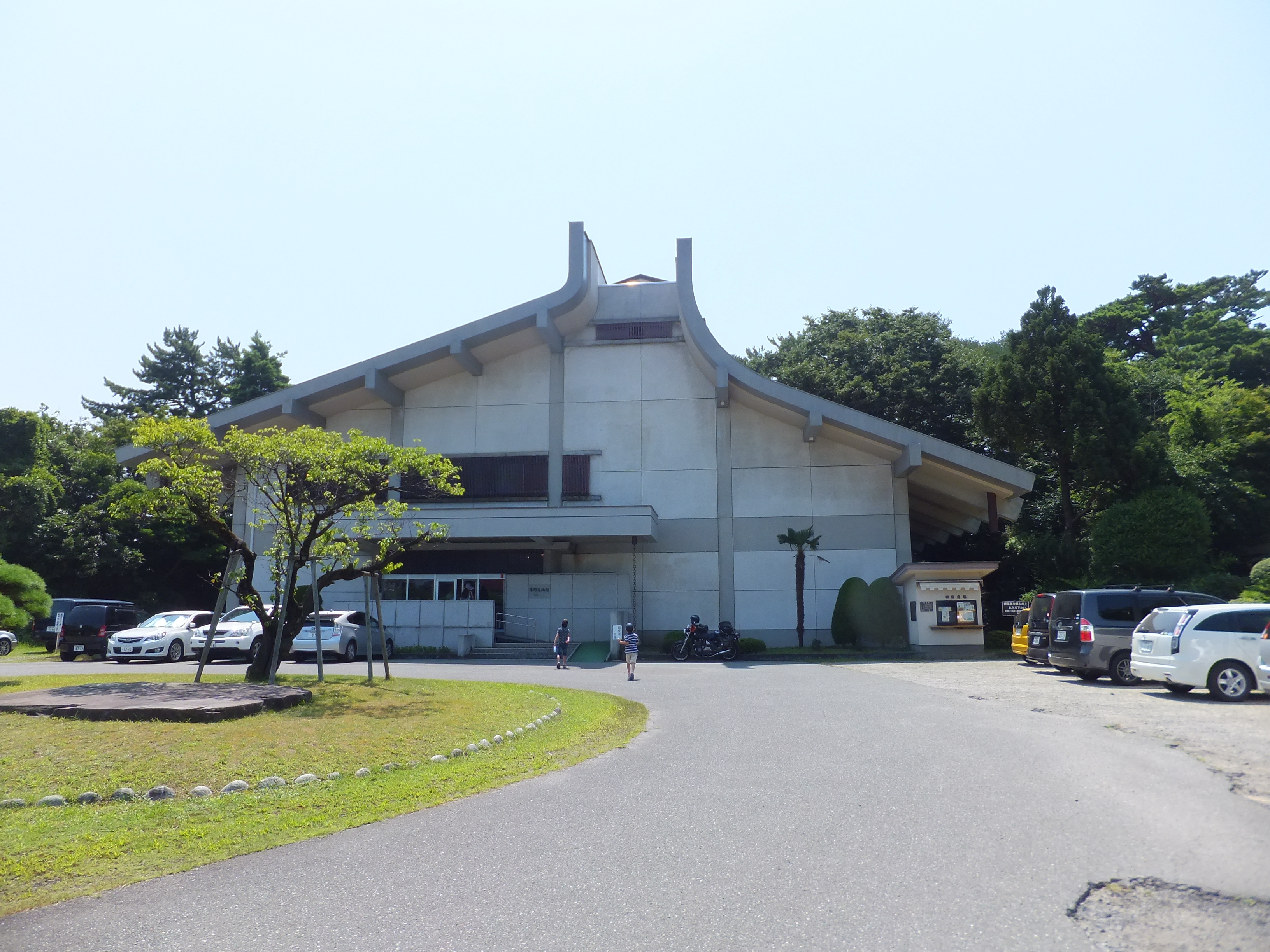
Homma Museum of Art
There is a folk song in Sakata that goes: "Homma Sama is out of our reach, but we wanna be Tonosama at least." In Edo-period Japan, where the rigid social hierarchy placed merchants at the very bottom and feudal lords near the top, this lyric was extraordinary. It meant that the Homma family -- technically the lowest class -- had accumulated wealth and influence so vast that even aspiring to match them was futile. The best an ordinary person could dream of was becoming a lord. That merchant dynasty's former residence, a graceful wooden villa overlooking gardens that borrow the silhouette of a sacred volcano, is now the Homma Museum of Art, and it holds the artistic legacy of a family that used commerce to build a cultural empire.
From Rice Ships to Rembrandts
The Homma family built their fortune on the kitamaebune -- the coastal trading ships that linked Osaka to Hokkaido during the Edo period, carrying rice, safflower, and other goods along the Sea of Japan coast. Sakata was a critical waypoint on this route, and the Homma clan dominated its commerce through trade and moneylending. By the Meiji period, they had become one of the largest landowners in the entire Tohoku region of northern Japan. Junji Homma, the fourth family head, channeled that wealth into culture. A noted collector of Japanese swords and chairman of the Nihon Bijutsu Token Hozon Kyokai, he built the original residence in 1813 as a place where art and power could meet under one roof.
A Villa Fit for Emperors
The Seienkaku villa served as the family's secondary residence and guest house, and its guest list reads like a roster of Japanese nobility. Members of the Sakai and Uesugi clans -- former daimyo of the Shonai and Yonezawa Domains -- passed through its rooms. In 1908, a second story was added to the wooden structure in preparation for a planned visit by the future Taisho emperor. When the future Showa emperor visited in 1925, the villa had already established itself as a place where political power and merchant wealth intersected with studied ease. In 1947, the family opened the residence as a public art museum, and a modern annex followed in 1968, creating a dialogue between Edo-era timber architecture and twentieth-century gallery design.
Twenty-Five Centuries of Beauty
The museum's collection of some 2,500 objects spans centuries and media. Among the treasures are a Kamakura-period edition of the Ise Monogatari and three other designated Important Cultural Properties of Japan. The paintings alone chart the arc of Japanese art history: works by Kano Tan'yu, the master of the Kano school; Nagasawa Rosetsu, known for his playful animal compositions; Ito Jakuchu, the eccentric genius of Kyoto; and Kuroda Seiki, who brought French Impressionism home to Japan. Beyond painting, the collection includes Goryeo celadons with their distinctive jade-green glaze, raku ware by Chojiro -- the founder of the raku tradition -- lacquerware, sculptures, and delicate Japanese traditional dolls. Shiba Kokan, Matsumura Goshun, Okada Hanko, and Kishi Ganku round out a roster of artists that any national museum would envy.
The Dancing Crane Gardens
Outside the museum walls, the Kakubu-en -- the "Dancing Crane" Gardens -- hold a designation as a National Place of Scenic Beauty. The garden employs the Japanese technique of shakkei, or borrowed scenery, drawing the distant profile of Mount Chokai into its composition so that the 2,236-meter volcano becomes the garden's backdrop. The effect collapses distance: the meticulously pruned trees and stones in the foreground merge seamlessly with the snow-capped peak on the horizon, making the garden feel infinite. It is a living artwork that changes with the seasons, from the heavy snow of Yamagata winters to the lush green of summer, and it embodies the same principle that guided the Homma family -- that true wealth lies not in what you own, but in what you see.
From the Air
Located at 38.923N, 139.842E in Sakata, on the Sea of Japan coast of Yamagata Prefecture. The museum sits near the waterfront in central Sakata. Best viewed at 2,000-3,000 feet AGL to appreciate the city layout against the coast. Mount Chokai (2,236m) is a prominent visual landmark to the northeast. Shonai Airport (RJSY) is approximately 20 km south. The Mogami River mouth and the port area provide good visual reference for locating the city.