Homomonument
The badge came first. In the camps, the Nazis sewed pink cloth triangles onto the uniforms of men they had arrested for being homosexual; an estimated 100,000 men were arrested under Paragraph 175, and roughly half spent time imprisoned. Forty-some years after the war, in a city only a short walk from where Anne Frank had hidden, a Dutch sculptor named Karin Daan took that symbol of persecution and turned it back on itself. She cut three large pink triangles from granite and set them flat into the pavement at the Westermarkt, point-to-point, forming a larger triangle around the Keizersgracht canal. On 5 September 1987, the Homomonument opened. It was the first monument anywhere in the world to commemorate gay and lesbian victims of Nazi persecution, and the campaign that built it had been losing arguments for two decades.
Why It Took So Long
After the war, the Netherlands honored its resistance dead and its murdered Jews and, slowly, its Romani dead. The gay men who had been arrested, imprisoned, and killed under the Nazis were not part of the official memory. In the 1970s, activists began trying to lay wreaths at the National Monument on Dam Square on 4 May, the Dutch day of remembrance. Police removed the flowers and declared them insulting to the memory of the dead. Activists tried again the next year. And the next. Bob van Schijndel, a member of the Pacifist Socialist Party, watched a Romani memorial open in Amsterdam in 1978 and asked, in effect, the obvious question. A fundraising committee formed. A design competition followed. Out of 137 entries, the jury chose Karin Daan's three pink triangles in 1981. Then came six more years of arguing about whether the dead deserved a monument at all.
Three Triangles, Three Times
Daan's design refuses to behave like most war memorials. It is not vertical. There is no name list, no carved wreath, no statue. The three pink granite triangles are flat in the pavement, and you can walk on them; tourists often do. One triangle steps down four broken stairs to a platform that rests on the surface of the Keizersgracht itself; its point reaches into the water toward Dam Square, lining up exactly with the National Monument the activists had been kept away from. A second triangle points toward the Anne Frank House, half a block away. A third reaches toward the COC, the Dutch gay rights organisation. The three together stand for past, present, and future. Daan said she wanted a monument that supported the living, not only one that grieved the dead. Some critics wanted something more imposing. Some wanted no monument at all. Joseph Luns, a former Dutch foreign minister, compared homosexuals to kleptomaniacs. The monument was built anyway.
What Happens Here Now
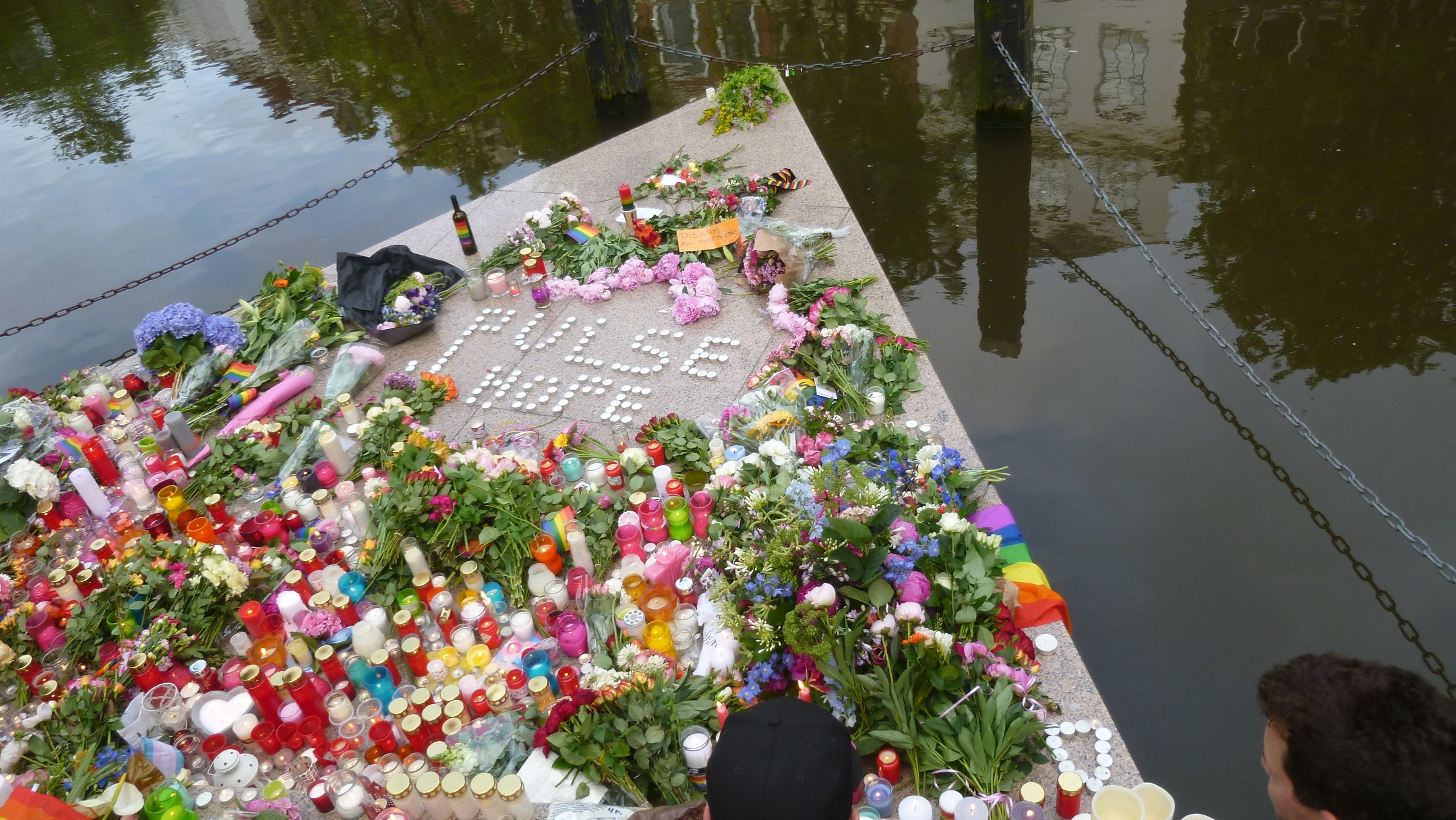
On 4 May each year, the Dutch flag is lowered at the Homomonument and the two minutes of silence are kept. People lay flowers on the triangle that points into the canal. On 5 May, Liberation Day, the place becomes a street party; on King's Day, drag queens take the stage on the same granite platform. Pink Point, a small kiosk beside the canal, sells books and information about queer Amsterdam. When the Orlando nightclub was attacked in June 2016, Amsterdammers laid candles and photographs along the triangles for weeks. In 2002 the city renamed the small bridge just north of the monument after Niek Engelschman, a wartime resistance fighter and long-time leader of the COC. After Karin Daan's monument opened, Barcelona commissioned its own memorial in 2011 and patterned it closely on hers. The triangle that was once a mark of shame had become something the camps' designers could not have imagined: an address.
Westermarkt
The setting matters. The Westerkerk, the tall church beside the monument, is the church Rembrandt was buried near and the bells Anne Frank wrote about hearing from the attic that is now a museum a short walk away. Stand on the canal-side triangle and you can see the church tower and the Anne Frank House from the same spot. The geography is the argument. The people who built the Homomonument insisted, against three decades of polite refusal, that the dead they were grieving had been part of the same Holocaust as the people Amsterdam already knew how to mourn. They were right. The pavement remembers it now. Visitors arrive from every continent. They sit on the steps. They take pictures. Sometimes they cry, and they don't always know exactly why.
From the Air
The Homomonument sits at 52.3744°N, 4.8847°E on the Westermarkt in central Amsterdam, on the embankment of the Keizersgracht canal, immediately beside the Westerkerk and a short walk from the Anne Frank House. Best viewed at low altitude in clear weather. Nearest airport is Amsterdam Schiphol (EHAM), about 13 km southwest.