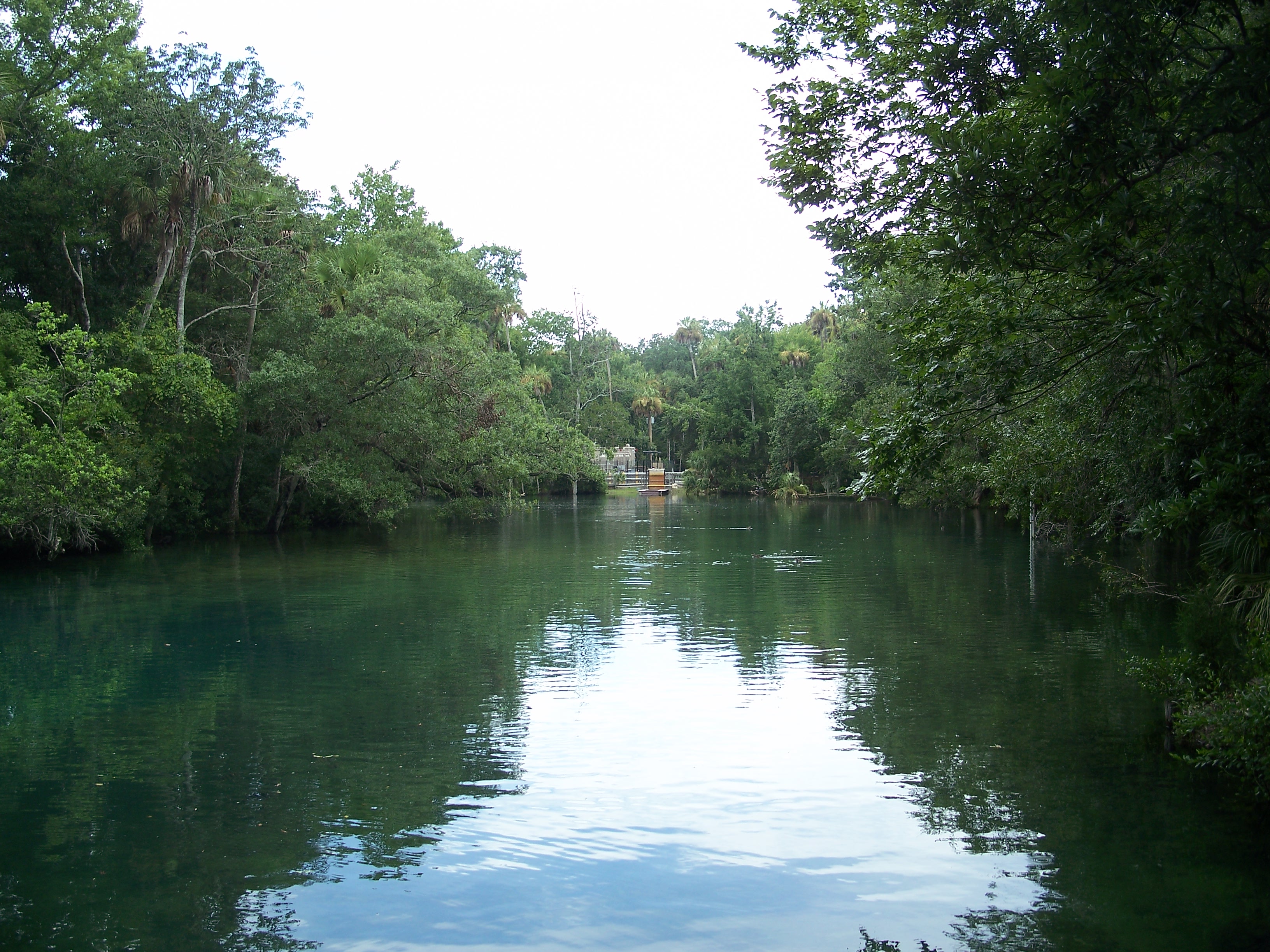
Homosassa Springs Wildlife State Park
For more than sixty years, a hippopotamus named Lucifer held court in a corner of Florida that most tourists never find. Lu arrived at Homosassa Springs in 1964 as a young Hollywood performer, fresh off appearances in the television shows Daktari and Cowboy in Africa. He never left. By the time Governor Lawton Chiles declared him an honorary citizen of the state in the 1990s, Lu had become something far rarer than a celebrity animal. He was the reason people drove an hour north of Tampa, past the strip malls and billboards, into the quiet tangle of Citrus County's spring-fed rivers.
Water from the Deep
The springs at Homosassa pump roughly 65 million gallons of water daily from the Floridan Aquifer, maintaining a constant 72 degrees year-round. That steady warmth is what draws West Indian manatees here each winter, sometimes dozens at a time, drifting into the spring run from the Gulf of Mexico like enormous gray ghosts. A floating underwater observatory lets visitors descend below the surface and watch these animals at eye level through thick glass panels, an experience that feels less like a zoo exhibit and more like being invited into someone else's living room. The clarity of the water is remarkable. You can count the scars on a manatee's back from boat strikes, each one a reminder of the uneasy coexistence between Florida's marine life and its boating culture.
Layers Beneath the Surface
Native Americans lived along these springs long before European contact. The Seminole and Miccosukee peoples resettled the area after the original inhabitants were devastated by disease and colonial warfare. By the early 1900s, the springs had already become a tourist attraction, with a railroad running along what is now Fishbowl Drive depositing passengers for a short walk to the water's edge. The park changed hands multiple times through the twentieth century, cycling through private ownership until the Citrus County Commission purchased the land in the 1980s as an environmentally sensitive area, holding it until Florida could formally designate it a state park. That patchwork history of conservation and commerce defines the place. Homosassa Springs is not wilderness. It is something more complicated: a natural wonder that humans have been visiting, managing, and arguing over for more than a century.
Lu's Long Goodbye
Born at the San Diego Zoo on January 26, 1960, Lu came to Homosassa as part of the Ivan Tors Animal Actors troupe. When Florida's state parks began phasing out non-native species from their wildlife exhibits, officials made an exception for Lu. He had lived at the springs for so long that removing him seemed cruel. So he stayed, growing old in a place that suited him, becoming the oldest hippopotamus in North America. Visitors who returned year after year watched him slow down, his massive body settling deeper into the water. On June 8, 2025, Lu died at the age of 65. The park mourned him publicly, and strangers who had never met the animal left flowers at the entrance. His absence left a silence in the park that the manatees and otters and alligators could not quite fill.
A Living Refuge
Today the park, officially named the Ellie Schiller Homosassa Springs Wildlife State Park in honor of benefactor Elmyra Felburn Schiller, focuses on native Florida species. Black bears pace behind enclosures. Bobcats watch from elevated platforms with unblinking yellow eyes. River otters tumble through pools with the frantic energy of children at recess. American alligators sun themselves on concrete banks, barely distinguishable from logs until they move. The park functions as both a wildlife rehabilitation center and a public window into what Florida looked like before the highways and housing developments arrived. It is not pristine, but it is honest about what it is: a managed space where people can encounter wild animals that are increasingly squeezed out of the landscape they once dominated.
From the Air
Located at 28.80N, 82.59W on Florida's Nature Coast in Citrus County. The spring run is visible from low altitude as a bright turquoise thread winding through dense green vegetation. Nearest airports include Crystal River Airport (KCGC) approximately 8nm north and Brooksville-Tampa Bay Regional Airport (KBKV) roughly 20nm southeast. Best viewed at 1,500-2,000 feet AGL on a clear day. The Homosassa River leading to the Gulf of Mexico provides a clear navigation reference.