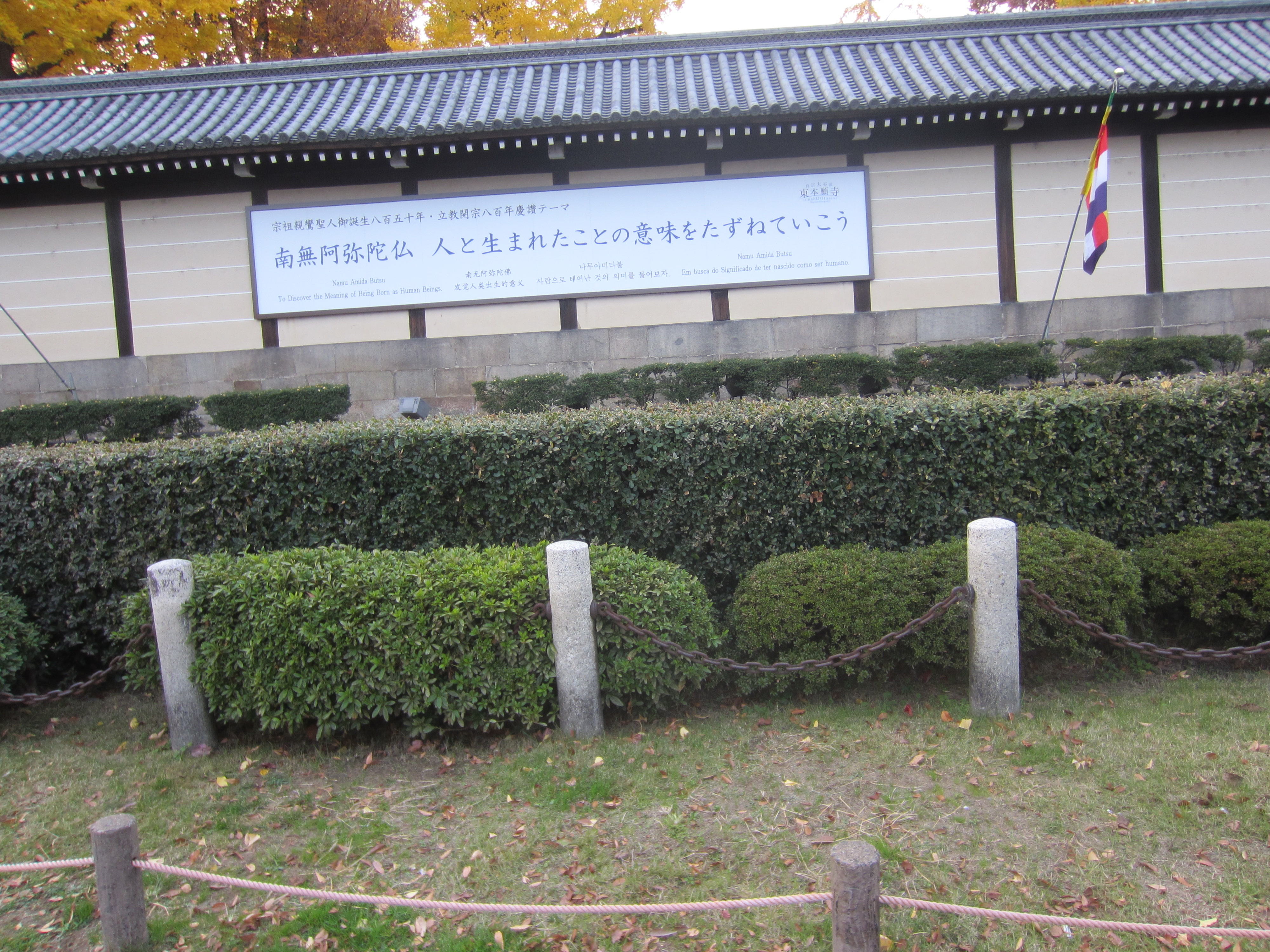
Hongan-ji
Step off the train at Kyoto Station, look north, and the first structure to command the skyline is not a pagoda or a Shinto gate but the massive Goei-do of Higashi Hongan-ji, its roofline stretching 103 feet wide and rising 90 feet above the pavement. A few blocks west stands its mirror twin, Nishi Hongan-ji, equally immense but distinguished by what it shelters inside: the oldest surviving Noh stage in Japan, a shimmering tea pavilion called Hiunkaku, and a storehouse packed with National Treasures the public rarely sees. These are not rival temples that happened to spring up near each other. They are two halves of a single institution, split apart by the ambitions of shoguns and the stubbornness of an abbot's disowned son -- a fracture that has lasted over four centuries and shows no sign of healing.
A Mausoleum Becomes a Movement
The story begins not with a temple but with a grave. In 1321, followers established Hongan-ji on the site of Higashi Otani, the mausoleum where Shinran, founder of Jodo Shinshu Pure Land Buddhism, was buried. Shinran's grandson Kakue tended the site; Kakue's son Kakunyo became the first chief priest and dedicated the temple to the worship of Amitabha. For generations it remained a modest institution. Then Rennyo became the eighth monshu -- spiritual leader -- in the 15th century, and Hongan-ji exploded in both size and influence. The Tendai monks of Mount Hiei, alarmed at this expansion, attacked three times with armies of sohei, warrior monks. Rennyo fled north to Yoshizaki-gobo and built a new compound, but the message was clear: Hongan-ji had grown powerful enough to threaten the established Buddhist order.
The Fortress That Defied Nobunaga
During the Sengoku period, Hongan-ji's armed leagues -- the ikko-ikki -- controlled temple-fortresses that doubled as military strongholds. Oda Nobunaga, the warlord closest to unifying Japan, saw them as the last obstacle to his dominance. In 1570, he laid siege to Ishiyama Hongan-ji in Osaka, one of the sect's two great fortresses. The siege ground on for ten brutal years. When Abbot Kosa finally surrendered in 1580, the fortress burned to the ground. His son Kyonyo refused to yield and was publicly disowned for his defiance. Three years later, Osaka Castle rose on the charred ruins of Ishiyama -- as if Nobunaga's successor, Toyotomi Hideyoshi, wanted to plant his power directly on the ashes of the old resistance.
One Temple Becomes Two
After Nobunaga's death in 1582, Hideyoshi rewarded the cooperative Kosa with land in Kyoto, where Nishi Hongan-ji now stands. Meanwhile, the disowned Kyonyo rebuilt a Hongan-ji site in Osaka in 1596, drawing support from followers who admired his refusal to surrender. When Tokugawa Ieyasu became shogun in 1602, Kyonyo backed the winning side and was rewarded with land east of the Nishi temple. By 1603, Higashi Hongan-ji -- the Eastern Temple -- had its own compound, its own congregation, and its own lineage of leaders. In 1619, the government formally recognized the two as separate entities. A popular theory holds that the shogunate deliberately split the institution to weaken it, but historians consider this a myth. The real cause was a family feud between a father who surrendered and a son who would not.
Twin Giants of Kyoto
Today the twin temples anchor a vast religious community. Nishi Hongan-ji, formally the Jodo-Shinshu Honganji-ha, claims the larger global footprint, with affiliated temples in the United States, South America, Hawaii, Canada, and Europe -- the Buddhist Churches of America being the largest overseas district. It also holds architectural treasures: four Noh stages, one believed to be the oldest surviving example; the Hiunkaku tea pavilion; and the Kokei no Niwa garden. Higashi Hongan-ji, home to the Otani-ha branch with approximately 5.5 million members, counters with intellectual firepower, having produced influential thinkers like Kiyozawa Manshi and Soga Ryojin. Its Mie-do hall, rebuilt in 1895, competes for the title of largest wooden building in the world. A few blocks away, the Shosei-en garden -- designed in part by poet-scholar Ishikawa Jozan in the 17th century -- offers one of Kyoto's most serene retreats.
Faith Without Borders
What began at a graveside seven centuries ago now spans continents. The Hongwanji International Center, east of the Nishi temple, coordinates dialogue among Jodo Shinshu organizations worldwide, while the Hongwanji Publishing Company produces books, films, and even anime explaining Pure Land Buddhism. In recent years, members from both branches have joined protests against political visits to the controversial Yasukuni Shrine, and in 2003 both issued a joint statement opposing the invasion of Iraq. It is a reminder that Hongan-ji has never been merely a place of quiet contemplation. From its earliest days, when warrior monks stormed its gates and a warlord tried to burn it from existence, this institution has been tangled in the affairs of state -- sometimes resisting power, sometimes aligning with it, but always enduring.
From the Air
Located at 34.991N, 135.751E in central Kyoto, Japan. Both Nishi and Higashi Hongan-ji are visible from low altitude as massive dark-roofed complexes just north of Kyoto Station. The twin temple compounds are separated by roughly 500 meters. Nearest airport: Osaka Itami (RJOO) approximately 20nm southwest, or Kansai International (RJBB) approximately 45nm south. Kyoto sits in a basin surrounded by mountains on three sides, so expect terrain in all directions except south. Best viewed on approach from the south following the rail corridor into the city.