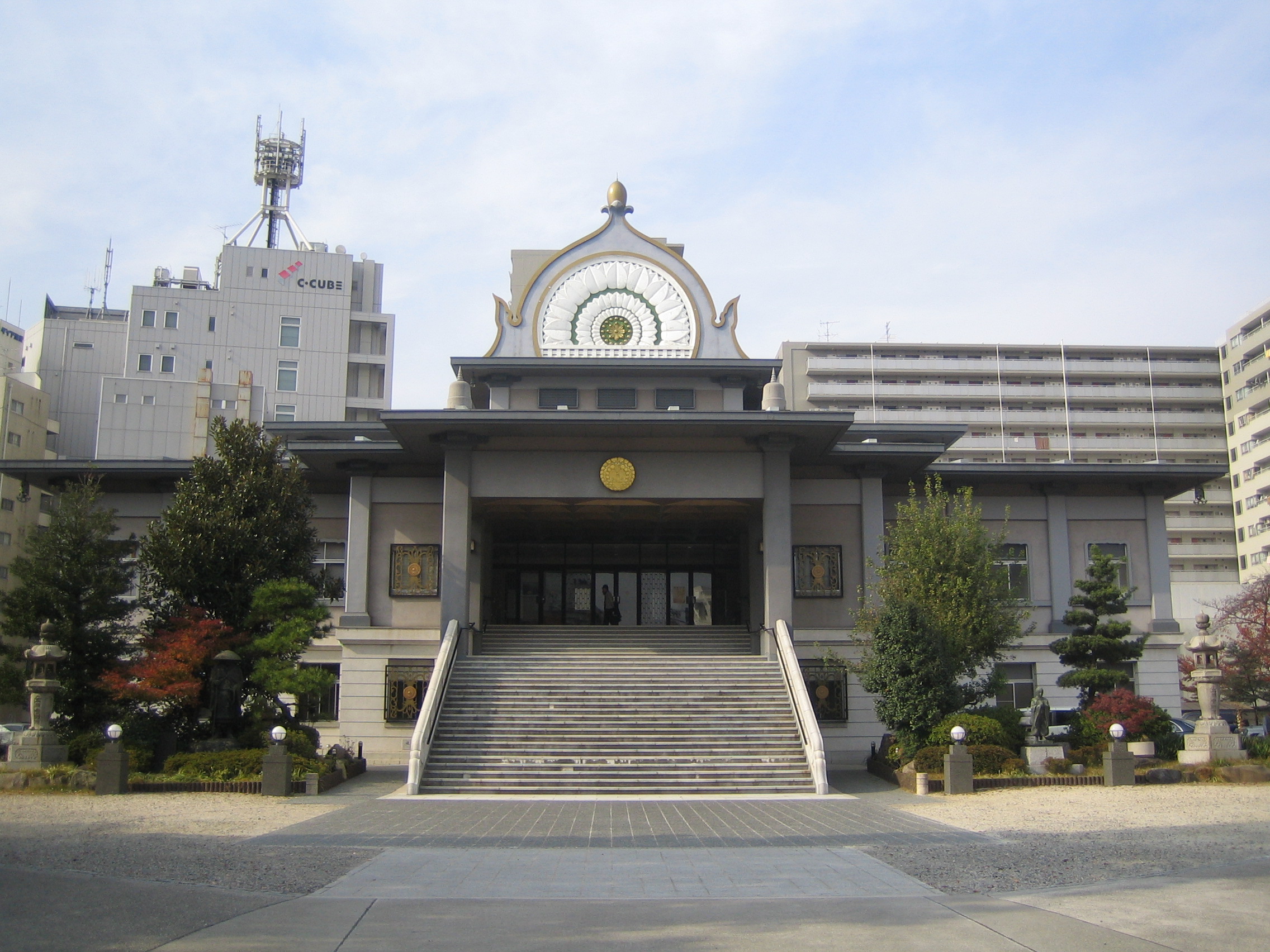
Hongan-ji Nagoya Betsuin: The Temple Where Hokusai Painted a Giant
On October 5, 1817, the legendary ukiyo-e master Hokusai stood before a sheet of paper measuring 18 by 10.8 metres -- roughly the footprint of a modest house -- spread across the grounds of Hongan-ji Nagoya Betsuin. With the help of his disciples and a crowd of astonished onlookers, he painted a colossal image of Daruma, the founder of Zen Buddhism, earning himself the nickname "Darusen" -- short for Daruma Sensei. The painting was a sensation. Two centuries later, the original is gone, destroyed in the same firebombing that leveled most of Nagoya in 1945. But the temple that hosted Hokusai's spectacle still stands in Naka ward, rebuilt in an architectural style nobody in 1500 could have predicted, sheltering a wooden bell tower that somehow survived the war and a history that stretches back to the final years of medieval Japan.
From Cedar Groves to Castle Town
Hongan-ji Nagoya Betsuin traces its origins to around 1500 CE, when Renjun, the thirteenth child of the chief abbot Rennyo, built Gansho-ji temple amid the Japanese cedar groves of Ise Province. The temple belonged to the Jodo Shinshu school of Buddhism, a Pure Land tradition founded by Shinran in the thirteenth century that emphasized faith over ritual and became one of the most widely practiced forms of Buddhism in Japan. Gansho-ji fell on hard times over the decades, was renovated, and eventually relocated to its current site in central Nagoya during the early Edo period, when Tokugawa Ieyasu ordered the construction of Nagoya Castle and the surrounding castle town took shape. The temple found a powerful patron in Baisho-in, concubine of Tokugawa Tsunanari, lord of the Owari Domain from 1652 to 1699. Her support helped establish the temple as a significant presence in the city's religious life.
The Day Hokusai Painted a Colossus
Hokusai was fifty-seven years old in 1817, already famous, restless, and perpetually in search of new challenges. His visit to Hongan-ji Nagoya Betsuin produced one of the most extraordinary artistic performances in Japanese history. The Great Daruma painting required a sheet of paper so enormous it had to be laid flat on the ground. Hokusai directed his disciples as they helped manipulate brushes and ink across the vast surface, completing the image before a crowd of impressed spectators. The feat earned him the honorific "Darusen." Though the original painting was destroyed in the 1945 bombings, promotional handbills from the 1817 event survived and are preserved at the Nagoya City Museum. On November 23, 2017, the temple hosted a public recreation of the painting to mark the two-hundredth anniversary, using the same dimensions, techniques, and materials as the original. A prayer ceremony followed to bless the reproduction.
Fire, Ruin, and an Indian Rebirth
In May 1945, American firebombing raids devastated Nagoya, and Hongan-ji Nagoya Betsuin was not spared. The wooden main hall and its accumulated artwork were largely destroyed. When the time came to rebuild, the temple's architects made a striking choice: rather than replicate the traditional Japanese wooden structure, they designed the new main hall in the style of ancient Indian Mauryan Dynasty architecture. The result is a building that looks nothing like a conventional Buddhist temple in Japan -- a deliberate echo of Buddhism's origins on the Indian subcontinent. The choice mirrors that of Tsukiji Hongan-ji in Tokyo, another Honganji branch temple rebuilt with Indian-inspired architecture after disaster. Meanwhile, just south of the temple, a medical training center had been established in 1874 that would eventually evolve into Nagoya University's School of Medicine, later relocated to Tennozaki on the banks of the Hori River. The temple's neighborhood has always been a place where institutions put down roots.
The Bell Tower That Endured
While the firebombing destroyed the main hall, the temple's wooden bell tower -- its shoro -- survived the war undamaged. Said to have been donated by Baisho-in in 1729, during the Kyoho era, the tower is an unusual example of its form: the bell hangs from the lower level rather than the upper, departing from the typical Japanese bell tower design. The carved sculptures adorning the structure are considered high quality, and in 2017, the tower was designated a City Cultural Property. Today the shoro stands as the oldest surviving structure on the temple grounds, a physical bridge across centuries of upheaval. On the grounds nearby, a bronze statue of Shinran, founder of Jodo Shinshu, commemorates the religious tradition that has sustained this place through five hundred years of relocation, patronage, spectacle, destruction, and reinvention. The temple also serves a practical modern purpose: its ground floor houses the ashes of deceased persons in metal urns, with monks available to perform prayer services for families by request.
From the Air
Located at 35.157°N, 136.900°E in Naka ward, central Nagoya, south of Osu Kannon Station. The temple grounds are situated in a dense urban area and are best identified from low altitude by the distinctive Indian-style main hall architecture, which differs markedly from surrounding Japanese structures. Chubu Centrair International Airport (RJGG) lies approximately 25 nautical miles to the south. Nagoya Airfield / Komaki (RJNA) is about 8 nautical miles north-northwest. The nearby Nagoya Castle grounds provide a useful visual reference point to the north.