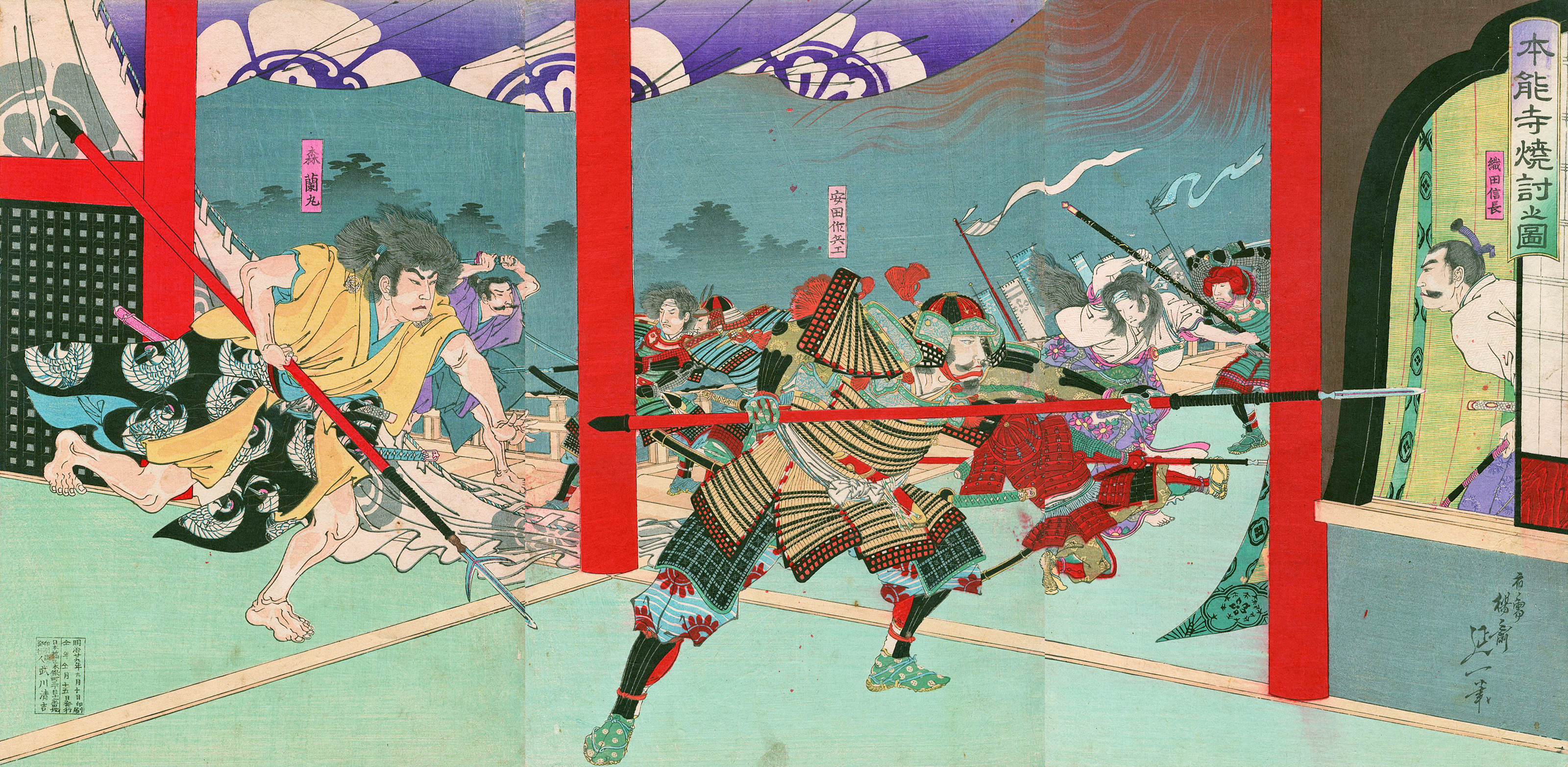
Honnō-ji Incident
Nobody knows why Akechi Mitsuhide did it. More than fifty theories have been proposed over four and a half centuries, and scholars still argue. What is known is this: before dawn on June 21, 1582, thirteen thousand soldiers surrounded Honno-ji, a modest Buddhist temple in Kyoto where Oda Nobunaga -- the most powerful warlord in Japan, on the brink of unifying the entire country -- slept with fewer than a hundred guards and attendants. By the time the sun cleared the eastern mountains, Nobunaga was dead by his own hand, the temple was in flames, and the entire trajectory of Japanese history had shifted. The spot where this happened, in central Kyoto near the intersection of Teramachi and Oike streets, is marked by a small stone monument that gives no hint of the earthquake it caused.
A Nation Almost Unified
By the spring of 1582, Nobunaga had crushed nearly every rival standing between him and total control of Japan. He had destroyed the Takeda clan at the Battle of Tenmokuzan. The Mori clan, his strongest remaining opponent in the west, was offering to surrender five provinces to his general Hashiba Hideyoshi. The Uesugi clan in the north had been crippled by the death of Uesugi Kenshin and an internal succession war. The decade-long Ishiyama Hongan-ji War against the armed Buddhist leagues had ended in Nobunaga's favor. With supreme confidence, he dispatched his generals in every direction: Hideyoshi west to finish the Mori, Shibata Katsuie north into Echigo, Niwa Nagahide south toward Shikoku, Takigawa Kazumasu east to watch the Hojo. Nobunaga himself, with only a small retinue, traveled to Kyoto. He had deliberately avoided building a castle in the capital to maintain distance from the Imperial Court. Instead, he lodged at Honno-ji.
Thirteen Thousand Against Thirty
Akechi Mitsuhide was supposed to be marching west to reinforce Hideyoshi's campaign against the Mori. Instead, he turned his army toward Kyoto. According to the Jesuit missionary Luis Frois, who was in Kyoto at the time and later recorded testimonies from surviving soldiers, Mitsuhide revealed his true purpose only to his officers. The rank-and-file troops had no idea whom they were about to attack; some believed they were targeting Tokugawa Ieyasu. When the assault came, Nobunaga fought with a spear until it snapped, then retreated into the burning temple. According to Gyuichi Ota, author of the Shincho Koki, who interviewed ladies-in-waiting who were present, Nobunaga entered a back room, closed the door, and committed seppuku as the building collapsed around him. His body was never found.
A Corpse That Vanished
The disappearance of Nobunaga's remains became an obsession for his successors. When Hideyoshi held a formal funeral at Daitoku-ji Temple in Kyoto in October 1582, he had no body to cremate. Instead, he commissioned a life-size wooden statue of Nobunaga, burned it on the pyre, and placed the ashes in an urn as a substitute. The gesture was as much political theater as mourning: by staging the funeral, Hideyoshi positioned himself as Nobunaga's legitimate heir. At the Kiyosu Conference that followed, four of Nobunaga's chief vassals -- Shibata Katsuie, Niwa Nagahide, Ikeda Tsuneoki, and Hideyoshi -- debated the succession. Three candidates emerged: Nobunaga's second son Nobukatsu, his third son Nobutaka, and his three-year-old grandson Hidenobu. Hideyoshi championed the infant, knowing a child ruler would leave real power in his own hands.
Thirteen Days to Yamazaki
Mitsuhide's reign as master of Kyoto lasted less than two weeks. Hideyoshi, upon learning of the betrayal, negotiated a hasty ceasefire with the Mori clan and force-marched his army back east in what became legendary as the Chugoku Ogaeshi -- a sprint so fast that only his cavalry kept pace, while infantry straggled behind. On July 2, 1582, just thirteen days after the incident, Hideyoshi's forces crushed Mitsuhide at the Battle of Yamazaki. Mitsuhide fled and was killed by bandits -- or local farmers, depending on the account. Meanwhile, Tokugawa Ieyasu, who had been visiting Sakai when the news broke, made a desperate overland dash back to his home province of Mikawa. His escape route took him through territory crawling with ochimusha-gari, outlaw bands who hunted fleeing soldiers. Friendly Koka and Iga clans escorted Ieyasu to safety, though his party suffered some 200 casualties along the way.
A Mystery With Fifty Answers
Why did Mitsuhide betray Nobunaga? The question has generated a cottage industry of theories. Some point to personal grudges: forced transfers of territory, public humiliation, the alleged execution of Mitsuhide's mother. Historian Tetsuo Owada has dismissed most grudge theories as embellishments from unreliable later sources. A handwritten letter from Mitsuhide discovered in modern times suggests he planned to restore the Muromachi Shogunate by welcoming the exiled Shogun Ashikaga Yoshiaki back to Kyoto. Others suspect a conspiracy involving the Imperial Court, Hideyoshi, or even Ieyasu. In 2020, NHK convened seven historians for a televised debate; the theory that garnered the most support was the Shikoku theory -- that Mitsuhide acted to prevent Nobunaga's planned invasion of Shikoku, which would have destroyed Mitsuhide's diplomatic ties with the Chosokabe clan there. Four centuries on, the burned-out temple still guards its secret.
From the Air
Located at 35.006N, 135.754E in central Kyoto, Japan. The modern Honno-ji temple (rebuilt after the fire) sits near the intersection of Teramachi and Oike streets in Kyoto's downtown grid. The original site was slightly to the southwest. From the air, central Kyoto's grid pattern is clearly visible. Nearest airports: Osaka Itami (RJOO) approximately 20nm southwest, Kansai International (RJBB) approximately 45nm south. Kyoto occupies a basin surrounded by mountains on three sides; expect rising terrain to the north, east, and west. The temple is not individually distinguishable at altitude, but Nijo Castle, the Imperial Palace grounds, and the Kamo River provide useful landmarks for orientation.