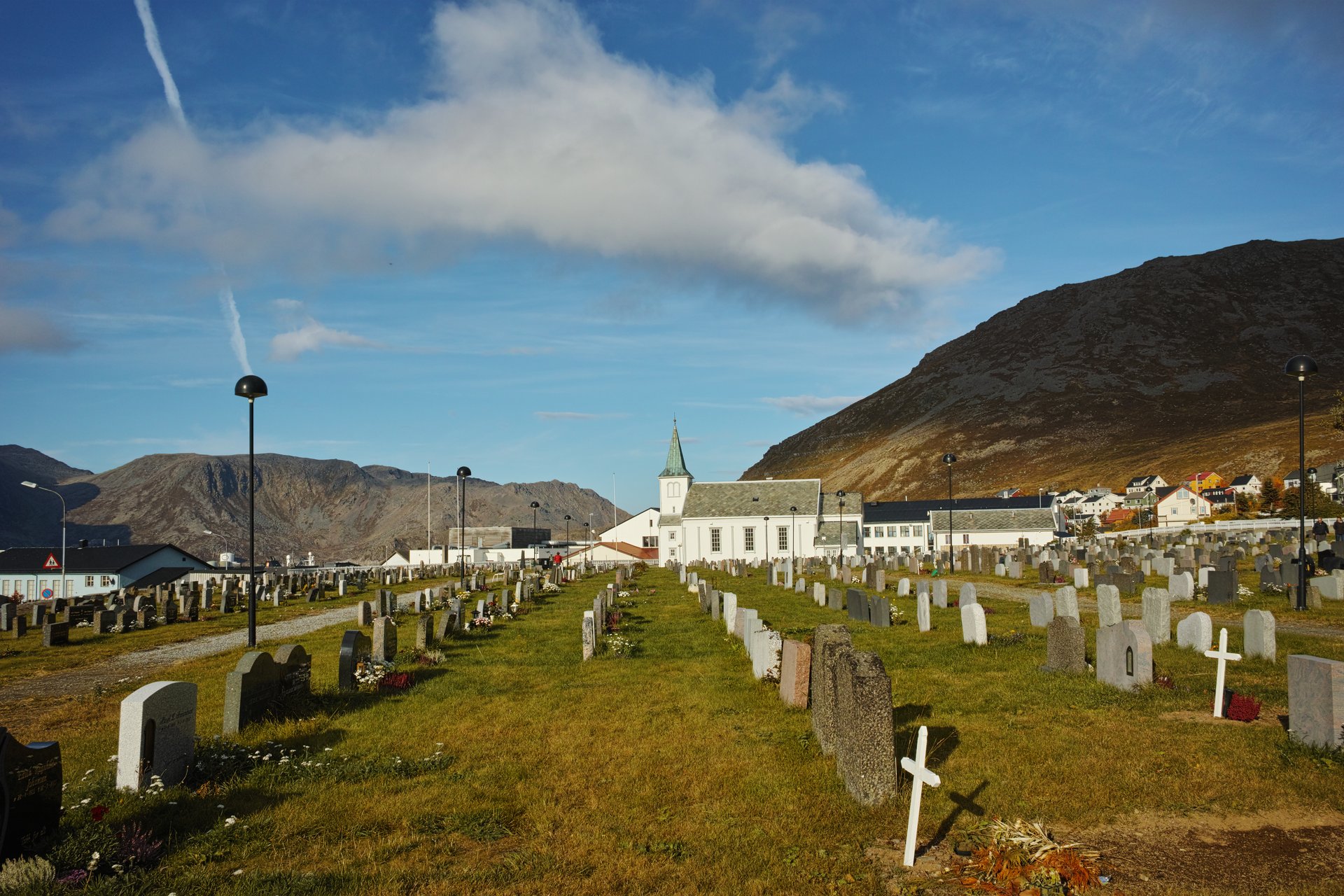
Honningsvag Church
When the German army retreated from Finnmark in the autumn of 1944, they burned everything. Homes, schools, warehouses, fishing sheds -- nearly every structure in Norway's northernmost county was reduced to ash and rubble under a scorched-earth policy meant to deny the advancing Soviets any usable infrastructure. In the small harbor town of Honningsvag, on the island of Mageroya near the North Cape, nearly every building was destroyed. But the white wooden church, with its neo-Gothic windows and modest steeple, stood intact amid the ruins. The local German officer in charge had enjoyed playing the church organ during his posting, and made certain it was spared. But in the desperate winter that followed, Honningsvag Church became something its architect Jacob Wilhelm Nordan could never have anticipated when he drew its plans in 1885: a home for an entire town.
Churches That Came Before
The story of worship on Mageroya reaches back centuries before the current church. Historical records from 1556 mention a church in the village of Kjelvik, about five kilometers north of the present site, though the building was already old by then. That early church was a timber-framed structure with a small tower on its roof -- modest shelter against winds that blow off the Barents Sea with a ferocity that makes architecture a matter of survival, not aesthetics. A new entry porch was added in 1704. By the late 1730s, the whole building required heavy repair and reconstruction. In 1810, the British Navy blockaded the area during the Napoleonic Wars, and fighting damaged the church significantly. It was rebuilt with an octagonal design, a resilient shape better suited to resisting the horizontal gales. But in the winter of 1882, a hurricane destroyed it entirely.
A New Site, a New Beginning
After the 1882 hurricane, the community made a practical decision: rather than rebuild in increasingly depopulated Kjelvik, they would place the replacement church in Honningsvag, which was more accessible and closer to the municipality's shifting population center. A local man named Karesius Lokke donated the land. Architect Jacob Wilhelm Nordan designed a neo-Gothic long church in white-painted wood, seating about 220 people. On 22 October 1885, the Reverend Mr. Balke, a priest who had traveled from Karasjok Church far to the south, consecrated the new building. It stood at the eastern end of Mageroya, facing the harbor where fishing boats came and went with the seasons, a beacon of white timber against the gray Arctic landscape.
Sole Survivor
Honningsvag Church is one of only a handful of churches in all of Finnmark county that was not destroyed during the German retreat at the end of World War II. As Wehrmacht forces withdrew before the Soviet advance in late 1944, they systematically burned the towns and villages of Finnmark and northern Troms, forcibly evacuating the civilian population. The destruction was so thorough that nearly 11,000 buildings were torched across the region. In Honningsvag, the church and the town morgue were the only structures the Germans left standing. After liberation, the surviving population -- those who had hidden in caves and fishing huts to avoid forced evacuation, and those who gradually returned -- sheltered inside the church while the town around it was slowly rebuilt. The building that had been designed for Sunday services became a communal living space: sleeping quarters, meeting hall, and the one intact roof in a landscape of ashes.
Worship at the Edge of the World
Today Honningsvag Church serves as a parish church of the Church of Norway within the Hammerfest deanery and the Diocese of Nord-Halogaland. It sits in a town that rebuilt itself around it -- a small harbor community at latitude 70.98 degrees north, where the sun does not set for weeks in summer and does not rise for weeks in winter. The church remains white, its neo-Gothic pointed windows still facing the harbor. Its cemetery, with headstones weathered by Arctic wind, slopes toward the water. For the cruise passengers who arrive via the Hurtigruten coastal steamer or the ships that call at Honningsvag en route to the North Cape, the church is a quiet landmark easily overlooked. But for the people of Nordkapp Municipality, it carries a weight that no visitor center or souvenir shop can match: the memory of being one of the only things left standing.
From the Air
Coordinates: 70.978°N, 25.979°E on the island of Mageroya in northern Norway. The white church is visible from low altitude on the eastern shore of Honningsvag harbor. Nearest airport: Honningsvag Valan Airport (ENHV). From cruising altitude, Mageroya is a distinctive island connected to the mainland by the North Cape Tunnel. The church sits in the cluster of buildings along the harbor's eastern waterfront. The North Cape plateau is approximately 33 km to the northwest.