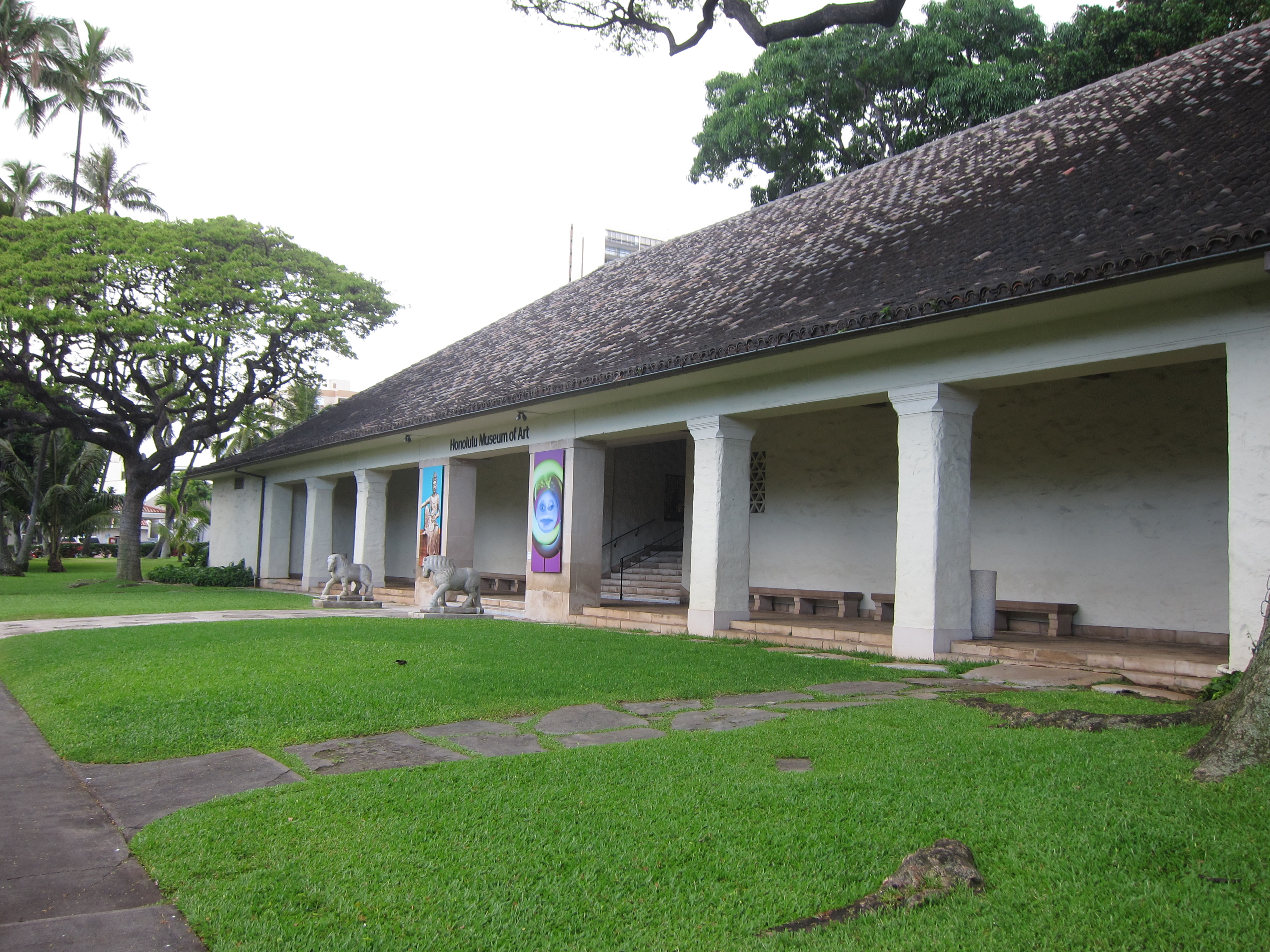
Honolulu Museum of Art
Anna Rice Cooke grew up in a missionary household on Maui, surrounded by the collision of cultures that defined nineteenth-century Hawaii. Chinese plantation workers, Japanese immigrants, Native Hawaiians, Portuguese laborers, American merchants -- each brought artistic traditions that the others rarely saw. Cooke believed that if people could stand together before a beautiful object, the differences between them might shrink. In 1922, she founded what would become the Honolulu Museum of Art, and when the doors opened on April 8, 1927, her vision took physical form: an open-courtyard building designed by Bertram Goodhue's firm, where galleries of Asian silk paintings opened onto gardens, and European Renaissance panels hung steps away from Pacific Island carvings.
Crossroads in a Courtyard
The museum's permanent collection has grown to more than 55,000 works, and its strengths reflect Hawaii's position as a crossroads of the Pacific. The Asian holdings alone exceed 20,000 pieces, with dedicated galleries for Japanese, Chinese, Korean, Indian, Southeast Asian, Indonesian, and Filipino art. The crown jewel is the James A. Michener Collection of more than 10,000 Japanese ukiyo-e woodblock prints, the third-largest collection of its kind in the United States. Western art is anchored by the Samuel H. Kress Collection of Italian Renaissance paintings, along with works by Modigliani, Picasso, Gauguin, and van Gogh. The building itself -- with its tiled roofs, interior courtyards, and open-air walkways -- feels less like a fortress of culture and more like a garden that happens to contain masterpieces.
A Collector's Island
Several major private collections shaped the museum's identity. Robert Allerton, who maintained a lavish estate on Kauai, donated significant works. The Charles M. and Anna C. Cooke Gallery anchors the Western painting collection. In 2011, The Contemporary Museum -- Honolulu's dedicated modern art institution housed at the former Spalding Estate in Makiki Heights -- gifted its entire collection and assets to the museum, and in 2012 the combined institution changed its name from the Honolulu Academy of Arts to the Honolulu Museum of Art. That merger brought contemporary works by David Hockney, Jasper Johns, Robert Rauschenberg, and Yoko Ono under the same roof as Kamakura-period Buddhist sculpture and Mughal miniatures.
Where the Light Gets In
J. Carter Brown, who directed the National Gallery of Art in Washington from 1969 to 1992, called it "the finest small museum in the United States." The compliment captures something essential. The Honolulu Museum of Art is not trying to be encyclopedic in the way that the Met or the Louvre attempts. Instead, it curates with a Pacific sensibility -- emphasizing the connections between cultures rather than cataloguing them separately. Textile galleries display kapa cloth alongside Japanese kimono. A corridor of Chinese scholar's rocks leads to a courtyard where plumeria trees drop blossoms on a stone path. The museum also operates an independent art house cinema, an art school opened in 1990, and the Doris Duke Theatre. In 2001, the Henry R. Luce Pavilion added 8,000 square feet of gallery space, a cafe, and a museum shop.
Doris Duke's Shangri La
Closely affiliated with the museum is Shangri La, the oceanfront estate built by American heiress Doris Duke beginning in 1937. Located at the base of Diamond Head, the house was designed as a living showcase for Islamic art and architecture, incorporating tile work, carved screens, and garden elements collected during Duke's travels through North Africa, the Middle East, and South Asia. Duke bequeathed the property to the museum's stewardship, and today visitors reach Shangri La by guided tour departing from the museum campus. The estate holds roughly 2,500 objects spanning the Islamic world, from Moroccan textiles to Syrian interiors -- a collection as eccentric and singular as the woman who assembled it.
From the Air
Located at 21.30N, 157.85W in the Makiki neighborhood of Honolulu, about 1 mile north of Waikiki. The museum's low-rise courtyard campus with tiled roofs is nestled among residential streets near Thomas Square. Best observed at 2,000-3,000 feet AGL. Nearby Shangri La (Doris Duke estate) is visible at the foot of Diamond Head to the SE. Nearest airport: PHNL (Honolulu International, 5 nm NW).