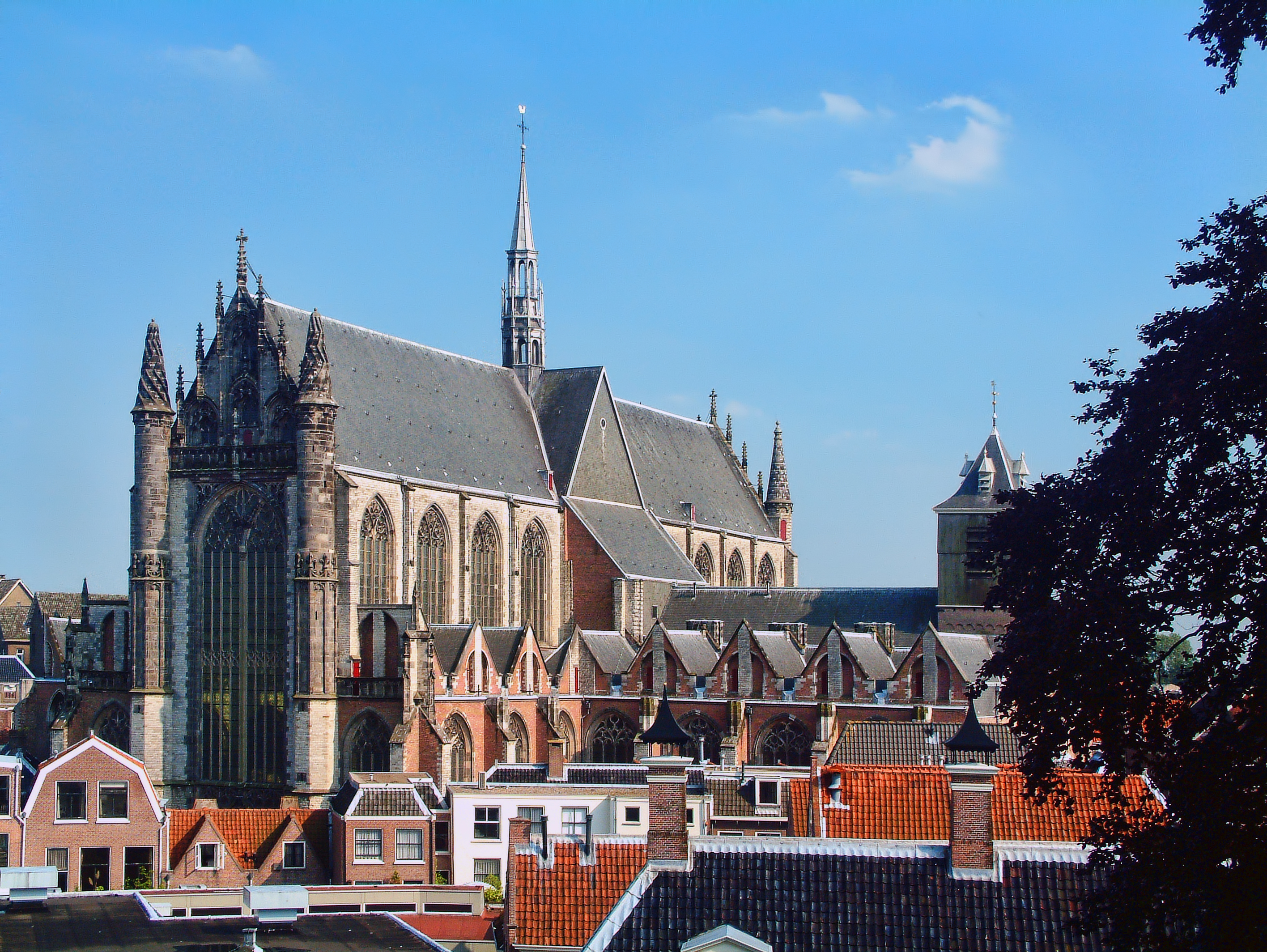
Hooglandse Kerk
The transept is longer than the nave - and the nave was never finished. Walk into the Hooglandse Kerk in Leiden and the proportions feel wrong, because they are. The medieval builders set out to construct a cross-shaped Gothic cathedral that would tower over the rival Pieterskerk across town. They built the transepts and the choir, soaring and Gothic at sixty-five meters across the longest Gothic transept in the Netherlands. Then the money and the ambition ran out. The stunted nave, dwarfed by the choir it was meant to lead into, is a frozen monument to a city that aimed for the heavens and stopped halfway.
Permission Granted, 1314
The whole improbable story begins with a piece of paper. On 20 December 1314, the bishop of Utrecht, Gwijde of Avesnes, gave permission for a wooden chapel on a patch called the Hooge Land - the High Land - that rose just enough above Leiden's marshy ground to keep its feet dry. The chapel was dedicated to Saint Pancratius, a Roman teenager martyred under Diocletian, and consecrated nine months later. It was meant to be a humble annex to the parish church in nearby Leiderdorp. Nobody guessed that within a century and a half, the High Land would become the seat of a chapter church answerable directly to the Pope, decorated with twenty-four altars, and gunning for cathedral status.
The Cathedral That Wasn't
Around 1525, Leiden's clergy and city fathers began talking openly about elevating Saint Pancras to a bishop's seat. The plans were serious, the politics promising. Then the episcopal reorganization of 1559 came, and Haarlem got the bishopric instead. Within a decade, the Reformation arrived. In August 1566, iconoclasts spent two days plundering Leiden's churches; statues smashed, archives burned, frescoes scarred. A second wave in 1572 was uglier still, because troops loyal to the revolt against Spain participated in the violence against people, not just things. By July 1574, Saint Pancras held its first Protestant service - whitewashed walls, plain glass, no altars - and was renamed for the High Land it had always sat on. The cathedral dream was over. The building remained.
Bread, Not Bricks
During the Siege of Leiden in 1574, the Hooglandse Kerk did not echo with prayer. It echoed with the sound of grain being measured. Spanish forces had surrounded the city for months, and starvation was killing more citizens than musket balls. The church became a granary, its great Gothic spaces holding what little food remained between the city and surrender. The mayor, Pieter Adriaanszoon van der Werff, famously offered the starving crowd his own arm to eat rather than capitulate. He held out until 3 October, when the Dutch breached the dikes and the relief fleet sailed into the flooded fields with bread and herring. Van der Werff is buried inside the Hooglandse Kerk. The man who would not surrender lies under the floor of the church that fed his city.
The Explosion Next Door
On 12 January 1807, a gunpowder ship moored a few hundred meters away on the Steenschuur canal detonated, killing a hundred fifty-one people and destroying over two hundred buildings. The Hooglandse Kerk, towering over the same neighborhood, took the blast hard. Vaults cracked. Stained glass shattered. For decades afterward, the church limped along with deferred repairs and gradual decay, ringed by small houses that had been leaning against its walls since the 1590s. A serious renovation campaign began in 1839 and didn't finish until 1979. The wooden vaults in the choir and transept, restored in 1850, give the truest sense of what the medieval interior must have felt like - a high, pale, light-filled hall under the Dutch sky.
Still Open
The Ecumenical Leiden Students Ekklesia worships in the Hooglandse Kerk every Sunday. The space hosts concerts, conferences, and the occasional art installation that fills the unfinished nave with sound and color. Seen from above, the building's strange silhouette - tall Gothic at one end, modest at the other, a stubby wooden-clad bell tower rising over a tangle of small houses - tells the whole story without a guidebook. The cathedral that wasn't became something more durable: a church that absorbed iconoclasm, siege, explosion, and four hundred and fifty years of renovation, and is still standing on the Hooge Land.
From the Air
Hooglandse Kerk sits in Leiden's historic core at 52.158°N, 4.494°E, a few hundred meters north of the Rapenburg canal. The bell tower and tall Gothic transept stand well above the surrounding rooftops; from the air, the contrast between the soaring choir and the squat nave is the easiest way to identify it. Recommended viewing altitude is 1,500-3,000 ft AGL. Nearest airports: Rotterdam The Hague (EHRD) about 15 nm south, and Schiphol (EHAM) about 16 nm northeast. Local airspace below Schiphol's TMA - check NOTAMs and altitude restrictions before approaching.