Hoosac Tunnel
They called it "The Great Bore" -- and not as a compliment. Future Supreme Court Justice Oliver Wendell Holmes Jr. quipped that he would like to "wall up a dozen lawyers at one end of the tunnel and put a good fee at the other." Critics ridiculed the project for decades. But the workers who dug through the Hoosac Range in western Massachusetts, dying by the score from explosions and cave-ins, called it something else: the "Bloody Pit." Between 1851 and 1875, the Hoosac Tunnel consumed $21 million against an original estimate of $2 million, claimed 135 verified lives, and pioneered the use of nitroglycerin, pneumatic drills, and electric blasting caps in American construction. The American Society of Civil Engineers would later call it the "fountainhead of modern tunnel technology."
A Paper Mill Owner's Obsession
The tunnel began as a dream to connect Boston to Upstate New York without crossing the mountain barrier that gave the rival Western Railroad its monopoly on east-west traffic through Massachusetts. The idea first surfaced in 1819 as a canal through the Hoosac Range, then was reborn as part of the Troy and Greenfield Railroad. Its most persistent champion was Alvah Crocker, a self-made paper mill owner from Fitchburg who had already built the Fitchburg Railroad between Boston and his hometown. In 1848, Crocker secured a charter for the Troy and Greenfield with provisions for a tunnel through Hoosac Mountain. The word "Hoosac" itself comes from an Algonquian term meaning "place of stones" -- a name that would prove grimly prophetic. The Western Railroad, running a southern route through Springfield and Pittsfield under Chester W. Chapin, fought the tunnel at every turn, successfully lobbying to block state funding in 1861.
Into the Mountain
The first attempt at mechanized boring failed almost immediately. On March 16, 1853, Wilson's Patented Stone-Cutting Machine chewed into the rock face and broke down after cutting just a short distance. Workers resorted to hand digging. The project cycled through engineers: A.F. Edwards, then Herman Haupt, who managed to excavate about a fifth of the tunnel before the 1861 funding cutoff bankrupted him. Haupt left to become a Union Army railroad engineer during the Civil War. After the Troy and Greenfield Railroad defaulted in 1862, Massachusetts seized the project and sent engineer Charles Storrow to Europe to study modern tunneling techniques. He returned with knowledge of nitroglycerin and compressed air. Thomas Doane took over as chief engineer in 1863, introducing the Burleigh drilling machine -- one of the first pneumatic drills -- and overseeing the first large-scale commercial use of nitroglycerin and electric blasting caps in the United States.
The Bloody Pit
Construction killed or seriously injured 195 workers, with 135 verified deaths. Men died from explosions, falling rock, and accidents on ladders and scaffolding. In 1865, workers went on strike and burned buildings in protest of the conditions. The worst disaster came during the digging of the Central Shaft. An explosion set the hoisting mechanism on fire, and it collapsed into the shaft. Four men near the top escaped, but 13 workers far below were trapped by falling naphtha and iron debris. The pumps were destroyed and the shaft began filling with water. A worker named Mallory was lowered in by rope the next day but was overcome by fumes and reported no survivors. No further rescue was attempted. Months later, when crews finally reached the bottom, they found that several victims had survived the initial catastrophe long enough to build a raft before suffocating from the fumes.
Alignment by Sighting Towers
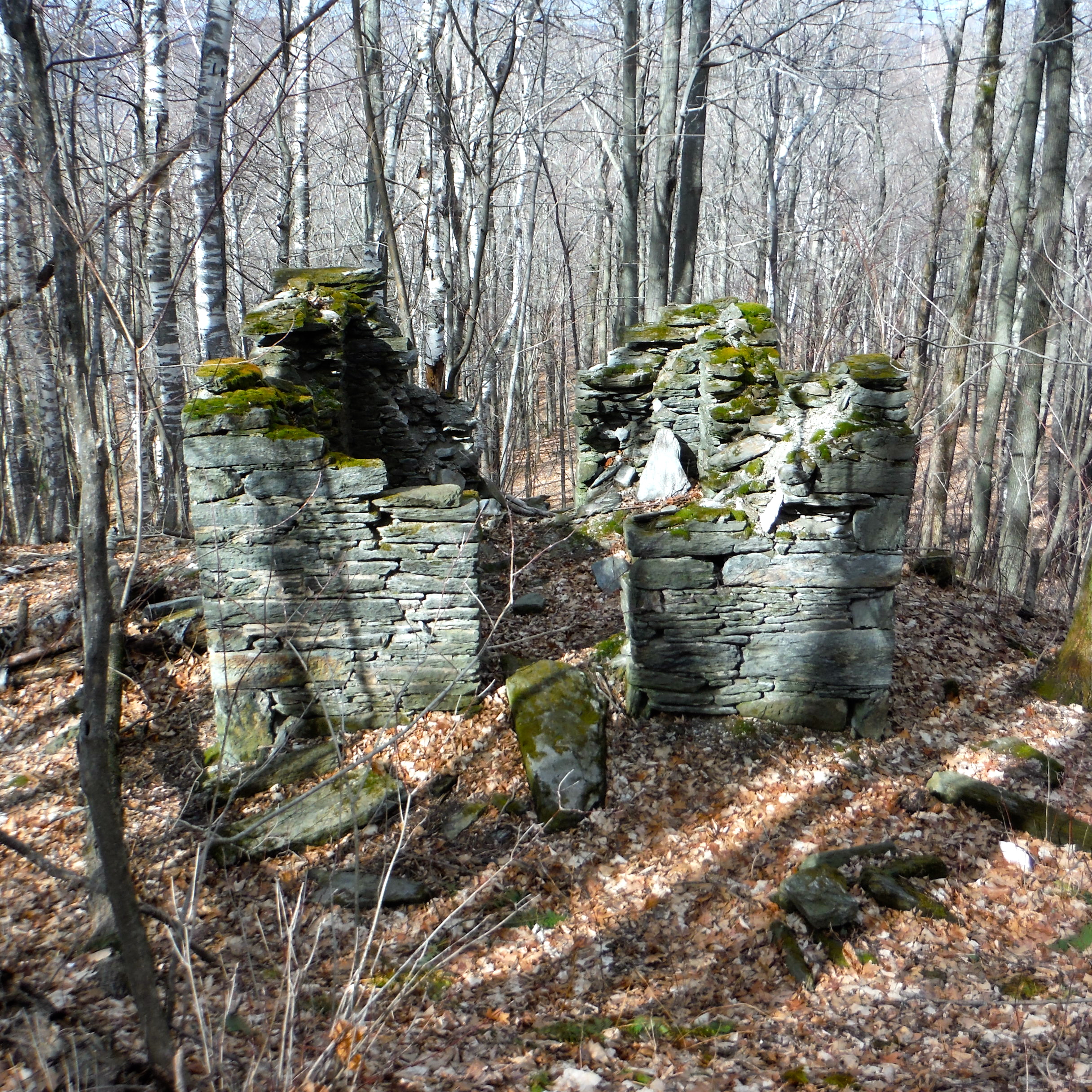
One of the greatest engineering challenges was aligning four separate tunnel segments being dug simultaneously: from the east portal, the west portal, and two headings outward from the Central Shaft. Engineers cleared a path through the forest over the mountain and strung a straight sighting line between the east and west portals using a series of stone alignment towers with transit scopes on their peaks. Thomas Doane constructed six of these towers to resurvey the route. On December 12, 1872, when the east portal tunnel broke through to the Central Shaft heading, the two bores were aligned within a fraction of an inch -- a remarkable achievement for the era. The west connection followed on November 27, 1873. The final engineer, Bernard N. Farren, completed the enlargement and reinforcement work. On Thanksgiving Day 1874, the last rock was removed beneath North Adams. The first train passed through on February 9, 1875. Four of the alignment towers still stand in ruins, hidden in the forest overgrowth on Hoosac Mountain.
Still Boring After All These Years
The tunnel remains the longest active transportation tunnel east of the Rocky Mountains. At its completion it was the second-longest tunnel in the world, after the Mont Cenis Tunnel through the French Alps, and the longest in North America until the Connaught Tunnel opened under Rogers Pass in British Columbia in 1916. The tunnel was electrified in 1910, handling 70,000 rail cars per month by 1913. Diesel locomotives replaced electric power in 1946. The last scheduled passenger train, the Minute Man, passed through in 1958. Today, about five freight trains use the tunnel each day, operated under the ownership structure that resulted from CSX's 2022 acquisition of Pan Am Railways. The tunnel partially collapsed near the West Portal in February 2020 but was repaired and reopened by April. It has been converted to single track, and its clearances remain too low for double-stack intermodal trains -- a constraint from the 1870s that still shapes New England's rail network.
From the Air
The Hoosac Tunnel runs east-west at approximately 42.675N, 73.045W through the Hoosac Range in western Massachusetts. The east portal is along the Deerfield River in the town of Florida, and the west portal is in North Adams. From the air, the tunnel itself is invisible beneath the forested mountains, but look for the cleared rail corridor emerging from the mountainsides at both portals. The Central Shaft location on top of the mountain may be visible as a small clearing. Harriman-and-West Airport (KAQW) in North Adams is roughly 3 nm from the west portal. Pittsfield Municipal Airport (KPSF) is about 20 nm to the south. Best viewed at 3,000-5,000 feet AGL to appreciate the mountain terrain the tunnel penetrates.