Hoover Tower
Lightning has struck the same spot twice -- literally. In December 1970, a bolt hit Hoover Tower and sent a 300-pound ornamental concrete ball crashing onto a parking lot below. Fifty years later, in August 2020, another electric storm shattered the replacement ball into fragments. The 285-foot tower on the Stanford University campus has weathered these indignities with the same stolid persistence it has maintained since 1941, when it was completed for the university's 50th anniversary. Designed by Arthur Brown Jr. and inspired by the tower of the New Cathedral of Salamanca in Spain, Hoover Tower dominates the campus skyline and serves as both landmark and library, archive and observation deck.
A President's Gift, An Architect's Vision
Herbert Hoover, Stanford class of 1895, donated the materials that filled the tower's first nine floors with library stacks. Three more floors served as offices. The most famous tenant may have been Aleksandr Solzhenitsyn, the exiled Russian Nobel laureate who lived on the 11th floor upon Stanford's invitation before moving in 1976. From that perch above the campus, the man who had documented the Soviet gulag system worked amid an archive that held some of the most extensive documentation of the Russian revolutionary movement outside of Russia itself. The irony was not lost on observers -- a dissident finding refuge inside a tower named for an American president, surrounded by the paper trail of the regime that had imprisoned him.
Bells from a Fallen Kingdom
The tower's carillon has one of the more improbable origin stories in American campanology. Its 35 bells were cast in Tournai, Belgium, by Marcel Michiels for the Belgian Pavilion at the 1939 New York World's Fair. When Germany invaded Belgium in May 1940 while the fair was still running, the pavilion fell under the control of the Belgian government in exile. The bells needed a home. They were offered to the Washington National Cathedral, which declined -- it had already ordered a larger set and its tower was unfinished. In July 1940, Stanford accepted the gift from the Belgian American Educational Foundation. The bells waited while the tower was completed, then were installed in March 1941 and first rang on March 18 of that year. The largest bell weighs 2.5 tons. Their motto captures the paradox of an archive dedicated to war: "For peace alone do I ring."
The View from 250 Feet
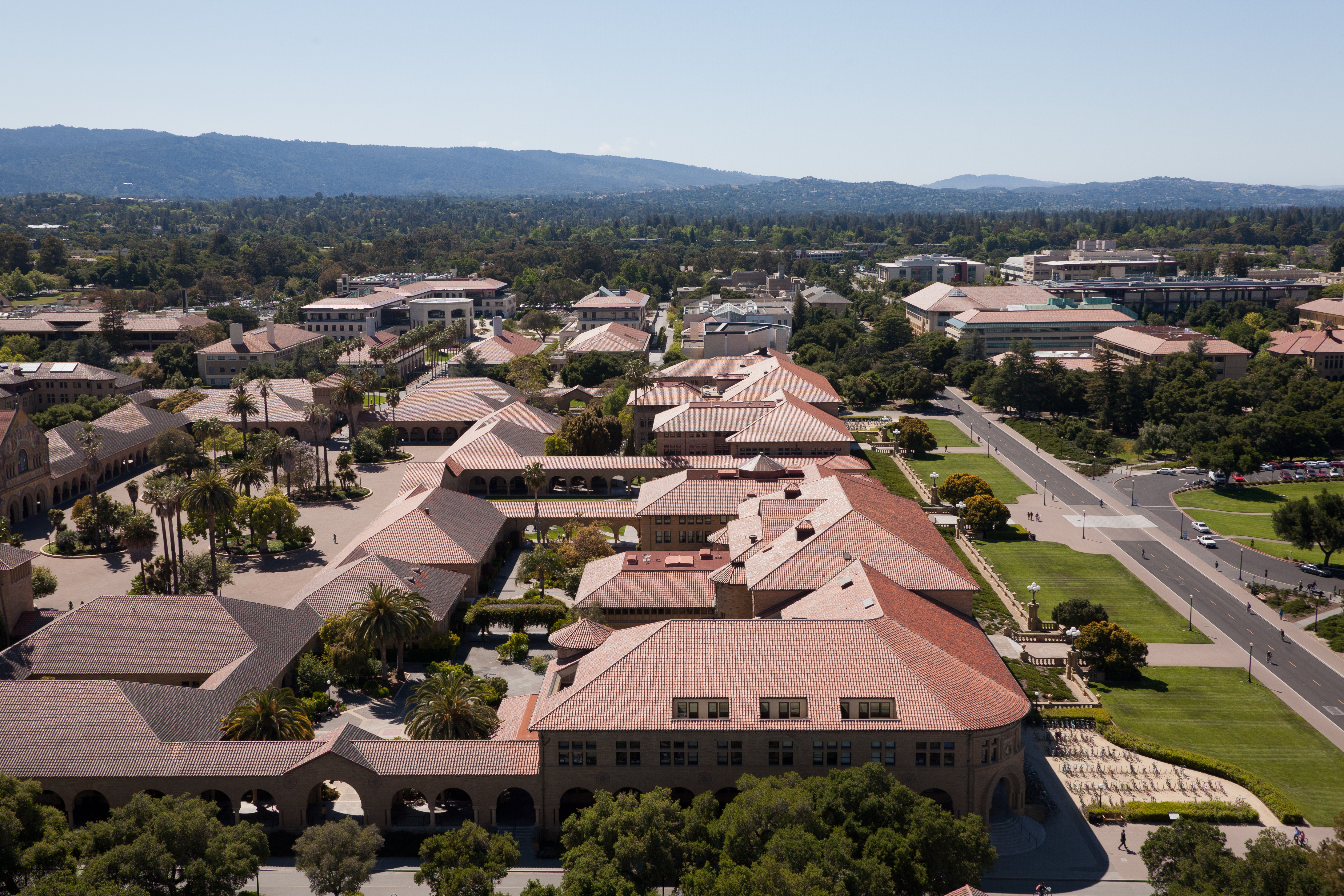
Approximately 200 visitors per day ride to the observation deck, which sits 250 feet above the ground. On clear days the view extends to the San Francisco skyline, a distance of roughly 30 miles. The deck is open daily from 10 a.m. to 4 p.m., though it closes during academic breaks and finals -- apparently even panoramic views must yield to exam schedules. Below, the Stanford campus spreads in its distinctive pattern of sandstone arcades and red tile roofs, the foothills of the Santa Cruz Mountains rising to the west. The tower anchors the campus visually the way the Hoover Institution anchors it intellectually: impossible to ignore, occasionally controversial, and older than almost everything around it.
From the Air
Hoover Tower is at 37.43°N, 122.17°W on the Stanford campus. At 285 feet, it is the tallest structure on campus and a prominent visual landmark from the air. Nearby airports: Palo Alto (KPAO), San Jose (KSJC), San Carlos (KSQL). Best identified at 3,000-5,000 ft AGL.