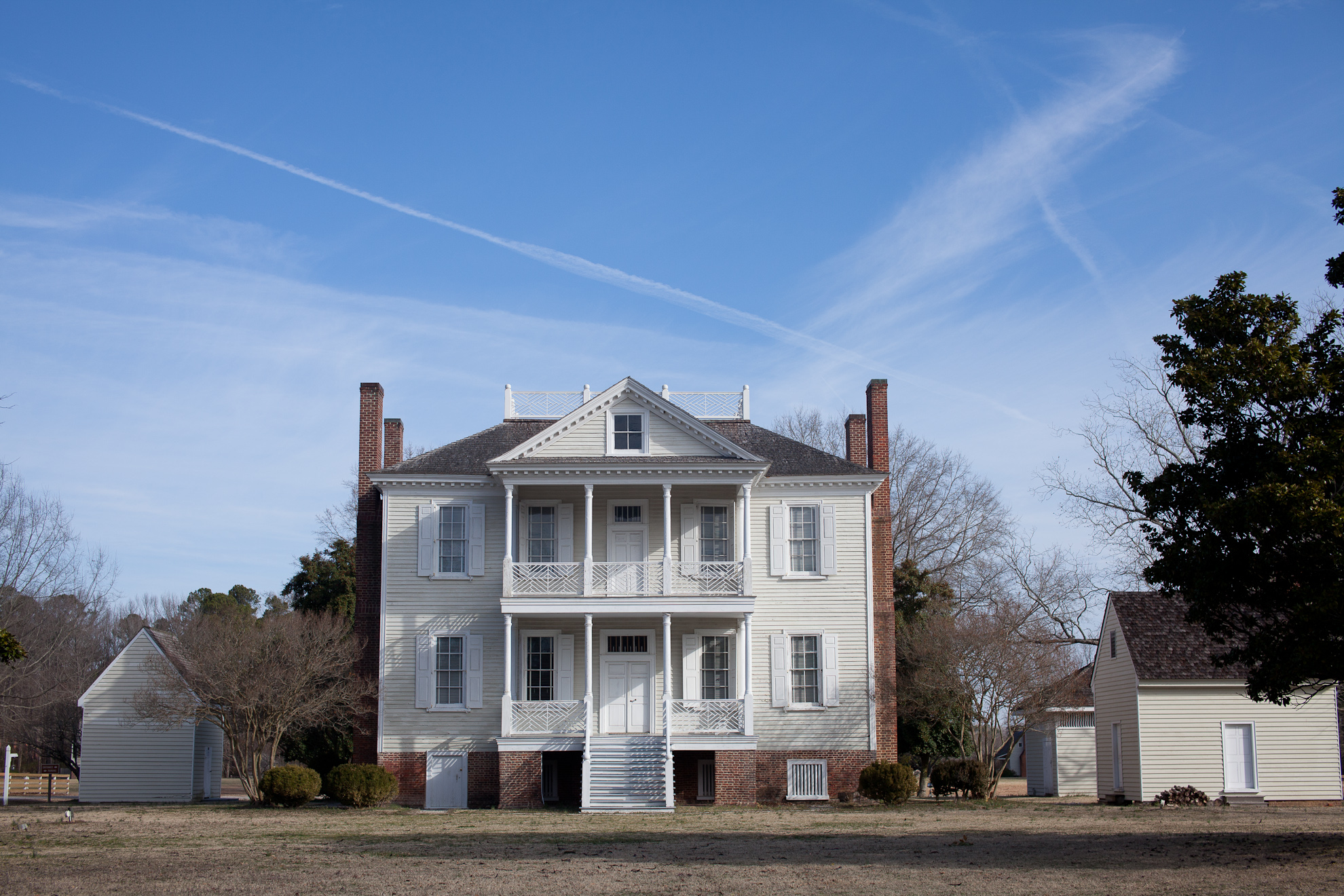
Hope Plantation
"Hope is hopeless." That was the verdict from the executive director of the North Carolina Department of Archives and History when locals first begged the state to save a crumbling mansion near Windsor in the 1960s. The house had survived the Civil War, Reconstruction, and nearly a century of neglect -- but the official word was that nothing could be done. The citizens of Bertie County disagreed. The building they refused to abandon was Hope Plantation, a 1803 Palladian manor house designed from a pattern book by a Princeton valedictorian who would become the 15th Governor of North Carolina. Today it stands restored on the coastal plain, its Chinese Chippendale balustrades and widow's walk intact, a testament to both the ambition that built it and the stubbornness that saved it.
A Princeton Man on the Cashie
The name "Hope" predates the grand house by decades. In the 1720s, the Lords Proprietor granted land along the western end of Albemarle Sound, near the Cashie River, to the Hobson family. Francis Hobson and his wife Elizabeth had roots in Hope Parish, Derbyshire, England. After Francis died in 1765, Elizabeth inherited the property and married Zedekiah Stone, an emigrant from New England who named the tract "Hope" to honor her heritage. Their son David, born in 1770, graduated first in his class at the College of New Jersey -- now Princeton -- in 1788. He read law, corresponded with Thomas Jefferson, and served North Carolina as state legislator, congressman, U.S. senator, and ultimately as the state's 15th governor from 1808 to 1810. When David Stone decided to build a home on the tract his father deeded him in 1793, he reached for a plan in Abraham Swan's The British Architect, a book from his own library, and built a grand Palladian mansion in timber on the Carolina coastal plain.
Roman Ideals in First-Growth Pine
The Palladian style was no casual choice. American patriots in the South saw themselves as inheritors of Roman republican ideals, and the style's absolute symmetry expressed that sense of order. Hope Plantation's five-bay facade rises on high brick piers, creating a full above-ground basement story. Imposing entry stairs lead to a pedimented double portico laced with intricate Chinese Chippendale balustrades on both levels and repeated on the rooftop widow's walk. Four stepped chimneys and eight side windows reinforce a precise front-to-back balance. Inside, the layout inverts convention: the entertaining rooms -- including a drawing room that resembles a ballroom -- occupy the upper floor to catch breezes, while bedrooms and the family dining room sit below. David Stone's library once held some 1,400 volumes, a remarkable collection for rural eastern North Carolina. A 1803 letter from New York supplier Joseph Sands discusses marble and red stone for the fireplaces, hinting at the materials that traveled far to furnish this remote plantation house.
What the Inventory Preserved
David Stone died intestate in 1818, and the law required a complete inventory of his property. That document became an unexpected gift to history. When the Historic Hope Foundation began restoring the house in the 1960s, they used that detailed inventory to furnish the interior with a degree of accuracy that has drawn scholarly attention. The 45-acre site also includes the 1763 King-Bazemore House, one of the few surviving mid-eighteenth-century hall-and-parlor houses in North Carolina, restored and furnished from its own 1778 inventory. Outbuildings -- a reconstructed kitchen on the original foundation, the manor house's original dairy, a smokehouse, and an herb garden -- fill out the working landscape. Archaeological work has identified the remnants of the elder Stones' earlier house and the probable location of quarters for the more than 200 enslaved people who worked the plantation's nearly 1,051 acres.
The Miracle of Hope
David Stone's son sold the property in 1836, and it passed through many hands over the following decades. By the time local preservationists took notice, the mansion had endured well over a century of decline. When the state declared it hopeless, the community organized anyway. On February 2, 1965, the Historic Hope Foundation was chartered as a nonprofit. They purchased the house and launched a grassroots restoration that drew support from across North Carolina and beyond. By late summer of 1972, the restoration was complete. Today the Foundation manages the site, opens its buildings to the public, sponsors educational programs with schools and universities, and hosts fundraising events, including the Governor Stone Ball. The state of North Carolina appoints a tourism officer to the site -- a fitting recognition for a house that official wisdom once wrote off entirely.
From the Air
Hope Plantation sits at 36.18°N, 77.02°W on the flat Carolina coastal plain near Windsor, North Carolina. The Cashie River and the western end of Albemarle Sound provide strong visual reference points. Nearest airport is KEDE (Northeastern Regional Airport, Edenton) approximately 26 nm east. KPGV (Pitt-Greenville Airport) is about 48 nm west-southwest. Best viewed at 2,000-3,000 ft AGL where the manor's symmetrical roof and surrounding grounds stand out against the agricultural landscape. The flat terrain and proximity to the sound mean morning fog is common in cooler months.