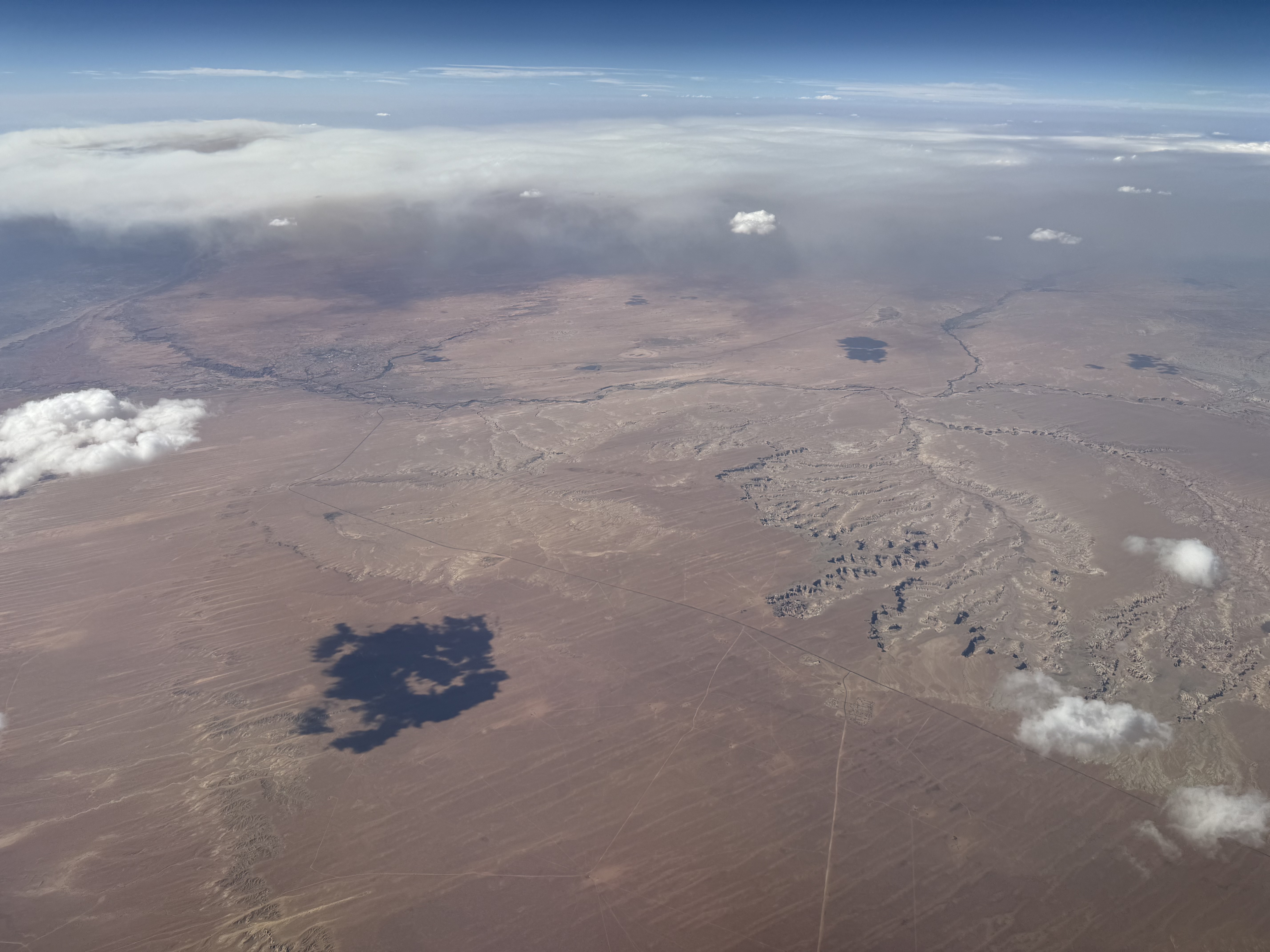
Hopi Reservation
Set your clock carefully before visiting the Hopi Reservation. The 2,532-square-mile territory follows Mountain Standard Time year-round, like most of Arizona -- but the Navajo Nation that completely surrounds it observes daylight saving time. Cross the boundary in summer and you gain an hour; cross back and you lose it. This quirk of timekeeping hints at something deeper: the Hopi Reservation exists as a world within a world, an island of one sovereign nation entirely enclosed by another, where villages perched on three dramatic mesas have maintained their distinct culture, language, and ceremonial life since long before anyone thought to draw borders on a map.
Three Mesas, One People
The Hopi Reservation organizes itself around geography that is immediately visible from the air: three parallel mesas jutting southward from the larger Black Mesa formation in northeastern Arizona. First Mesa, Second Mesa, and Third Mesa each hold clusters of stone-built villages in the traditional Pueblo style. Walpi, the oldest village on First Mesa, was established in 1690 when residents of the lower village of Koechaptevela moved to the mesa top out of fear of Spanish reprisal following the 1680 Pueblo Revolt. The Arizona Tewa people also live on First Mesa, having arrived as refugees from the Rio Grande valley. Second Mesa holds Shongopavi, Mishongnovi, and Shipaulovi. Third Mesa is home to Oraibi, one of the oldest continuously inhabited settlements in North America, along with Hotevilla, Bacavi, and Moenkopi. The community of Winslow West serves as off-reservation trust land for the tribe.
Surrounded on All Sides
The Hopi Reservation is one of only a handful of reservations in the United States that is entirely surrounded by another tribe's territory. The Navajo Nation encircles the Hopi lands in Navajo and Coconino counties, creating a complex geographic and political relationship that has generated conflict for over a century. The two nations formerly shared a Joint Use Area, but Congressional acts in 1974 and 1996 partitioned the disputed territory known as Big Mountain, resulting in forced relocations and lasting controversy. The partition drew an artificial boundary through land that both peoples had used for generations. As of the 2020 census, the reservation's population stood at 7,791 people spread across its 2,531.773 square miles -- a vast territory of high desert, mesas, and dry washes where the density works out to roughly three people per square mile.
Corn, Kivas, and the Fourth World
The Hopi consider their life on the reservation an integral and critically sustaining part of what their cosmology calls the Fourth World. Three elements anchor this existence: the traditional clan residence, the spiritual life of the kivas on the mesas, and their dependence on corn. Hopi dry farming -- growing corn, beans, and squash in an environment that receives barely ten inches of rain per year -- is not just agriculture but a spiritual practice, an act of faith in the land's ability to provide. The kivas, underground ceremonial chambers found in every village, remain the center of religious life, and many ceremonies are closed to outside visitors. The Hopi Tribal Council governs the reservation through elected officials from the various villages, operating under a Tribal Constitution. Governance has not always been smooth; some traditional villages have historically resisted the council system, viewing it as an imposition of Western political structures on an older, clan-based authority.
Voices on the Mesa
Hopi High School serves as the secondary education institution for reservation residents, and it has become something of a journalism powerhouse -- its student newspaper has won numerous national awards. KUYI, known as Hopi Radio, broadcasts a distinctive mix of traditional Hopi music, language programming, and typical American content, serving both as a media outlet and a vehicle for language revitalization. The station provides internships for Hopi High School students, creating a pipeline between education and cultural preservation. The reservation's isolation -- the nearest significant town is Winslow, Arizona, roughly 70 miles to the south -- makes these institutions particularly vital. There are no traffic lights on the reservation, no chain restaurants, and limited cell service in many areas. What exists instead is a community bound by ceremonies that have continued unbroken for centuries.
The View from Eight Thousand Feet
From the air, the Hopi Reservation reveals the dramatic mesa-and-wash topography that defines this corner of the Colorado Plateau. The five major washes run roughly north to south, carving shallow valleys between the mesa formations. The villages appear as clusters of stone buildings on the mesa edges, nearly indistinguishable from the rock itself. Arizona State Route 264 threads along the mesa tops, connecting the villages in a ribbon of asphalt that is often the only paved road for miles. The contrast with the surrounding Navajo Nation is subtle but real -- the Hopi mesas are more compact, the settlement patterns tighter, the land more intensively used despite the sparse population. The nearest general aviation airports are Winslow-Lindbergh Regional (KINW) to the south and Polacca Airport (P10) within the reservation. Best viewed at 6,000 to 8,000 feet AGL, when the mesa edges cast sharp shadows and the village layouts become visible against the sandstone.
From the Air
The Hopi Reservation is located at approximately 35.912N, 110.616W in northeastern Arizona, entirely surrounded by the Navajo Nation. The reservation covers 2,532 square miles of mesa-and-wash terrain on the Colorado Plateau. Three prominent mesas (First, Second, Third) extend southward from Black Mesa, each holding traditional pueblo villages visible from altitude. Arizona State Route 264 connects the mesa-top communities. Nearest airports: Polacca Airport (P10) on the reservation with limited facilities; Winslow-Lindbergh Regional (KINW) approximately 70 miles south. Best viewed at 6,000-8,000 feet AGL for mesa topography and village patterns. Watch for restricted airspace near tribal ceremonies. The reservation does not observe daylight saving time.