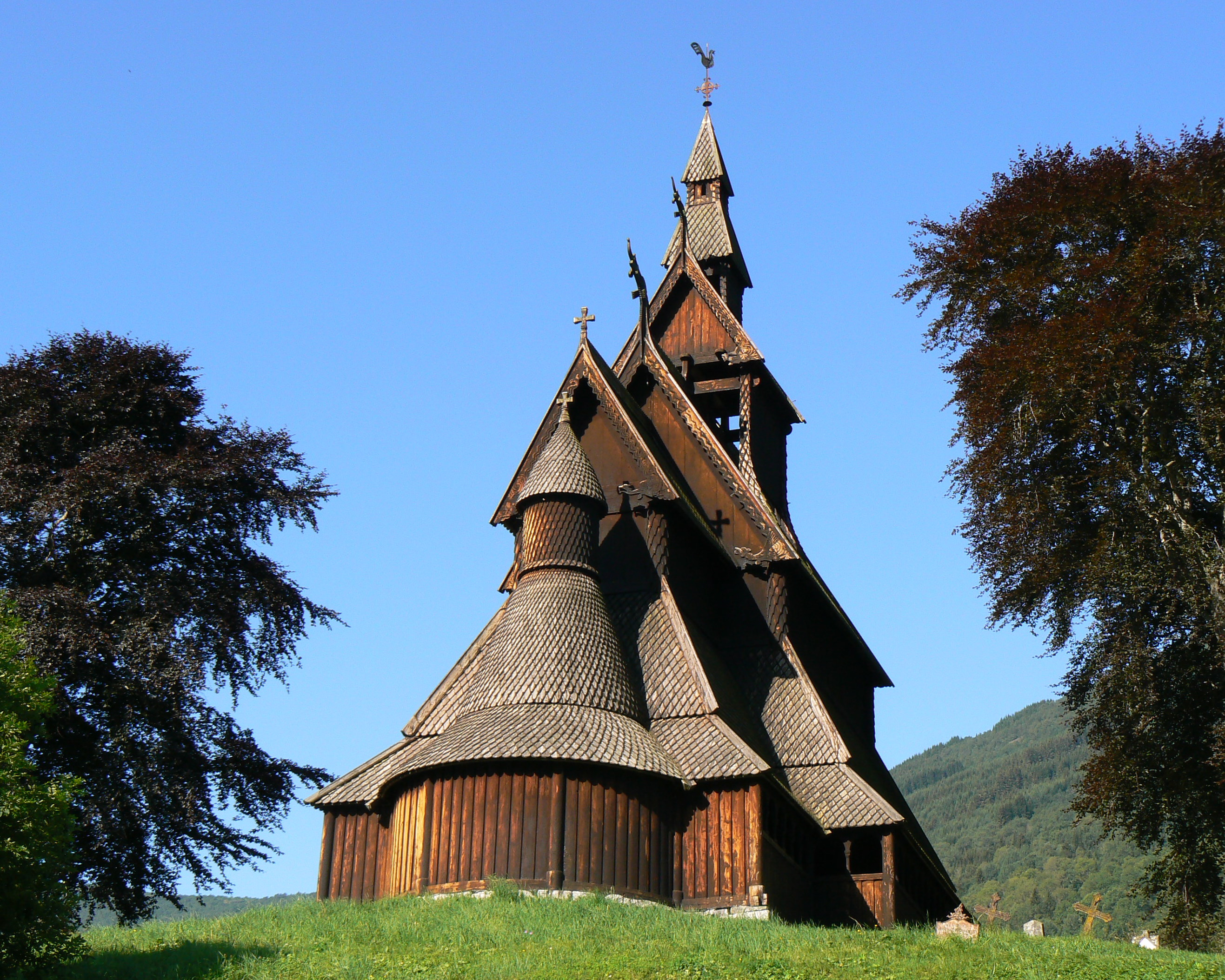
Hopperstad Stave Church
Thirty people. That is all Hopperstad Stave Church can seat, and the intimacy of the space is part of its power. Built around 1130 in the village of Vikoyri on the shore of the Sognefjord, this small brown wooden building has stood on the same patch of Norwegian ground for nearly nine centuries. Its medieval timbers are carved with runic graffiti left by parishioners whose names are otherwise lost, and its interior holds a 14th-century baldachin with four sculptured heads: Christ wearing a halo, a queen, a king, and a monk. The church is a survivor in the most literal sense. Of the roughly 1,000 stave churches built in Norway during the Middle Ages, fewer than 30 remain. Hopperstad is among the oldest.
Timber, Tar, and the Art of Standing Upright
Stave churches take their name from their structural method: vertical wooden posts, or staves, that bear the weight of the building. The technique dates to the transition period when Scandinavia was converting from paganism to Christianity, and the churches carry echoes of both traditions. Hopperstad's exterior features carved dragon heads that would look at home on a Viking longship, mounted on the roof ridges to ward off evil spirits. Inside, the ciborium on the north side shelters an altar dedicated to the Virgin Mary, its canopy painted with a scene of Christ's birth. The juxtaposition is deliberate and unselfconscious, the work of craftspeople who saw no contradiction between old protective symbols and new faith. No records survive describing the church's original appearance, but sketches show a nave and chancel typical of the period. The building did not undergo major changes until the 1600s, when the nave was lengthened westward, a bell tower added, and a log-built extension appended to the east.
Sold to Pay for a King's War
In 1723, the Danish-Norwegian crown needed money. The Great Northern War had drained the royal treasury, and the solution was to auction off more than 600 parish churches across Norway to private buyers. Hopperstad was among them. The church passed into private hands, its upkeep now dependent on owners who had little incentive to spend on maintenance. Yet the building endured, and in 1814 it played a small role in a moment of national rebirth. That year, Norway held its first national elections to choose representatives for the Constituent Assembly at Eidsvoll Manor, the body that would write the Norwegian Constitution. Each parish church served as a polling station, and Hopperstad was one of them. The congregants who cast their votes inside those medieval walls were participating in democracy under a roof that had sheltered worship for nearly seven centuries.
The Priest Who Nearly Killed It
By the 1870s, Hopperstad was in trouble. The local parish priest, Jorgen Christian Andreas Groner, complained that both Hopperstad and the neighboring Hove Church were too small and too old to serve their congregations properly. The villagers thought he was exaggerating, and the private owners refused to pay for repairs. Groner took matters into his own hands: he stopped holding services at Hopperstad, declaring it too cold and drafty for worship. His campaign worked, perhaps too well. On 11 December 1875, a royal decree ordered both churches closed and a new church built in Vikoyri for the merged parish. The new Vik Church opened in 1877, and Hopperstad was taken out of regular use. What could have been the end of the story became instead a reprieve. The Society for the Preservation of Ancient Norwegian Monuments acquired the building and undertook a careful restoration, saving the church from demolition and preserving it as a historical monument.
An Echo in Minnesota
In Moorhead, Minnesota, 6,500 kilometers from Vikoyri, a full-scale replica of Hopperstad Stave Church stands at the Heritage Hjemkomst Center. Dedicated in 1998, the replica was built by Scandinavian-Americans honoring their Norwegian roots, part of a larger museum complex celebrating the heritage of the immigrants who settled the upper Midwest in the 19th century. The original church, meanwhile, remains in its quiet spot by the Sognefjord, owned by the preservation society and open to visitors who come to touch the same timbers that medieval hands carved with runes. The dragon heads still watch from the roofline. The baldachin still bears its four sculpted faces. And the church still seats about thirty people, which turns out to be exactly enough.
From the Air
Located at 61.08N, 6.57E in the village of Vikoyri on the southern shore of the Sognefjord in Vestland county. The small brown wooden church is difficult to spot from high altitude but identifiable at lower altitudes near the village waterfront. The Sognefjord itself is a major visual landmark, stretching 205 km inland. Nearest airports: Bergen/Flesland (ENBR) approximately 150 km south, Sogndal/Haukasen (ENSG) approximately 50 km northeast. Best viewed below 1,500 meters in clear conditions.