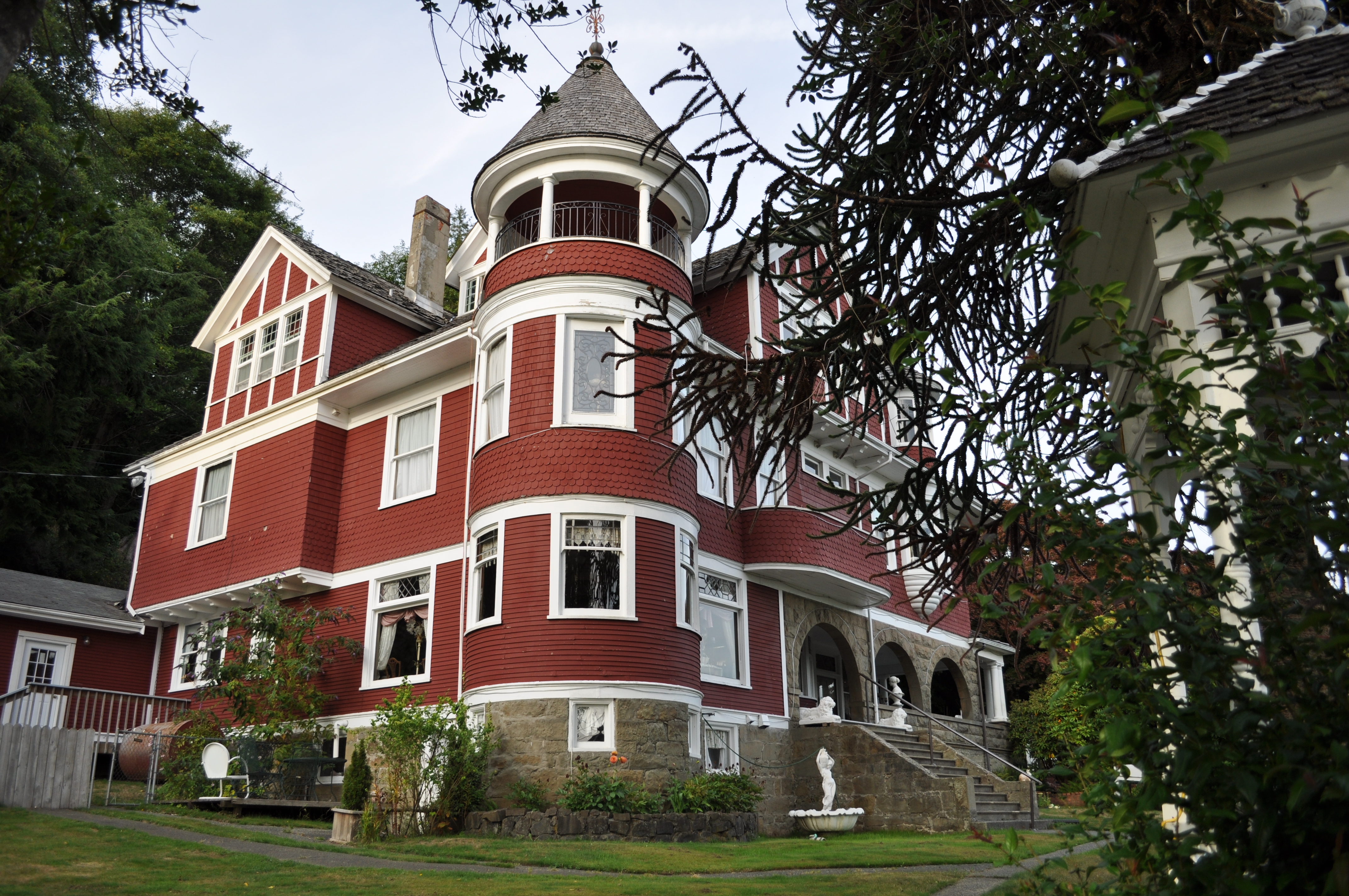
Hoquiam's Castle
A customer walked into the Lytle brothers' grocery store in Hoquiam sometime in the 1880s and settled his debt by handing over a logging operation. It was an unremarkable transaction in a town where timber was currency, land was cheap, and ambition ran hotter than the sawmill boilers. But that trade set Robert and Joseph Lytle on a path from shopkeepers to lumber barons, and before the century turned, Robert was building himself a castle -- literally -- on Chenault Avenue, overlooking the mudflats and mill smoke of Grays Harbor.
From Groceries to Grandeur
The Lytle brothers had come to Hoquiam from Fairhaven, Washington, hauling their grocery business to a town that was growing as fast as the surrounding forests could be felled. In 1889 alone, Hoquiam's population leapt from 400 to 1,500, and property values surged by more than a thousand percent. The Lytles rode that wave. After acquiring the logging operation, they expanded into milling, eventually building the Panama-Eastern Lumber Company sawmill in East Hoquiam and establishing one of the region's first all-electric shingle mills. By 1902, their Hoquiam Lumber and Shingle Company was turning out cedar shingles at an industrial scale, and by 1906, it ranked among the world's leading shingle manufacturers -- producing 275 million shingles per year. The grocery store was a distant memory.
Sandstone, Lions, and Electric Light
Robert began construction of his mansion in 1897, building next door to his brother Joseph's house. Completed in 1900, the 10,000-square-foot residence announced itself with twelve-foot-wide sandstone stairs, a sandstone arch, and cement lions flanking the entrance. The architecture is primarily Richardsonian Romanesque -- heavy, textured, assertive -- with Queen Anne and Shingle style flourishes softening the edges. Inside, more than twenty rooms sprawled across multiple stories, built atop a hand-fitted sandstone foundation. It was the first home in Hoquiam to have electric lights, a fitting boast for a man whose mill was all-electric. The house declared what its owner believed: that Hoquiam was no backwater logging camp, but a place worth building something permanent.
A Wedding Gift and a Long Silence
Shortly after the castle was finished, Robert Lytle gave it away. The recipient was his niece, Theadosia Bale, and the occasion was her wedding. Whether this was pure generosity or a sign that Lytle had already moved on to his next venture is unclear, but Bale lived in the mansion for decades. After she died in the 1950s, the house fell silent. For nearly two decades it sat empty, its twenty-plus rooms collecting dust while Hoquiam's timber economy contracted around it. In 1968, new owners arrived, and by the early 1970s, the Robert Watson family undertook a full restoration. The castle found a second life as a bed and breakfast, welcoming guests who wanted to sleep where a lumber baron once entertained.
Ghosts and Gingerbread
When the house changed hands again in 2004, the new owner opened it as a haunted house to raise money for children's activities -- a playful twist for a mansion that had already accumulated more than a century of stories within its Romanesque walls. Listed on the National Register of Historic Places since 1973, Hoquiam's Castle endures as the most visible artifact of the timber fortunes that built this corner of Washington. The shingle mills are gone. The old-growth forests that fed them are largely memory. But the castle remains on its hill above Chenault Avenue, its sandstone stairs still wide enough for the ambitions of a grocer who became something more.
From the Air
Located at 46.984N, 123.888W in Hoquiam, Washington, on a hillside above the city. Nearest airport is Bowerman Field (KHQM), approximately 3 miles southeast. The mansion sits on Chenault Avenue and is visible from low altitude against the residential hillside. Grays Harbor and the Chehalis River estuary provide prominent water references to the south and east. Recommended viewing altitude: 1,500-2,500 feet AGL for residential context.