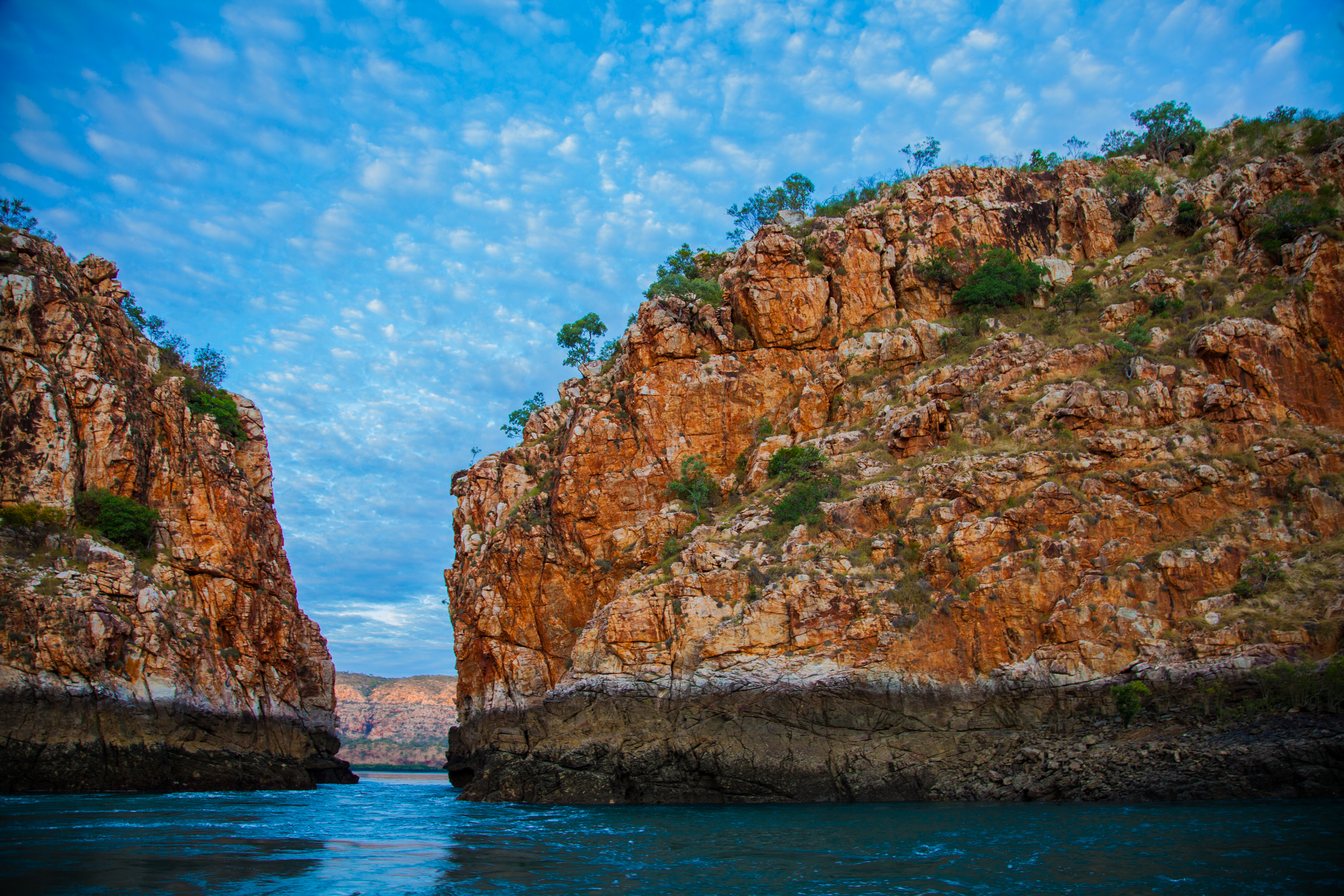
Horizontal Falls
The name is technically accurate, which makes it stranger. A waterfall, by any ordinary understanding, falls downward. The Horizontal Falls, in the Kimberley's Buccaneer Archipelago, flow sideways. Twice a day, tidal differences of up to 10 metres force seawater through two narrow gorges in the McLarty Ranges — a seaward gap about 20 metres wide, a landward one about 10 — faster than the water can equalise on either side. The result is a sustained horizontal torrent, a waterfall running at right angles to gravity, reversing direction with every change of the tide.
Physics of an Unlikely Waterfall
The mechanics are straightforward, even if the effect is startling. Talbot Bay (known to the Dambimangari people as Ganbadba) is enclosed on the seaward side by the McLarty Ranges, with only two narrow gaps connecting the bay to the open ocean. When the tide rises or falls by up to 10 metres, water cannot pass through those gaps quickly enough to keep pace with the tidal movement. It stacks up on one side, creating a head difference — and where there is a head difference, water flows downhill, or in this case, sideways, with the force of a river. The falls reach up to 4 metres in height. As the tide turns, the whole system reverses: what was flowing in begins flowing out, and the waterfall flips direction entirely. The Dambimangari people know the falls as Garaanngaddim.
Attenborough's Wonder
David Attenborough, who has seen a great deal of the natural world, called the Horizontal Falls "one of the greatest wonders of the natural world." The falls sit in the Lalang-garram / Horizontal Falls Marine Park, jointly managed by the Western Australian government and the Dambimangari (Worrorra) people, whose traditional country this is. The park's name comes from a Worrorra word meaning "the saltwater as a spiritual place as well as a place of natural abundance." For the Dambimangari, Garaanngaddim is not merely a natural curiosity but a sacred site. Access has always been challenging — the falls are reachable only by sea or air, in a region patrolled by estuarine crocodiles and box jellyfish. The remoteness is part of what has preserved them.
The 2022 Accident and What Changed
On 27 May 2022, a high-speed tour boat carrying 28 passengers and two crew was conducting a trip through the gorge gaps when it collided with a rock wall. More than a dozen tourists were left with serious injuries, including broken bones and head trauma. The rescue was complicated by the falls' remoteness and the presence of crocodiles and box jellyfish in the surrounding water. The accident prompted an investigation and, eventually, a policy change: from 2026, the Western Australian government began phasing out boat trips through the gaps entirely, with all operators ceasing by 2028. The decision reflected both the safety record and the Dambimangari Aboriginal Corporation's view that the gap passages intruded on the sacred significance of the site. Visitors can still travel to the entrance of the falls and observe the tidal movement and rock formations from a safe distance.
The Kimberley Tidal Coast
The Horizontal Falls sit within the Buccaneer Archipelago, a scattered chain of islands, reefs, and waterways on the Kimberley coast that has some of the most extreme tidal ranges in the world. The broader Lalang-gaddam Marine Park — amalgamating the Horizontal Falls, Camden Sound, North Lalang-garram, and the proposed Maiyalam Marine Parks — protects a vast stretch of this coastline. Camden Sound, just to the north, is one of the most important humpback whale nursery grounds in the southern hemisphere. This is a coast that rewards the effort it takes to reach it: wild, biodiverse, and shaped by forces that operate on their own schedule, twice a day, without exception.
From the Air
The Horizontal Falls are located at approximately 16.38°S, 123.96°E within Talbot Bay in the Buccaneer Archipelago, Kimberley coast of Western Australia. Derby (YDBY) is the nearest airport, approximately 80 km to the southeast by air. From altitude, the McLarty Ranges and the narrow gorge gaps are visible, and during tidal changes the water turbulence at the falls is detectable. Seaplane tours historically operated from Derby; access is now by vessel to the falls' entrance zone. The falls are best observed from sea level or low-altitude helicopter flight.