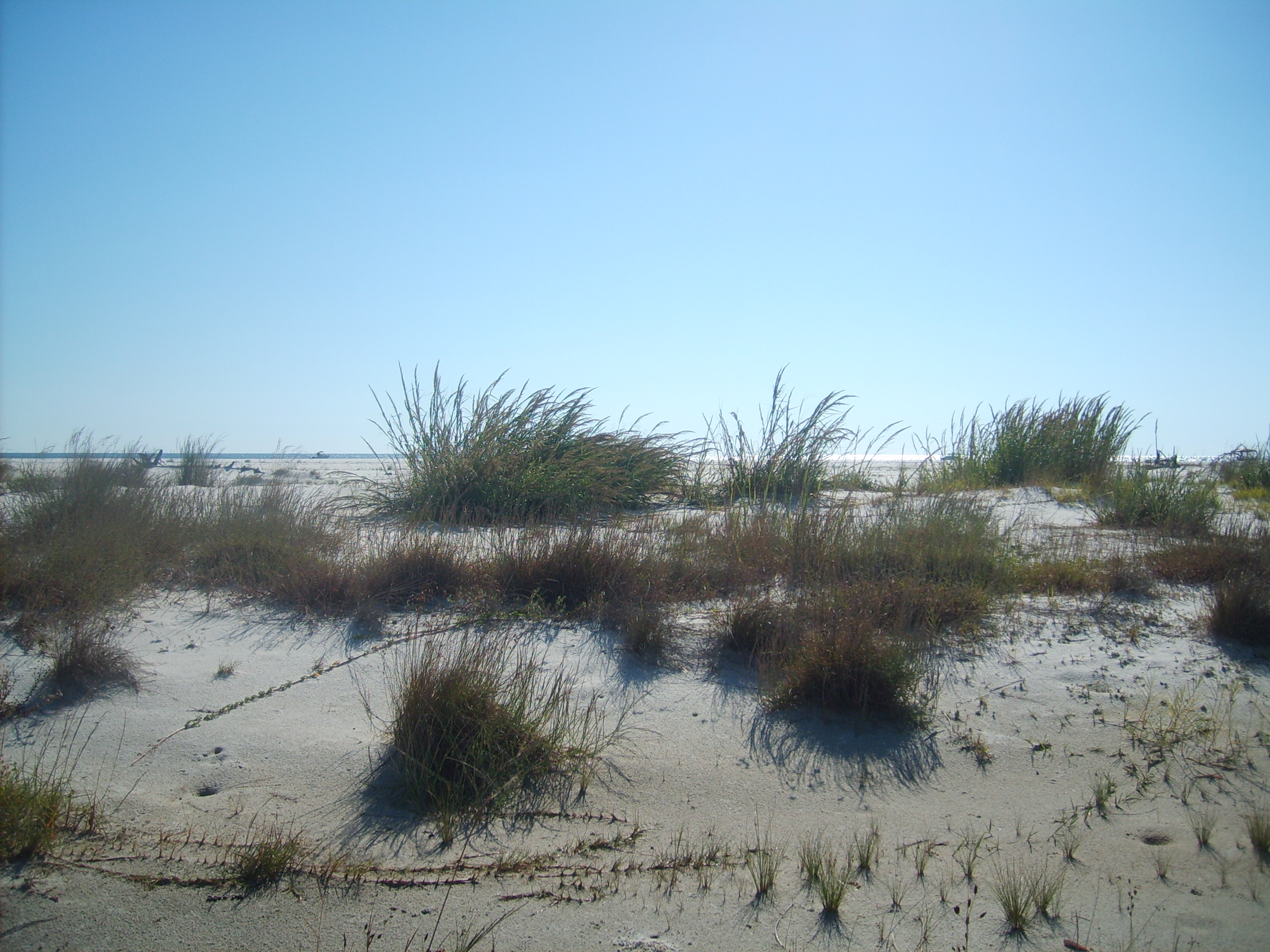
Horn Island
For the last sixteen years of his life, the artist Walter Anderson would row a small boat twelve miles across the Mississippi Sound to reach Horn Island. He carried watercolors, typing paper, and little else. On the island he slept under his overturned boat, painted the birds and plants obsessively - thousands of works on cheap paper - and spoke to almost no one. After his death in 1965, his family discovered a body of work now recognized as American modernist masterwork. Anderson understood what the island offers: radical solitude. Horn Island remains the largest and wildest of Mississippi's barrier islands, undeveloped except for a single ranger station, its interior a maze of lagoons, pine groves, and dunes that has resisted every attempt at civilization.
Horned Cattle and French Colonists
The island's name may come from its shape - a long narrow strip tapering to a western point - or from the cattle that early French colonists put ashore here. In 1718, Antoine-Simon Le Page du Pratz arrived in Louisiana and later wrote about Horn Island in his History of Louisiana. The first Canadians who settled on nearby Dauphin Island had placed their cattle on Horn Island in great numbers, he recorded, 'whereby they came to grow rich even when they slept.' The animals required no tending on the isolated island, multiplying freely until their owners harvested the profits. It was an early experiment in hands-off ranching, made possible by the same isolation that defines the island today. The cattle are long gone, but the wildness they grazed in has endured.
White Sand and Wild Things
Horn Island stretches several miles east to west but barely reaches a mile at its widest. The southern shore faces the open Gulf of Mexico with long beaches of sugar-white sand. The northern side shelters Mississippi Sound. Between the two coasts, the island holds a surprising interior: freshwater lagoons ringed by saw palmettos, small groves of tall pines, dunes crowned with sea oats. Alligators patrol the lagoons. Ospreys, pelicans, anhingas, ibises, herons, and terns nest along the shores. Manatees pass through the surrounding waters. The island is part of the Gulf Islands National Seashore, protected as wilderness and accessible only by private boat - there is no ferry service, no dock, no road. Visitors who make the crossing find a landscape that looks much as it did when Le Page du Pratz first described it three centuries ago.
The Secret Testing Ground
Between 1943 and 1945, Horn Island took on a darker role. The U.S. Army closed the island to all public access and used it as a biological weapons testing site. The remote, uninhabited barrier island offered ideal conditions for testing agents that could not safely be released near populated areas. Details of the program remained classified for decades. The testing ended with World War II, and the island eventually returned to its natural state, but the episode adds an unsettling layer to what otherwise seems like untouched paradise. The Army's interest in Horn Island, like the French colonists' interest before it, came down to the same quality: isolation.
Wolves and Recovery
In 1989, Horn Island entered a different kind of experiment. The U.S. Fish and Wildlife Service selected it as a propagation site for the endangered red wolf, hoping the island's isolation would allow a captive population to breed without the threats found on the mainland. For nine years, red wolves roamed the same dunes and pine groves where Anderson had painted and the Army had tested weapons. The program ended in 1998 when officials determined that increasing human visits created too great a likelihood of wolf-human encounters. The wolves were removed, and Horn Island returned to its birds, alligators, and silence. The island sits in a chain of Mississippi-Alabama barrier islands - Petit Bois and Dauphin to the east, Ship Island and Cat Island to the west - each with its own character, but none as wild as Horn.
From the Air
Located at 30.23°N, 88.67°W in the Gulf of Mexico, roughly 12 miles south of Ocean Springs, Mississippi. Horn Island is the largest of the Mississippi barrier islands, appearing as a long, narrow east-west strip of white sand with scattered green vegetation. It sits between Ship Island to the west and Petit Bois Island to the east, with Mississippi Sound to the north and the open Gulf to the south. No development is visible except a small ranger station mid-island. Gulfport-Biloxi International Airport (KGPT) is 18nm northwest; Keesler Air Force Base (KBIX) in Biloxi is 14nm north. The island chain is a striking visual feature at low altitude - white sand ribbons against turquoise water. Best viewed heading east-west along the chain to appreciate the full barrier island system.
Sources
- Horn Island (Mississippi) - Wikipedia
- Walter Inglis Anderson - Wikipedia
- The Many Voyages of Walter Anderson - The Bitter Southerner
- Horn Island Chemical Warfare Service Quarantine Station - Wikipedia
- Horn Island (Mississippi) - Wikipedia
- Chemical Warfare Station on Horn Island - National Park Service
- Walter Inglis Anderson - Wikipedia