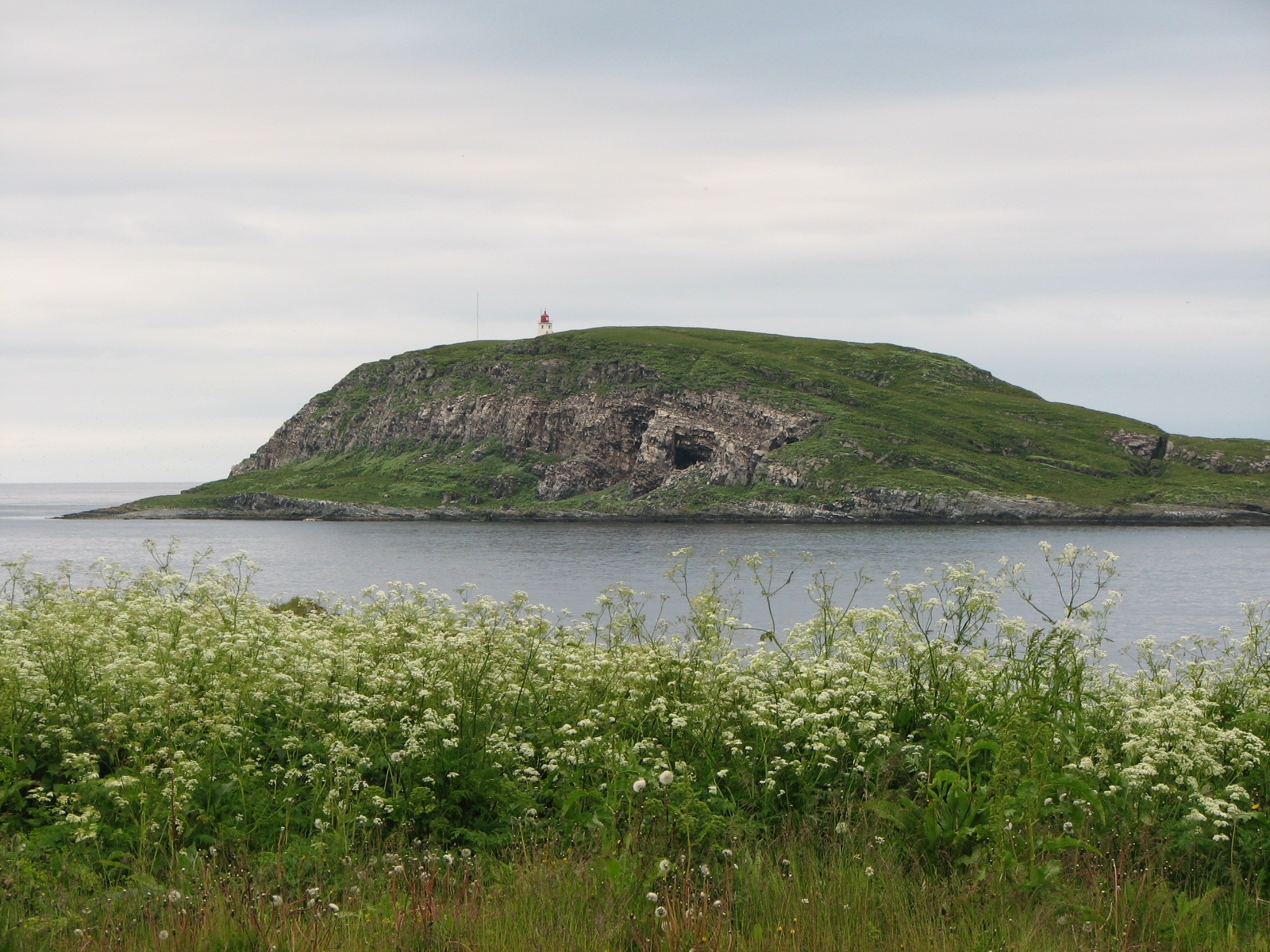
Hornøya, Finnmark
Stand on Hornøya and you are farther east than Istanbul, farther east than Cairo, farther east than any other point on Norwegian soil. This treeless scrap of rock -- just 0.4 square kilometers -- sits in the Barents Sea off the town of Vardo, and it holds a distinction that few visitors expect from a country they think of as facing west: Hornøya is the easternmost point of Norway proper. The island has no permanent residents. What it has are birds -- vast colonies of them -- and a lighthouse perched at 65 meters above sea level that has guided ships through these waters for generations.
At the Edge of the Map
Hornøya lies just east of Vardoya, the larger island where the town of Vardo is built. Vardo itself is Norway's easternmost town, a place where the Barents Sea meets the tail end of the Scandinavian peninsula and geography begins to feel more Russian than Norwegian. The longitude here -- just past 31 degrees east -- places Hornøya on the same meridian as parts of Ukraine and Turkey. This is the corner of Norway where the familiar coastline of fjords and forests gives way to something starker: low tundra, exposed rock, and an ocean that freezes in bad winters. A short boat ride from Vardo brings visitors to the island, but the crossing can be rough. The Barents Sea does not ease its temper for curiosity.
The Lighthouse on the Summit
Vardo Lighthouse stands at the island's highest point, 65 meters above the sea. It protects the shipping lanes around Vardo, marking a critical waypoint for vessels navigating the Finnmark coast and the entrance to the Varangerfjord. Lighthouses in this part of Norway are not decorative; they are essential. Winter brings polar night -- weeks of continuous darkness -- and the storms that sweep in from the Barents Sea can reduce visibility to nothing in minutes. The lighthouse is a fixed point in a landscape that seems designed to disorient. For pilots flying along the Finnmark coast, it serves as a reliable visual reference, its position confirmed by the distinct shape of the island itself: a low, flat mass with no trees, no buildings beyond the lighthouse complex, and cliffs that drop sharply to the sea.
A Kingdom of Wings
Hornøya is part of the Varangerfjord Important Bird Area, designated by BirdLife International for its support of large numbers of waterbirds, seabirds, and waders. The island's cliffs host breeding colonies of Atlantic puffins, common guillemots, Brunnich's guillemots, razorbills, and black-legged kittiwakes. During the summer breeding season, the noise is extraordinary -- a constant chorus of calls from tens of thousands of birds packed onto narrow ledges. The lack of terrestrial predators on the uninhabited island makes it an ideal nesting site, and the nutrient-rich waters of the Barents Sea provide abundant food. In winter, the colonies thin but do not disappear entirely; overwintering species continue to use the island and surrounding waters. For birdwatchers, Hornøya is one of the most accessible major seabird colonies in northern Europe, reachable by a short boat trip from a town with hotels and services.
The View from Altitude
From the air, Hornøya appears as a dark comma of rock set against the steel-gray Barents Sea, separated from Vardoya by a narrow strait. The lighthouse is the only significant structure. In summer, the cliff faces appear streaked white from guano -- a sign of the bird colonies even before individual birds become visible. The island's flat profile and lack of vegetation make it easy to identify against the surrounding water. To the west, Vardo's compact grid of buildings and harbor infrastructure stands out on Vardoya. To the east, there is nothing but open sea until Novaya Zemlya, over a thousand kilometers away. Flying here in winter means flying in darkness, the lighthouse beam the only indication of the island below.
From the Air
Located at 70.39N, 31.15E in the Barents Sea, just east of Vardoya island and the town of Vardo. Vardo Airport (ENSS) is the nearest airfield, located on Svartnes on the mainland connected to Vardo by an undersea tunnel. The island is flat and treeless with a prominent lighthouse at 65m elevation. Best identified by its position relative to Vardo harbor. Extreme weather conditions common; polar night in winter, midnight sun in summer. Strong winds and limited visibility frequent.