Horsemonger Lane Gaol: Where Dickens Watched and Wrote
On the morning of 13 November 1849, Charles Dickens rented a rooftop overlooking Horsemonger Lane Gaol in Southwark to watch a husband and wife hang for murder. Frederick and Maria Manning had killed a friend for his money and buried the body under their kitchen floor. The execution drew a crowd of thousands. Dickens was so revolted -- not by the hanging itself, but by the behavior of the crowd, their 'levity, drunkenness, and callousness' -- that he wrote an impassioned letter to The Times condemning public executions. The letter helped build the case for the abolition of public hangings, which came in 1868. The prison where Dickens had his epiphany is gone. A children's playground stands roughly where the gallows were.
The New Gaol
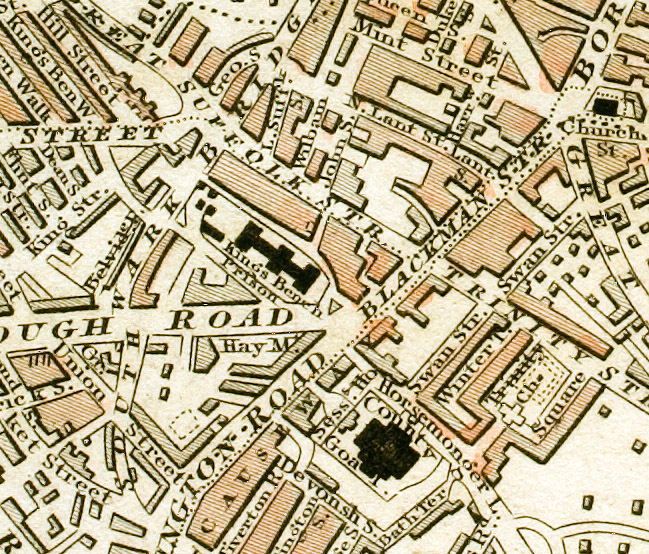
Horsemonger Lane Gaol was built to replace an overcrowded county prison housed in the former White Lion Inn on Borough High Street in Southwark. Designed by George Gwilt the Elder, surveyor to the county of Surrey, the new gaol was completed in 1799. It served as Surrey's principal prison and place of execution for nearly eighty years, holding both debtors and criminals in a capacity of around three hundred. The gallows were erected on the flat roof of the gatehouse, giving the public a clear view of executions from the street below. Between 1800 and 1877, 131 men and four women were hanged there. After 1868, when public executions were abolished, the gallows were moved to a yard behind the walls.
The Mannings and Dickens
The Manning case fascinated Victorian London. Maria Manning, a Swiss-born lady's maid, and her husband Frederick murdered their friend Patrick O'Connor, a customs officer and Maria's former lover, for the money and securities he carried. They buried him under the kitchen flagstones. Maria fled to Edinburgh with the securities; Frederick fled to Jersey. Both were caught. Their public execution at Horsemonger Lane became a sensation. Dickens, already famous, watched from a rented vantage point and was appalled by the spectacle. He later used Maria Manning as the model for the calculating Hortense in Bleak House. The prison appears in Little Dorrit as well -- Mrs. Chivery's tobacco shop is located on Horsemonger Lane. The gaol also surfaces in Sarah Waters's novel Fingersmith.
Notable Inmates
The gaol held a remarkable roster of prisoners. Edward Despard, convicted of high treason for plotting to assassinate George III and seize the Tower of London, was executed there on 21 February 1803 -- one of the last people in England to be sentenced to be hanged, drawn, and quartered, though the quartering was commuted. The poet and essayist Leigh Hunt was imprisoned at Horsemonger Lane for two years for publishing criticism of the Prince Regent, and famously decorated his cell with roses and a piano. William Chester Minor, an American surgeon who murdered a man in Lambeth, was held at the gaol before being transferred to Broadmoor asylum, where he became one of the most prolific contributors to the Oxford English Dictionary.
What Remains
The gaol was demolished in 1881. The Inner London Crown Court now occupies part of the site, and Newington Gardens, a small public park, opened on the remaining ground in 1884. The road itself changed names -- from Horsemonger Lane to Union Road and eventually to Harper Road -- as if Southwark wished to erase the memory of the place. But traces survive for those who know where to look. The park's layout echoes the old prison footprint. And the literary afterlife endures: Dickens, Manning, Leigh Hunt, and the makers of the Oxford English Dictionary all passed through these walls. A place designed for punishment and forgetting has instead been remembered through the words of the prisoners and witnesses who gave it meaning.
From the Air
The former site of Horsemonger Lane Gaol (51.50N, 0.10W) is in Southwark, south London, near Elephant and Castle. Newington Gardens and the Inner London Crown Court now occupy the site. The area is densely urban. Nearby airports: London City (EGLC) 6nm east, Battersea Heliport 3nm west. Best viewed from 2,000ft with the Elephant and Castle junction as a reference point.