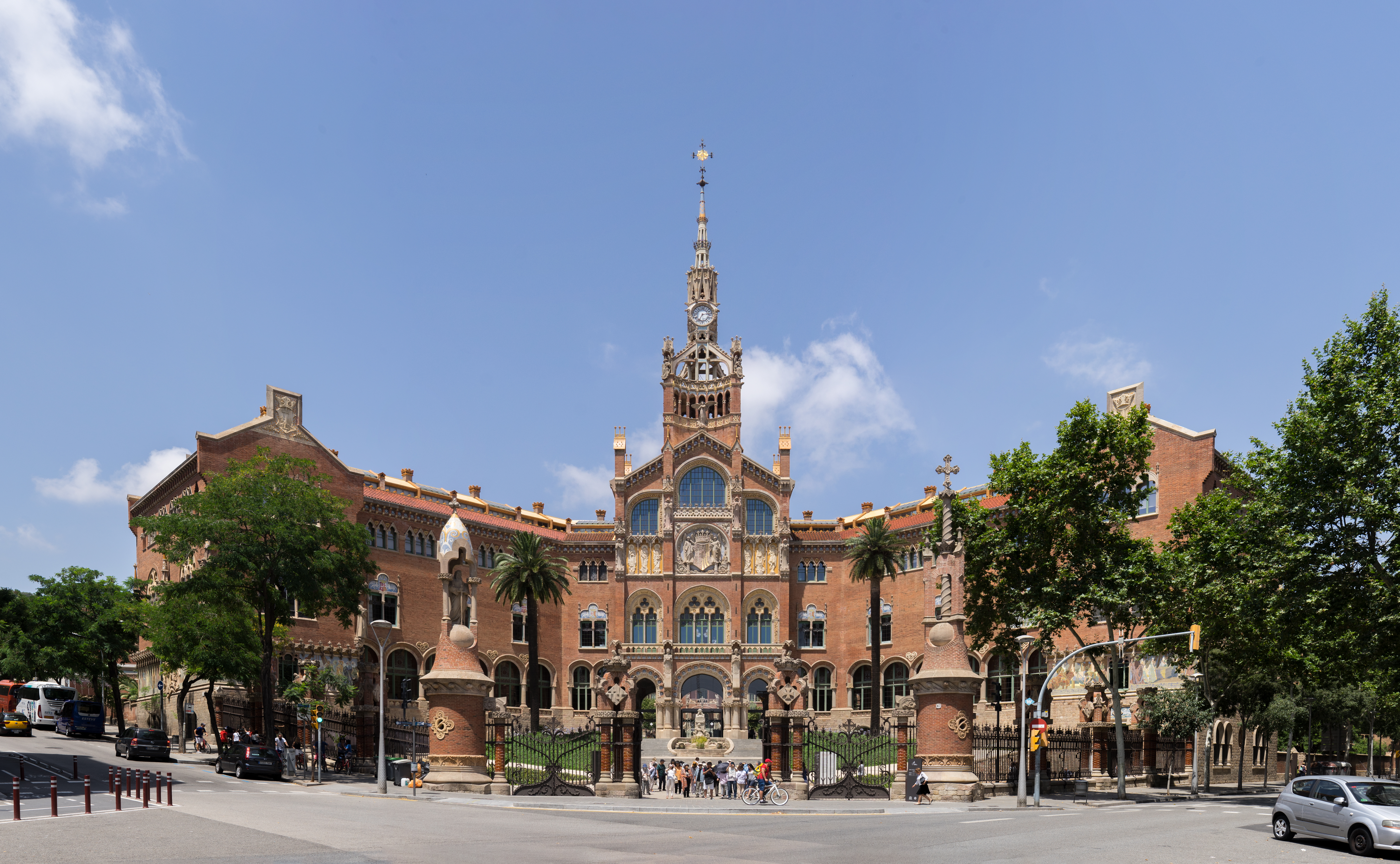
Hospital de Sant Pau
Most hospitals aim to be functional. The Hospital de la Santa Creu i Sant Pau aimed to be beautiful, on the theory that beauty itself was therapeutic. Architect Lluis Domenech i Montaner designed twelve pavilions connected by underground galleries, set them in gardens, and covered every surface with mosaics, stained glass, and sculpted stone. The result, built between 1901 and 1930 in Barcelona's El Guinardo neighborhood, is the largest complex ever constructed in the Art Nouveau style. It served as a fully functioning hospital for over a century. In 1997, UNESCO declared it a World Heritage Site alongside Domenech's other masterpiece, the Palau de la Musica Catalana.
Six Hospitals Become One
The institution's roots reach back to 1401, when six small medieval hospitals in Barcelona merged into a single entity: the Hospital de la Santa Creu. Construction of its first buildings began that year and finished in 1450. The Casa Convalescencia was added in the seventeenth century. Those medieval structures, located near Barcelona's center, still stand today -- they now house the Escola Massana art school and the Biblioteca de Catalunya, the national library of Catalonia. The "Sant Pau" in the hospital's name honors the banker Pau Gil, whose fortune funded the ambitious twentieth-century reconstruction. When the old buildings grew too cramped for a city bursting beyond its medieval walls, Domenech i Montaner was commissioned to imagine something entirely new.
Healing Through Color and Light
Domenech's original plan called for forty-eight buildings. Twenty-seven were actually built, which was still enough to create something without precedent in hospital design. Each pavilion was dedicated to a medical specialty and oriented to maximize sunlight and ventilation. Underground tunnels connected them, allowing staff to move patients and supplies out of the weather while gardens filled the spaces above. The buildings themselves are explosions of Catalan modernisme: ceramic tiles in blazing yellows and blues, carved stone facades, towers capped with mosaic domes. Domenech believed that patients surrounded by beauty would heal faster. Whether or not the data supported his hypothesis, the architecture made the case that a hospital could honor the dignity of its patients rather than merely process their illnesses.
From Wards to World Heritage
Sant Pau remained a working hospital until June 2009, when a modern facility opened next door and nearly all departments relocated. A few services -- the Blood and Tissue Bank, radiography, physical therapy -- lingered in the old pavilions. In 1991, the Generalitat de Catalunya had awarded the hospital the St. George's Cross, and the 1997 UNESCO designation cemented its architectural significance. But the buildings needed serious attention. Over a century of medical use, wartime damage, and improvised modifications had altered Domenech's original vision. Restoration began in 2009 with a budget of one hundred million euros, funded by a consortium including the European Regional Development Fund, the Spanish and Catalan governments, and the hospital's own private foundation.
A Second Life in Stone and Glass
More than thirty teams of experts worked on the restoration, which covered 29,517 square meters of built space and 31,052 square meters of outdoor grounds. The goals were exacting: strip away later additions to recover Domenech's original plans, strengthen the iron infrastructure without disturbing the facades, and adapt the complex for contemporary use as a museum and cultural center. Underground rooms and new structural columns were added invisibly. The ornamental details -- the ceramic mosaics, the carved capitals, the stained glass -- were restored with materials faithful to the originals. The complex reopened to visitors in 2014 and now serves as workspace for organizations including the World Health Organization and UN-Habitat. Walking its gardens, you are inside a building that was once a hospital, then nearly a ruin, and is now a living argument that architecture can serve purposes beyond the merely structural.
From the Air
Located at 41.41N, 2.17E in Barcelona's El Guinardo neighborhood. The complex is visible from the air as a distinctive grid of ornate pavilions with colorful mosaic roofs, set among gardens northeast of the Eixample grid. Nearest major airport is Barcelona-El Prat (LEBL), approximately 14 km southwest. The Sagrada Familia basilica, another prominent landmark, is roughly 700 meters to the southwest along Avinguda de Gaudi. Best viewed at 2,000-4,000 feet AGL.