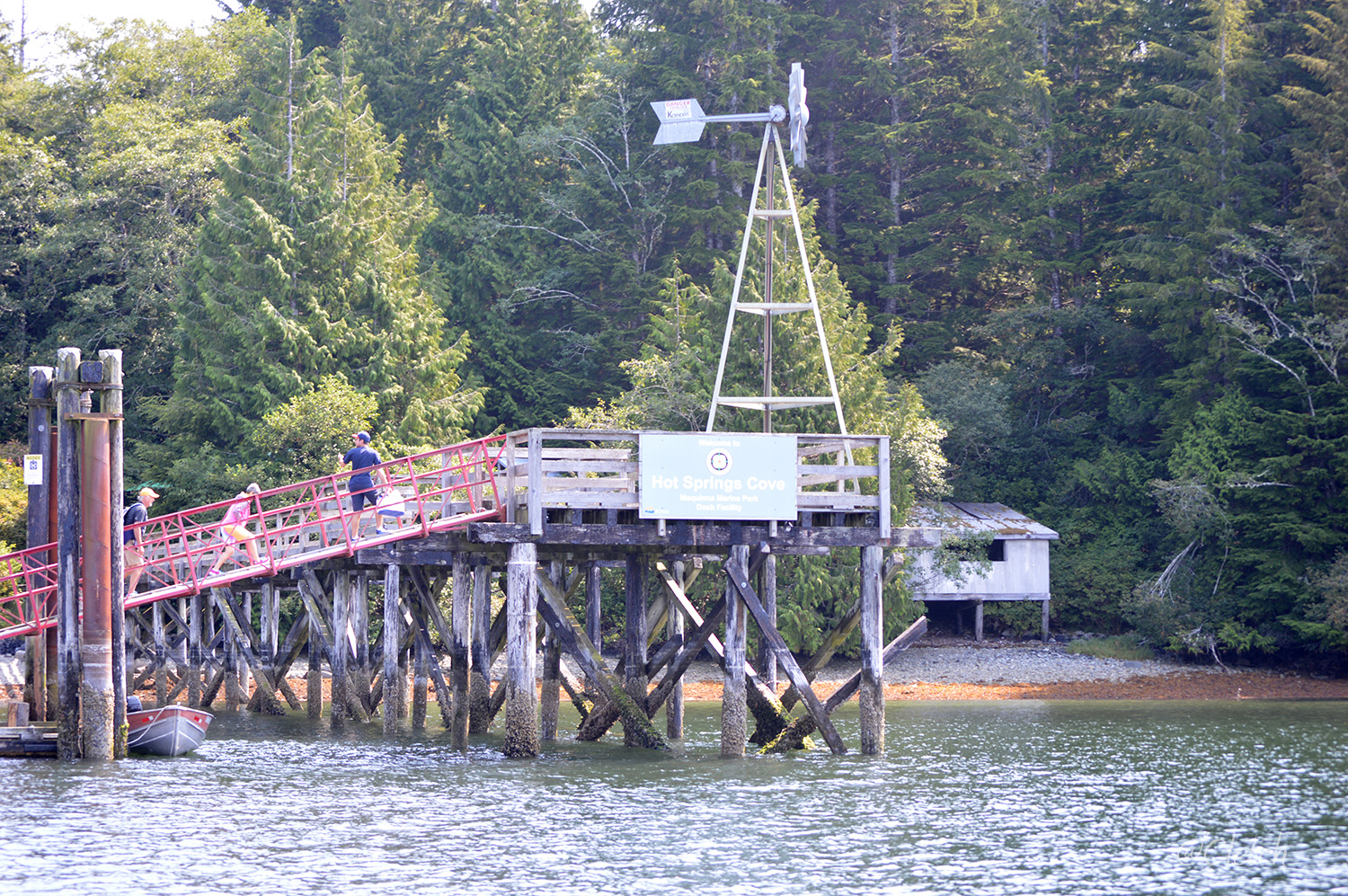
Hot Springs Cove
The water at Ramsay Hot Springs emerges from the earth at scalding temperatures and tumbles down a series of rock pools toward the Pacific Ocean, where it mixes with cold tidal seawater. This collision of geothermal heat and ocean cold -- adjusted by the tides themselves, so every visit is different -- is what gives Hot Springs Cove its name and its unlikely magnetism. The settlement sits on Sydney Inlet, on the west side of the Openit Peninsula in the western reaches of Clayoquot Sound. Formerly called Refuge Cove, it is one of the most remote inhabited places on Vancouver Island, a community that has persisted long after its post office closed in 1974.
A Refuge Renamed
The post office opened in 1947 under the name Sydney Inlet, was renamed Hot Springs Cove in 1948, and shut its doors in 1974. That institutional timeline -- open, renamed, closed in less than three decades -- captures something about the settlement's precarious relationship with the outside world. But the closure of a post office does not mean the closure of a community. Hot Springs Cove has maintained a year-round population through decades when similar coastal settlements were abandoned. The Hesquiaht First Nation, a Nuu-chah-nulth band, is based here, and their presence gives the community an anchor that outlasts any federal service.
Where the Parks Converge
Hot Springs Cove sits at the center of an extraordinary concentration of protected wilderness. Maquinna Marine Provincial Park safeguards the hot springs themselves. Sydney Inlet Provincial Park, Gibson Marine Provincial Park, Hesquiat Peninsula Provincial Park, and Sulphur Passage Provincial Park all surround the settlement, creating a mosaic of marine and terrestrial protection that encompasses temperate rainforest, rocky coastline, and the deep waters of the inlet. This is not a landscape that was preserved because it was already popular -- it was preserved because it is genuinely wild, the kind of coast where black bears forage on the shore and gray whales pass within sight of the hot springs pools.
Getting There Is the Point
There is no road to Hot Springs Cove. Visitors arrive by boat from Tofino -- a journey of about an hour through the islands and channels of Clayoquot Sound -- or by floatplane, which covers the distance in minutes but costs accordingly. From the dock at the cove, a boardwalk trail winds through old-growth rainforest for about two kilometers before reaching the hot springs. The walk itself is part of the experience: the forest canopy closes overhead, the air thickens with moisture, and the sound of the ocean grows louder as you approach the coast. When the pools finally appear -- terraced into the rock shelf above the surf line, steam rising into the salt air -- the remoteness that made the journey difficult is exactly what makes the destination worth it.
Tides as Thermostat
What makes Ramsay Hot Springs unusual among geothermal sites is the ocean's direct involvement. The lowest pools fill with cold seawater at high tide, creating a temperature gradient that ranges from near-scalding at the source to pleasantly warm where the thermal water meets the Pacific. At low tide, more of the rock shelf is exposed and the pools run hotter. Visitors learn to read the tides as a kind of thermostat, choosing their timing based on whether they want the heat turned up or dialed back. The springs have drawn people to this coast long before the post office opened or the provincial park was established -- long before the settlement had any name at all. The hot water keeps coming regardless, rising from deep in the earth to meet the cold ocean at the edge of the continent.
From the Air
Hot Springs Cove is located at approximately 49.37N, 126.26W on Sydney Inlet, west coast of Vancouver Island. The settlement is visible as a small clearing on the western shore of the Openit Peninsula. Maquinna Marine Provincial Park and the hot springs are located approximately 2 km south along the coast. The nearest airport is Tofino/Long Beach Airport (CYAZ), about 40 km southeast. Floatplane access is common. Expect frequent low cloud, marine fog, and rain along this exposed coastline.