Hotak Dynasty
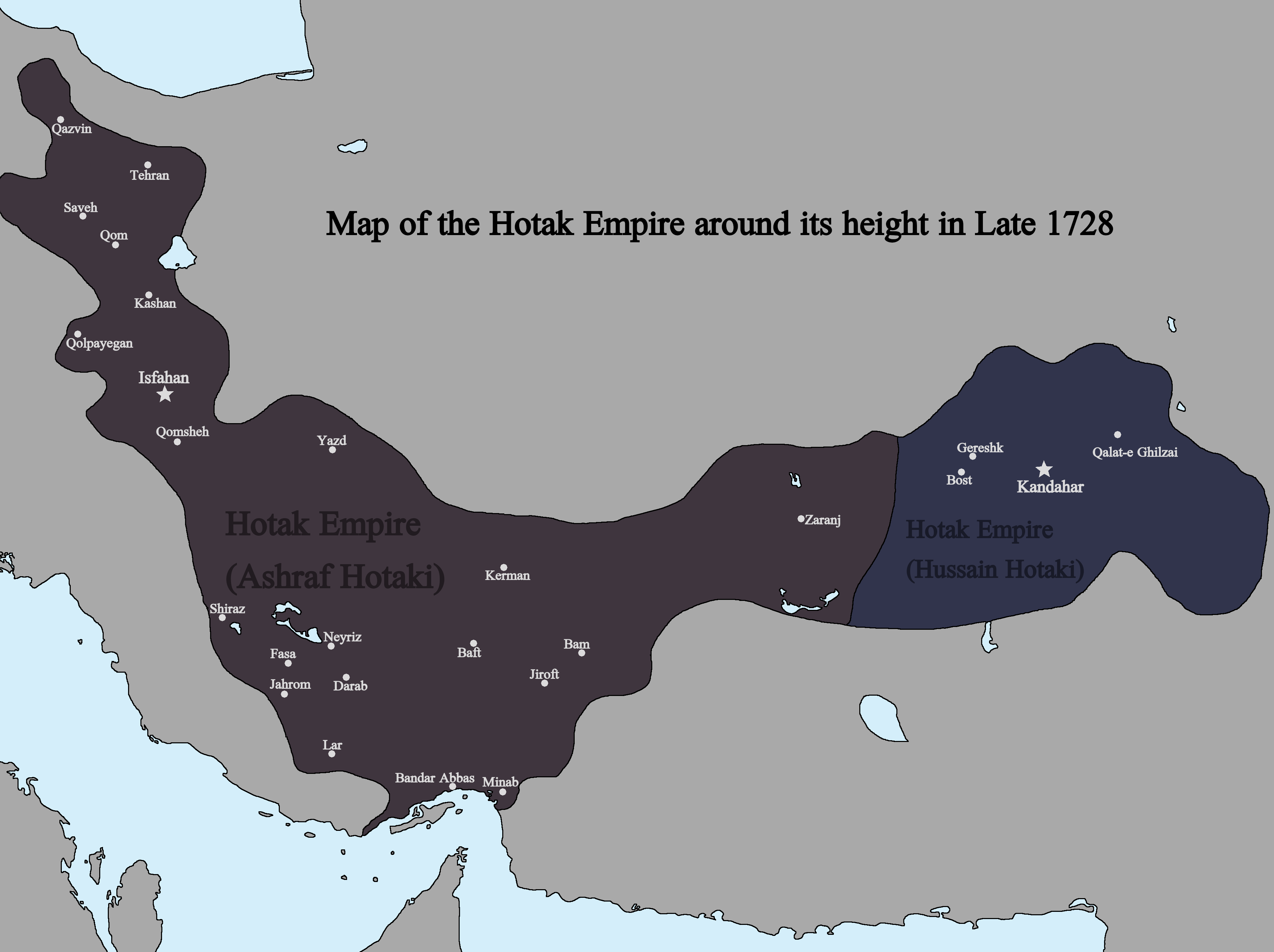
In 1722, an army of Afghan tribesmen starved the Persian capital of Isfahan into submission. For six months, the people behind those ancient walls ate rats and dogs while Mahmud Hotak's forces waited outside. When the Safavid Shah Sultan Husayn finally walked out and placed his crown on the conqueror's head, it was one of the most improbable power transfers in Asian history: a tribal confederation from Kandahar had toppled an empire that had ruled Iran for over two centuries. The Hotaks would hold their prize for barely seven years, undone not by external enemies but by the violence they could not stop turning on themselves.
The Governor's Ambush
The story begins with a Georgian. In 1704, the Safavid Shah Husayn appointed George XI of Kartli, a convert to Islam known as Gurgin Khan, as governor of Kandahar. The appointment was a provocation: Kandahar's Ghilji Pashtun tribes were Sunni Muslims governed by a distant Shia empire that had ruled their territory since the 16th century, and the arrival of a heavy-handed foreign governor pushed simmering resentment toward open revolt. Mirwais Hotak, a tribal leader involved in early resistance, was arrested and sent to Isfahan. There, in the imperial capital itself, he studied his enemy's weaknesses firsthand. When he returned to Kandahar, he waited. On April 21, 1709, Mirwais and his men ambushed Gurgin Khan and killed him. It was not a spontaneous uprising but a calculated assassination, and it marked the founding moment of a dynasty.
An Empire Caught Between Giants
Kandahar's position made it a prize and a curse. The Safavid Empire held it as their easternmost territory, but the Sunni Mughal Empire pressed from the east, and the Khanate of Bukhara loomed to the north. By the late 17th century, the Safavids were rotting from within. The last capable shah, Abbas the Great, had died in 1629, and his successors rarely left the palace. Courts grew bloated with factionalism while frontiers went undefended. Sultan Husayn, who took the throne in 1694, was perhaps the most passive of all, a ruler whose immobility became a kind of slow-motion abdication. Mirwais Hotak recognized what the Safavid court could not admit: the empire's grip on its periphery had become an illusion. When he declared independence from Safavid rule after killing Gurgin Khan, Persia was too enfeebled to take Kandahar back.
The Siege That Broke Isfahan
Mirwais died of natural causes in 1715, and the dynasty's violence began immediately. His brother Abdul Aziz succeeded him but was killed by Mirwais's own son, Mahmud, who seized power with the ambition his father had only dreamed of: conquering Persia itself. Mahmud marched west with a Ghilji army and laid siege to Isfahan. The city's agony lasted roughly six months. Starvation reduced the population to desperation, and on October 23, 1722, Sultan Husayn surrendered his throne. For the next seven years, the Hotaks were the de facto rulers of most of Persia. But ruling an empire proved harder than conquering one. The Persian population rejected the Ghilji occupiers as usurpers. Mahmud's reign dissolved into paranoia and mass killing: thousands of civilians were massacred in Isfahan, including more than three thousand religious scholars, nobles, and members of the Safavid royal family.
Cousins, Coups, and the Collapse
Mahmud died in 1725, and his cousin Ashraf Hotak took the throne through yet another palace coup. Ashraf inherited an empire in revolt: a Safavid loyalist movement under Sayyed Ahmad had seized much of southern Persia, including Fars, Hormozgan, and Kerman. Then came the force that would end everything. Nader-Qoli Beg, an Iranian soldier of fortune from the Afshar tribe, rallied under the Safavid banner and crushed Ashraf's army at the Battle of Damghan in October 1729. The remaining Hotaks were driven back to Kandahar, their empire reduced to the province where it had begun. In 1738, Nader Shah, as he now styled himself, besieged and destroyed the last Hotak stronghold. Among the troops in his army was a young Abdali Afghan named Ahmad Shah, who would later found the Durrani dynasty. Nader Shah built a new city nearby and named it Naderabad. The Ghilji were pushed back to their old stronghold of Kalat-i Ghilji, an arrangement that persists to this day.
Kandahar Remembers
From the air, modern Kandahar sprawls across a dusty plain ringed by barren mountains, a city whose strategic importance has drawn conquerors for millennia. The Hotak dynasty lasted barely three decades, from Mirwais's 1709 revolt to Hussain Hotak's defeat in 1738, yet it altered the trajectory of two nations. The Ghilji rebellion proved that a tribal confederacy could bring down a continental empire. It also demonstrated, through the blood of Isfahan's massacred civilians and the dynasty's own fratricide, how quickly conquest without legitimacy devours itself. The Safavid Empire never truly recovered; the Afsharid dynasty that replaced it was itself short-lived. And the young Ahmad Shah Abdali, who had watched the Hotaks rise and fall from inside the machine of empire, took the lesson and built something more durable. The Durrani dynasty he founded would shape Afghanistan for centuries.
From the Air
Centered at 33.00N, 66.00E in the Greater Kandahar region of southern Afghanistan. Kandahar Airfield (OAKN) is the nearest major airport, approximately 130 km to the south. The terrain is arid plateau surrounded by mountain ranges. Isfahan, the Safavid capital besieged by the Hotaks, lies approximately 1,500 km to the west in central Iran. Best viewed at 10,000-15,000 ft AGL. The ancient city of Kalat-i Ghilji (Qalat) is visible to the northeast along the Kandahar-Kabul highway.