Hotel Congress
The fire started in the basement on January 22, 1934, and climbed to the third floor where a group of men stayed under assumed names. When firemen rescued their heavy luggage, they recognized faces from wanted posters. Within days, John Dillinger and his gang were in custody, undone by a hotel fire and the weight of their own stolen cash. The Hotel Congress had been open barely fifteen years, designed by Los Angeles architects William and Alexander Curlett as part of a Congress Street expansion. A naming competition in the Arizona Daily Star had christened it. A gangster's bad luck would make it famous.
A Name Won by Contest
The Arizona Daily Star announced the competition in 1918. Tucson needed a name for its new hotel, rising alongside the Rialto Theatre on Congress Street, its rear facing the Southern Pacific train station built in 1907. Dorit Dinkel won with the obvious choice: The Congress Hotel. The prize was $15 in baby bonds. The Los Angeles firm of William Curlett and Son designed the building, though William himself had died in 1914. His son Alexander carried the family name forward. The hotel opened as railroad passengers stepped off trains into a downtown that was finally becoming a city. Congress Street tied it all together: train station, theater, hotel, the arteries of a growing Tucson.
The Dillinger Capture
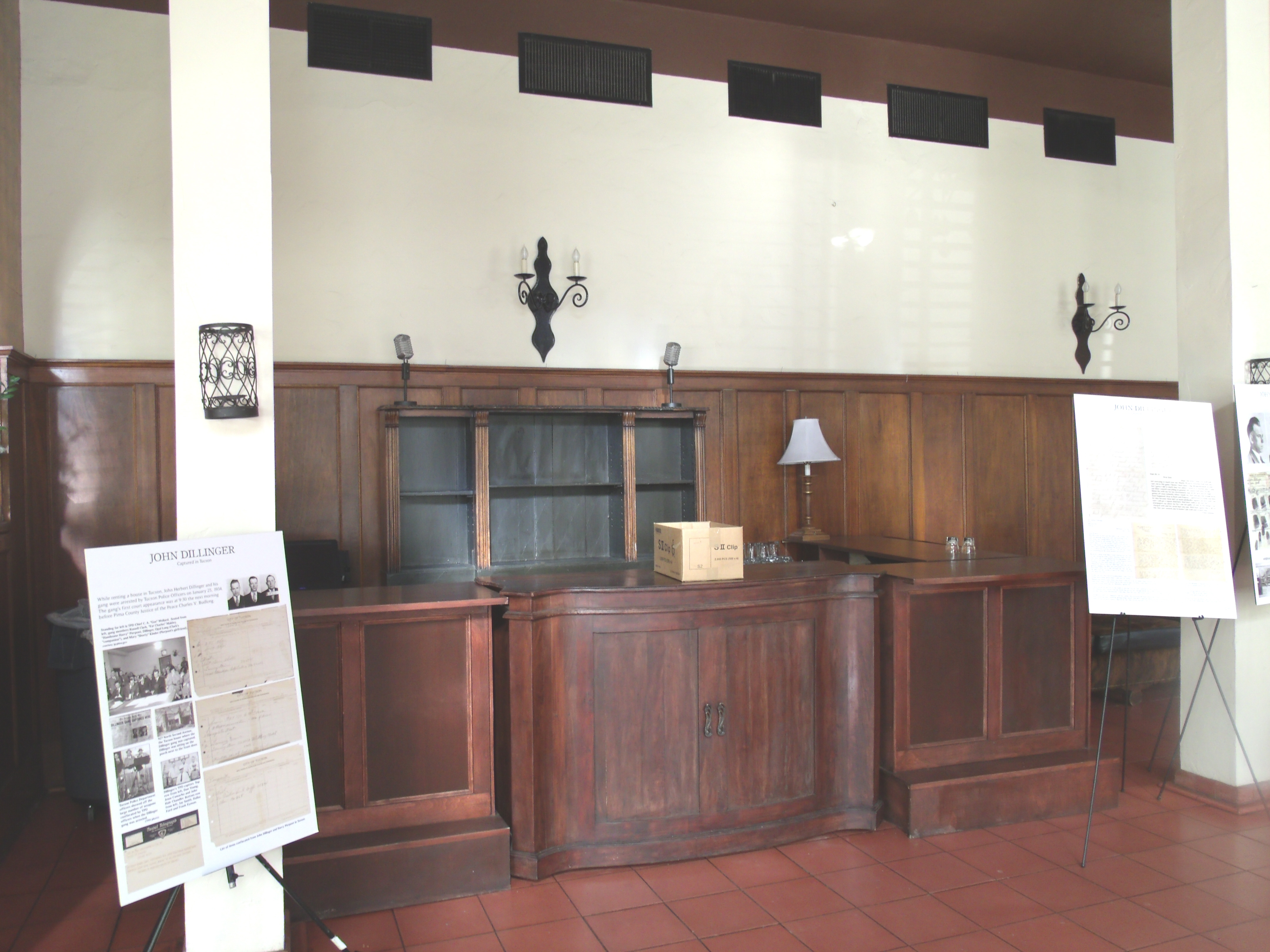
After robbing banks across the Midwest, the Dillinger Gang arrived in Tucson seeking anonymity. They took rooms on the third floor under aliases. Then the basement caught fire. The desk clerk reached them through the switchboard. They escaped down aerial ladders. In their panic, they asked firemen to retrieve their luggage. The bags were heavy with cash and weapons. Firemen recognized the faces. Police arrested the entire gang. Dillinger was transferred to Crown Point, Indiana, where he escaped again. He was eventually shot down in Chicago. But his Tucson capture remained the Hotel Congress's defining moment. Local architect Roy Place rebuilt the fire-damaged upper floor in the original style. A plaque bearing his name leads visitors to assume he designed the whole building.
The Music Never Stopped
In 1985, Richard and Shana Oseran bought the hotel and opened Club Congress. It became a touring stop for bands passing through Tucson. Local Latino artist Daniel Martin Diaz redesigned the stage in 2005, earning a Best Functional Art Installation award from Tucson Weekly. ZZ Top guitarist Billy Gibbons declared the Tap Room his favorite bar. Governor Janet Napolitano proclaimed Labor Day Weekend 2005 as Club Congress Weekend, recognizing it as the longest-running venue of its kind west of the Mississippi. Entertainment director David Slutes launched HOCO Fest in 2004, a three-day music event that continues today. The Century Room opened in 2022 as Tucson's only jazz club, founded by Arthur Vint after his time at the Blue Note and Dizzy's Club in New York.
Time Capsule Downtown
The Hotel Congress interior maintains its 1930s decor, the same aesthetic that greeted Dillinger's gang ninety years ago. The Cup Cafe operates off the lobby. The National Register listing came in 2003. Fodor's awarded the hotel its Choice distinction in 2006 and 2008. The Oserans have driven downtown Tucson's 21st-century redevelopment from this single building. What began as a railroad hotel named through a newspaper contest became a gangster hideout, a music venue, a jazz club, and an anchor of urban revival. The trains still arrive at the station behind the building. Congress Street still connects it all. The heavy luggage that betrayed Dillinger has become the Hotel Congress's heaviest historical asset.
From the Air
Located at 32.22N, 110.97W in downtown Tucson on Congress Street, directly adjacent to the historic Amtrak station. The hotel sits in the downtown core alongside the Fox and Rialto theaters, forming a cluster of historic entertainment venues visible from the air. Tucson International Airport (KTUS) lies approximately 10 miles south. Davis-Monthan Air Force Base (KDMA) is about 7 miles southeast. The railroad tracks running behind the hotel provide a clear visual reference from altitude. Best viewed at 1,500-2,500 feet AGL. Downtown Tucson's grid pattern makes navigation straightforward, with the Santa Cruz River channel marking the western edge of the urban core.