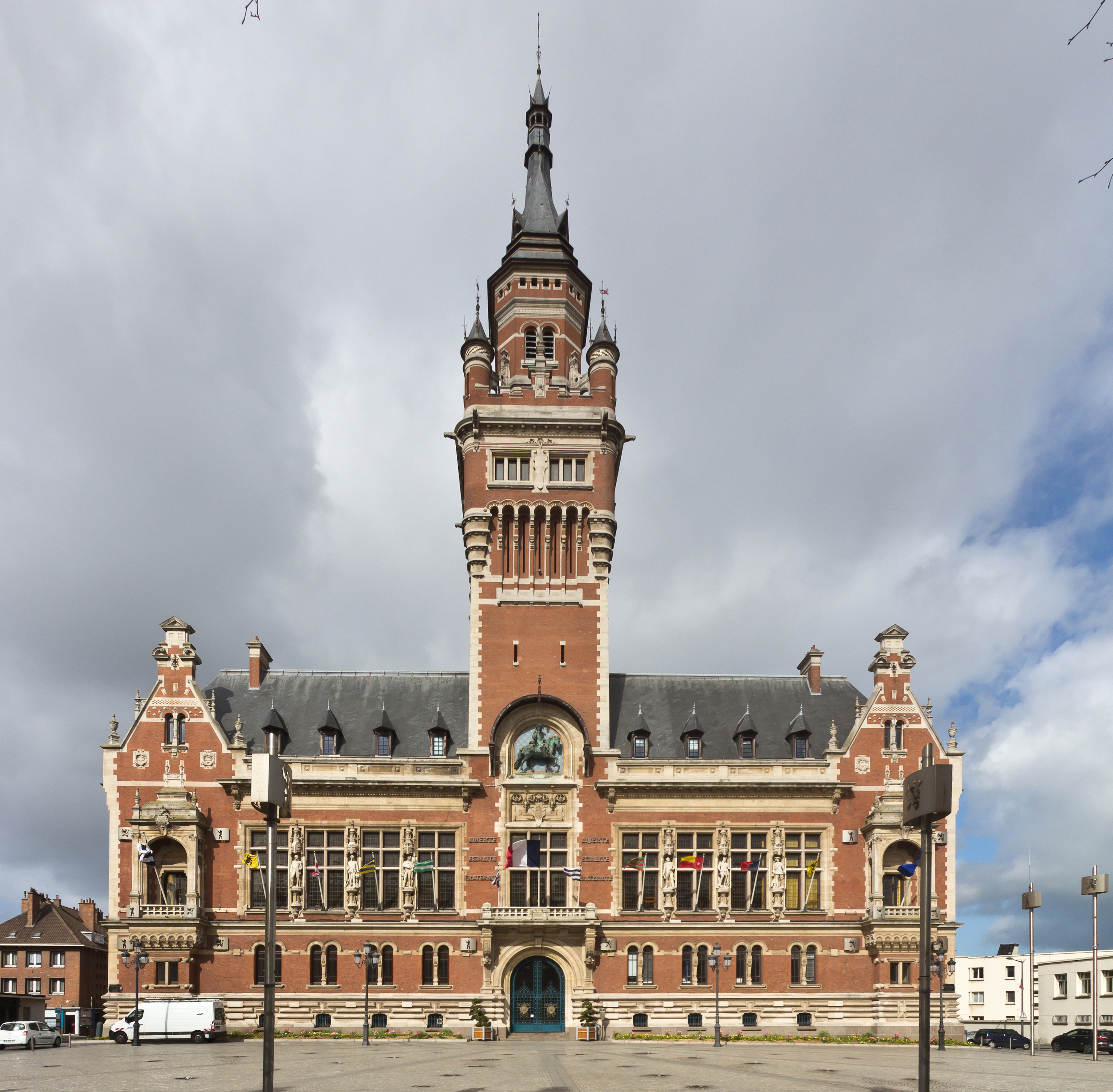
Hôtel de Ville, Dunkirk
On 17 September 1901, the President of France stood beside Tsar Nicholas II of Russia on a balcony in Dunkirk and opened a new town hall. It was the fourth municipal building on the same square. The first had gone up in 1233; the second had been destroyed when French marshal Paul de Thermes attacked English-held Dunkirk in 1558; the third had burned in 1642 and been rebuilt twice more, neoclassically remodelled in 1812, and finally pulled down at the end of the nineteenth century because it was falling apart. Each iteration suited the political moment. Émile Loubet's republican France, courting an alliance with Tsarist Russia, got something taller, redder, and unmistakably Flemish. It is the version still standing on Place Charles Valentin - though only just.
Eleven Bays and a 75-Metre Tower
Louis Marie Cordonnier designed the new building in the Renaissance Revival style. The brief was civic theatre: eleven bays of red brick with pale stone dressings facing onto the square, perfectly symmetrical, with a central clock tower rising 75 metres above the roofline. The doorway carried a moulded keystone and brackets that supported a stone balcony - the same balcony from which Loubet and the Tsar addressed the crowd. Above it, in the third stage of the tower, Cordonnier placed a relief of Louis XIV on horseback under a curved arch flanked by two lancet windows, a quiet political reminder that the Sun King had bought Dunkirk back from the English in 1662. The tower was castellated, with little bartizans at the corners and a hexagonal belfry topped by a spire.
Six Men in Stone
Between the windows on the first floor stand six statues, each chosen to tell a Dunkirk story. From left to right: Armand Charles Guilleminot, the Napoleonic-era soldier; Robert de Cassel, the medieval local magistrate; Jean-Marie Joseph Emmery, a former mayor; Pierre Jean Van Stabel, the naval officer who served the French Republic; Baldwin III, the tenth-century Count of Flanders who walled the original fishing village against Viking raids; and Michel Jacobsen, the sixteenth-century privateer who fought the Dutch and the English from Dunkirk harbour. Soldier, magistrate, mayor, naval officer, nobleman and corsair - the six trades the town has done best across a thousand years. Each statue watches the square below.
27 May 1940
On 27 May 1940, the day the Luftwaffe began its heaviest bombing of Dunkirk, German shelling hit the town hall. The interior was destroyed and the main structure was reduced to a shell. The brick skin of the building held; the floors, the offices, the council chamber, the records and the staircase did not. Around it, much of the rest of the town was on fire. About a thousand civilians died in Dunkirk that day. The town hall would stand as a gutted ruin for fifteen years, its tower still erect over a city being rebuilt around it. Louis-Stanislas Cordonnier, son of the original architect, was given the job of putting the interior back together. The reopening on 15 October 1955 was presided over by President René Coty - the same head of state who two years later sent General Ganeval to the unveiling of the Dunkirk Memorial.
The Belfry on UNESCO's List
Two further wings extended the building - north in 1960, south in 1974 - giving the hôtel de ville the working space a modern French commune needs. In 1989 the French government listed the whole structure as a *monument historique*. Then, in 2005, the belfry was added to the UNESCO World Heritage Site that groups together the Belfries of Belgium and France: 56 medieval and post-medieval bell towers across the two countries, recognised as symbols of civic independence in the historic Low Countries. Dunkirk's contribution is unusual on that list - not medieval, not even nineteenth century, but a 1901 tower whose silhouette was deliberately drawn to honour the older Flemish tradition. Beside it on the same square stands the older Belfry of Saint-Éloi, separately listed; visitors sometimes assume they are the same building. They are not.
Living On the Square
The clock still keeps the hour. The carillon in the belfry plays the *Cantate à Jean Bart* on the half hour, a small tribute to the corsair whose statue stands a block away. Inside, the council chamber rebuilt by the younger Cordonnier looks more sober than the original but has the same proportions. The carnival processions of February or March end at the foot of the steps; the *tambour-major* leads the crowd in calling the mayor to the balcony, where each year a fresh shower of smoked herring is hurled into the upturned hands of thousands of people in oilskins. The fourth Hôtel de Ville of Dunkirk has lasted longer than the first three combined. It has also been more battered. Both facts feel true to the town.
From the Air
The Hôtel de Ville stands at 51.038°N, 2.377°E on Place Charles Valentin in the centre of rebuilt Dunkirk, about 700 m inland from the harbour. From the air the most obvious feature is the 75 m clock tower with its hexagonal belfry - one of the few tall verticals on Dunkirk's low skyline. Nearest airfields: Calais-Dunkerque (LFAC) 30 km west; Ostend-Bruges (EBOS) 50 km northeast. Recommended viewing altitude 1,500-3,000 ft over the city centre; light is best from the south in late morning, when the red brick of the façade glows and the carillon may be audible if you have your window cracked.