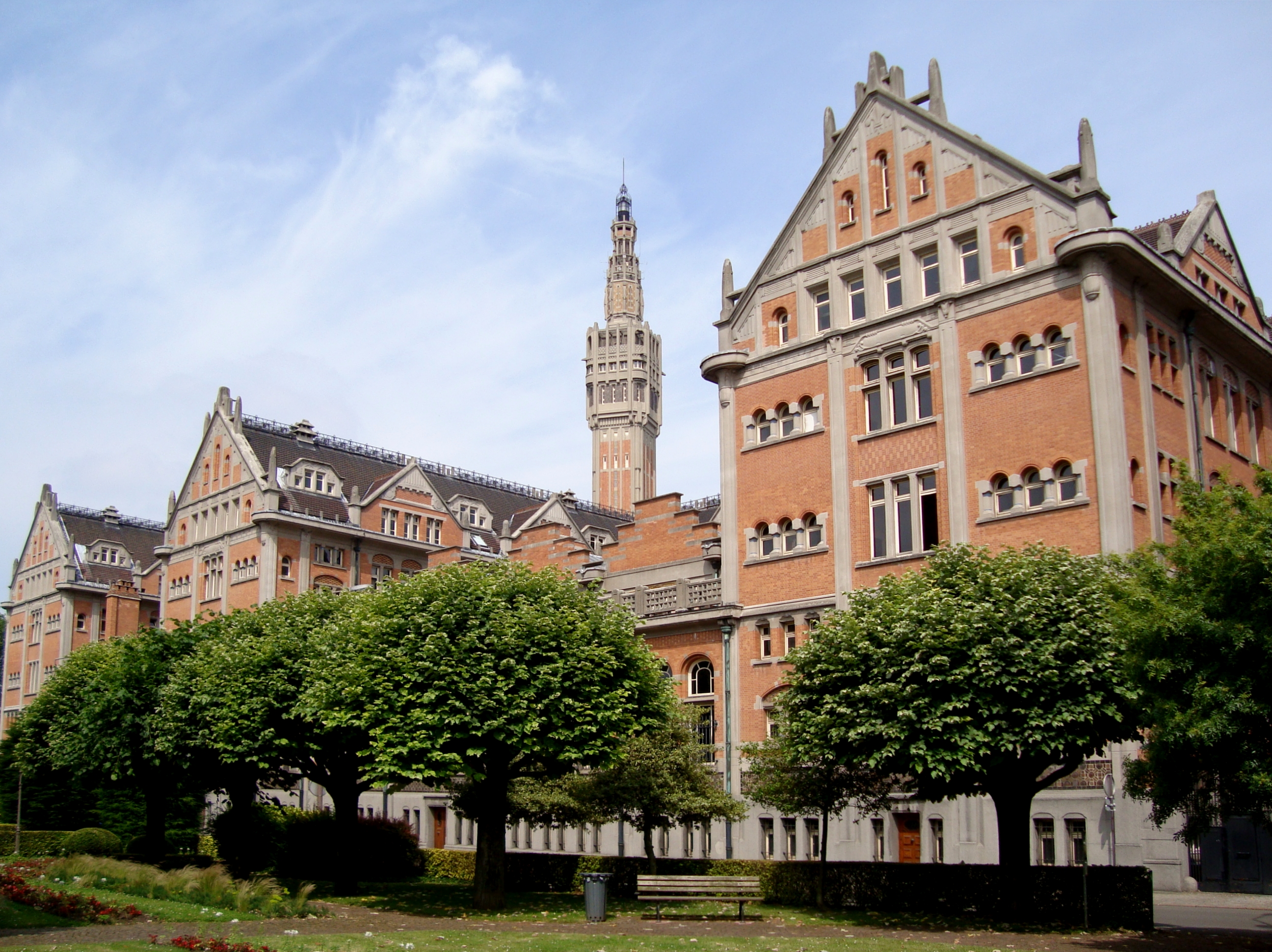
Hôtel de Ville, Lille
On the first floor of Lille's town hall there is an office that no mayor has used since 1936. The furniture is period. The fleur-de-lys is everywhere. The door stays closed. This was Roger Salengro's office — the socialist mayor who pushed for the belfry that now defines the city's skyline, who became France's Minister of the Interior, who was hounded by a far-right press campaign accusing him of desertion in the First World War, and who, on a November night in 1936, killed himself by gas in his Lille apartment. The city built a 104-metre tower in his lifetime. After his death, his successors made his office a permanent memorial, and worked from the deputy's room next door instead.
A New Town Hall for a New Era
The old town hall burned on 21 April 1916, mid-occupation, mid-war. When peace came, Lille's socialist municipality under Gustave Delory chose not to rebuild it. They wanted a new building in a new place — out in working-class Saint-Sauveur, on the leveled glacis of the demolished military fortifications. The site was deliberately political. The architect Émile Dubuisson was given a wide brief: redraw the district along Haussmann-esque lines, replace the dilapidated industrial housing, plant a civic monument in a neighbourhood that had never had one. Construction began in 1924. The war reparations meant to pay for it dried up almost immediately. Of three wings planned, only two were ever finished. The reception wing — the Hall of Honour, the Party Room — never rose at all.
Salengro's Belfry
Roger Salengro became mayor in 1925, with the building site already underway, and decided the town hall needed something the original plans did not include: a belfry. Not a stone one, in the medieval Flemish tradition, but a reinforced concrete tower — the first concrete building over 100 metres anywhere in France. It went up in two stages between 1929 and 1931, and was inaugurated in 1932 at 104 metres, with 400 steps to the top. The sculptor Carlo Sarrabezolles modeled two giants at its base — Lydéric and Phinaert, the legendary founders of Lille — directly into the fresh concrete with his bare hands, a technique he was almost alone in using. The tower's silhouette echoes the "Lilloise span," the stepped gable shape that defines the seventeenth-century houses a few streets north in Vieux-Lille. New material, old grammar.
Regionalist Art Deco
The building is Art Deco transcribed through Flemish memory — what local historians call "Regionalist Art Deco." Polychrome facades. Mullioned windows. Triangular gables bristling with sculpted ears of corn. Inside, a 143-metre gallery runs the full length of the building, divided into three naves by two rows of twenty-one concrete pillars whose capitals were cast in aluminium and whose bases wear marble and wrought iron. The gallery is essentially an indoor street: counters for the public at either end, a council chamber in the middle, four transverse blocks of offices opening off it. UNESCO inscribed the belfry as a World Heritage Site in 2005, part of the Belfries of Belgium and France ensemble — recognition of a thousand years of communal liberties, of which Lille's tower is the youngest member and, technically, the tallest.
Liberation and an Empty Office
During the occupation, the Germans used the town hall and the nearby Chamber of Commerce as headquarters. On 2 September 1944 the French Forces of the Interior seized both buildings; the next day, troops of the British Second Army under Miles Dempsey completed the liberation. Queen Elizabeth II visited the hall in April 1957 and received full civic honours under those same Art Deco gables. The final wing — closing the quadrilateral Dubuisson had drawn in 1920 — was only finished in 1992 to plans by Jean Pattou's Tandem+ firm, sixty years after the rest of the building opened. The vestibule visitors enter today is therefore the newest part of one of the most painstakingly slow town halls in France. Salengro's office is still upstairs, still untouched.
From the Air
50.6306°N, 3.0710°E. The Belfry of Lille is the easiest landmark in the city: a slender 104-metre concrete tower rising from a low Art Deco massing on the eastern edge of the centre, well clear of the medieval clutter of Vieux-Lille to the north-west. Recommended viewing altitude 1,500–2,500 ft AGL — high enough to take in the quadrangular plan and the neighbouring Porte de Paris, low enough to read the stepped gables. Nearest airports: Lille-Lesquin (LFQQ), 5 nm south-southeast; Brussels (EBBR) 50 nm east; Charles de Gaulle (LFPG) 100 nm south. Low haze is common in the Flanders plain — best visibility in autumn and winter mornings after a frontal passage.