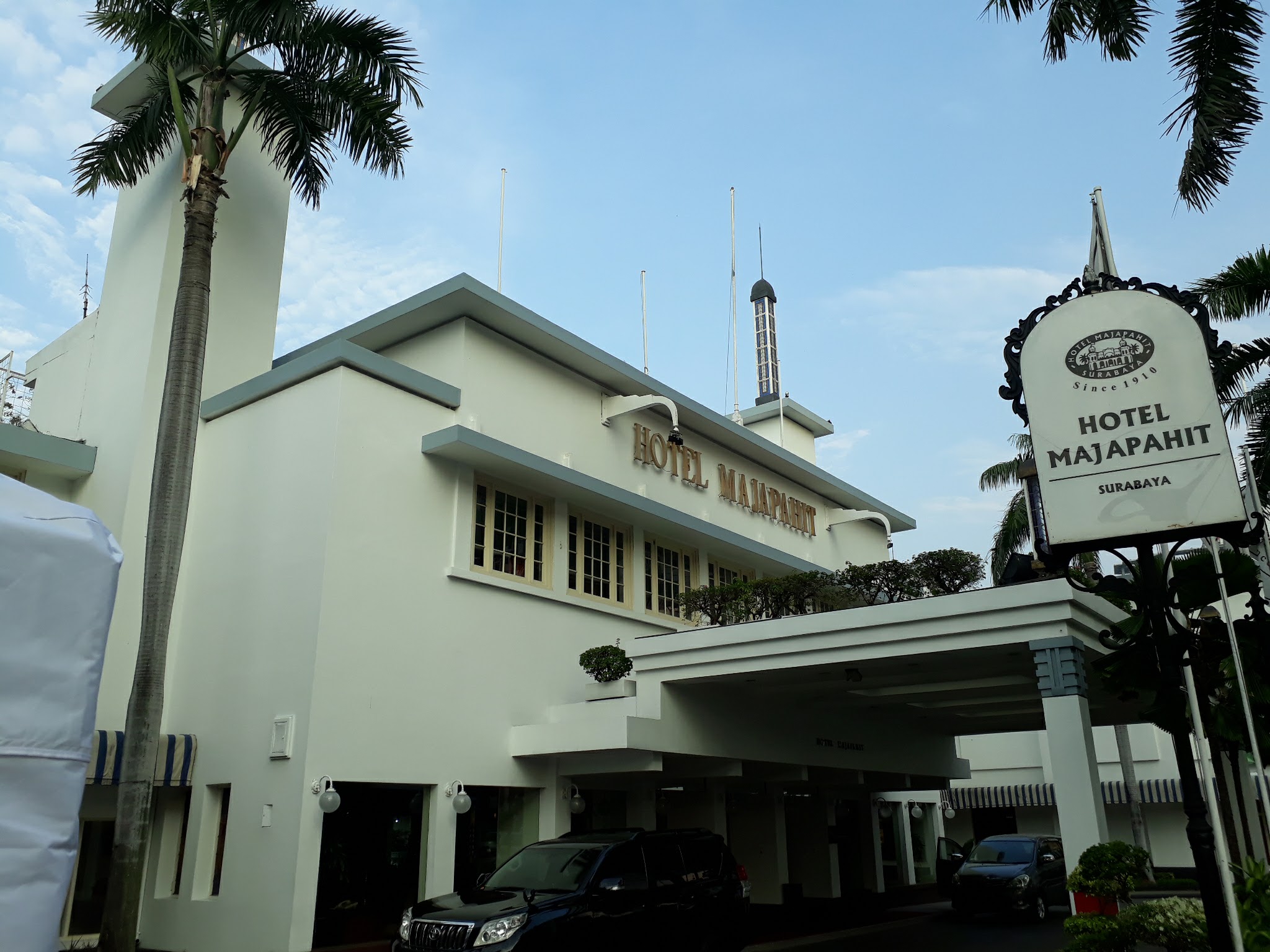
Hotel Majapahit: Where a Torn Flag Sparked a Revolution
On the evening of 19 September 1945, a group of Dutch nationals climbed to the roof of the Hotel Yamato in Surabaya and raised the Dutch tricolor. It was Queen Wilhelmina's birthday, and the gesture was meant to signal that the colonial order still held. By the next morning, Indonesian youth had stormed the building, hauled down the flag, and torn away its blue stripe - leaving only the red and white of the new Indonesian republic fluttering above the city. That act of fabric and fury at what is now the Hotel Majapahit set in motion the bloodiest battle of Indonesia's war for independence. The hotel still stands, its Art Deco lobby and colonial gardens intact, a five-star property where guests sleep in rooms that once housed Japanese military command and Dutch defiance alike.
An Armenian Family's Eastern Empire
The hotel was born from one of Asia's great entrepreneurial dynasties. The Sarkies brothers - Martin, Tigran, Aviet, and Arshak - were Armenian emigrants from Isfahan, Iran, who built a chain of legendary hotels across Southeast Asia. Tigran opened the Eastern & Oriental in Penang in 1884. The family went on to found the Raffles Hotel in Singapore and the Strand in Rangoon. In 1910, Lucas Martin Sarkies, Martin's son, commissioned British architect R.A.J. Bidwell - the same architect who designed the Raffles - to create a grand hotel in Surabaya. The Hotel Oranje opened in 1911. Two wings were added between 1923 and 1926, and an Art Deco lobby extension followed in 1930, its opening celebrated at a party attended by Belgium's Crown Prince Leopold III, Sweden's Princess Astrid, and Charlie Chaplin. By then, the Sarkies dynasty was collapsing under debt - Arshak died in 1931 and the family's hotels went into bankruptcy - but the Surabaya property endured.
Three Flags Over One Roof
The hotel has flown three nations' colors. Under the Dutch, it was the Hotel Oranje - named for the royal house and patronized by the colonial elite. When Japanese forces occupied the Dutch East Indies in 1942, they renamed it Hotel Yamato and turned it into the headquarters of Japanese military operations in East Java. For three years, the building that had hosted European garden parties served imperial Japan's war machine. Then came the moment that wrote the hotel into Indonesian history. When those Dutch nationals raised their flag on 19 September 1945, they misjudged the city's mood entirely. Indonesia had declared independence just a month before. Surabaya's youth - the pemuda - saw the tricolor as a direct provocation. The crowd gathered. Tensions broke. Hariyono and Kusno Wibowo climbed the flagpole, tore the blue stripe from the bottom, and what remained was the Merah Putih - red and white, the flag of the republic.
From Flashpoint to Battlefield
The flag incident did not end with fabric. It escalated into weeks of confrontation between Indonesian republicans and Allied forces. On 30 October, Brigadier General A.W.S. Mallaby was killed in the streets of Surabaya - the circumstances still debated decades later. The British responded with an ultimatum demanding the city's surrender by 10 November. When Surabaya refused, the British attacked with naval bombardment and air strikes. The Battle of Surabaya lasted three weeks, killed thousands of Indonesians, and drove 200,000 civilians from the city. It was the largest single battle of the Indonesian National Revolution. The hotel where a flag was torn became the prologue to a slaughter that, paradoxically, strengthened Indonesian resolve. November 10 is now Heroes' Day across the entire archipelago.
Names That Mirror a Nation's Story
After independence, the hotel's name changed with Indonesia's politics. It sat neglected for decades before reopening on 19 January 1996 as the Mandarin Oriental Hotel Majapahit Surabaya - the new name evoking the Majapahit Empire, the medieval Javanese kingdom whose capital lay not far from Surabaya and whose legacy Indonesian nationalists claimed as their own. In 2006, the CCM Group acquired the property and dropped the Mandarin Oriental branding, restoring the shorter name Hotel Majapahit -- the name Mantrust Holdings had first given it in 1969. Today it operates under Accor's MGallery brand. The colonial architecture has been preserved: thick walls, shaded verandas, gardens that soften the tropical heat. Guests can stay in rooms named for the building's eras. The flag incident is commemorated with a plaque and a memorial. What began as an Armenian businessman's commercial venture became, through accident and defiance, a touchstone of Indonesian identity - a hotel where history tore a flag in half and created a nation's symbol in the process.
From the Air
Hotel Majapahit sits at 7.26S, 112.74E in central Surabaya, East Java, roughly 1.5 km south of the Madura Strait coastline. The nearest major airport is Juanda International (WARR/SUB), approximately 20 km south of the city center, with dual 3,000-meter runways. The hotel is not individually visible from altitude, but Surabaya's dense urban grid and the Kalimas River corridor provide orientation. The Suramadu Bridge connecting Java to Madura Island is a prominent visual landmark to the northeast. Tropical monsoon climate with best visibility during dry season (May-October).