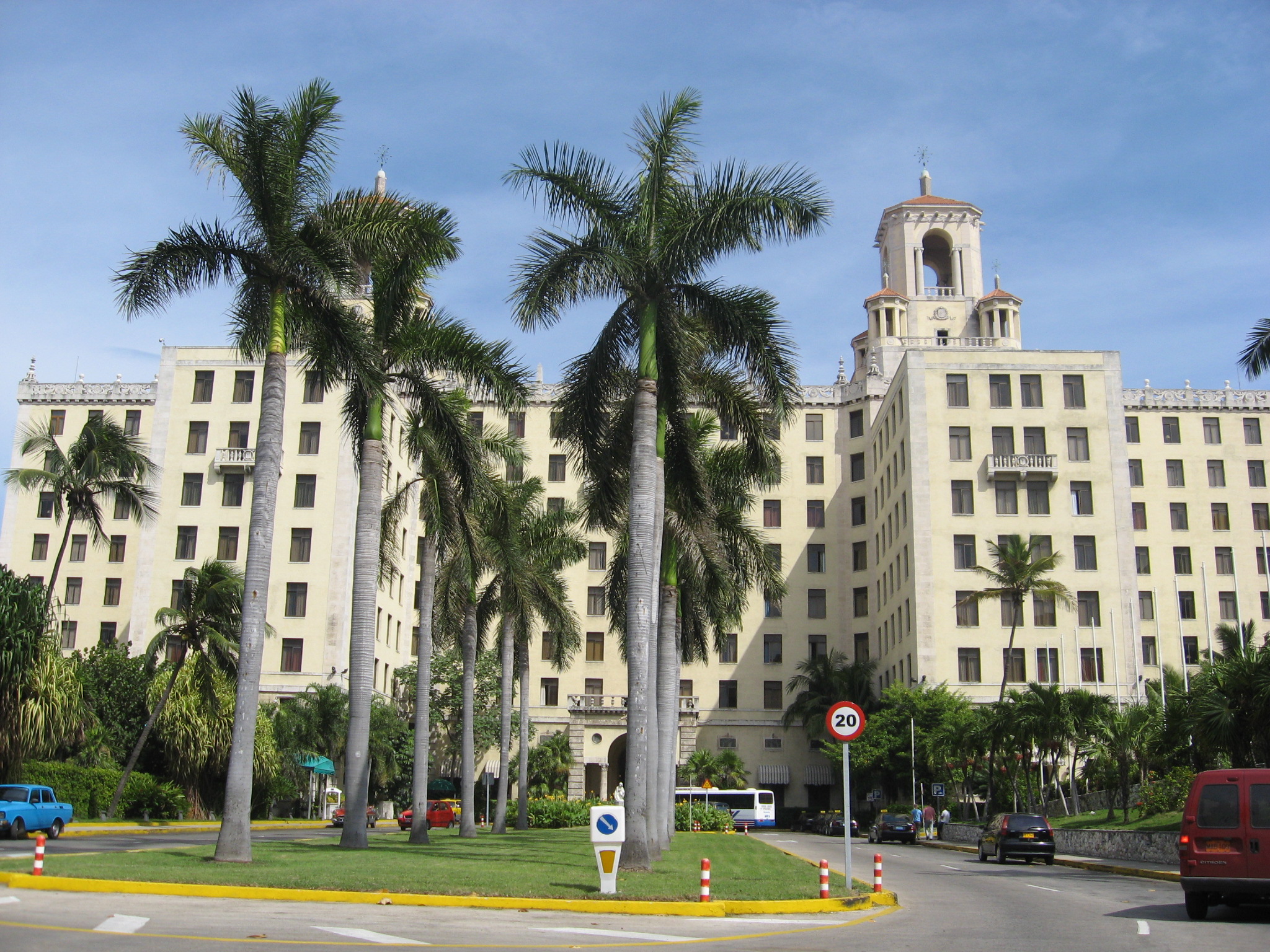
Hotel Nacional de Cuba
On October 2, 1933, soldiers loyal to Fulgencio Batista stormed the Hotel Nacional de Cuba. When the shooting stopped, 94 men lay dead and the building was riddled with shell and bullet holes. It was not the first crisis this hotel would endure, nor the last. Built in 1930 on Taganana Hill overlooking the Vedado seafront, the Nacional has been a battlefield, a mob summit venue, a Cold War missile battery, a target of bomb attacks, and the site of mysterious acoustic phenomena that baffled American diplomats. Through all of it, the hotel has kept welcoming guests -- from Winston Churchill and Ernest Hemingway to Yuri Gagarin and Marlon Brando -- making it arguably the most storied hotel in the Western Hemisphere.
New York Architects, Coral Stone
The Hotel Nacional was designed by McKim, Mead and White, the New York architecture firm behind many of America's most prestigious buildings, financed by the National City Bank of New York, and built in just fourteen months by the engineering firm of Purdy and Henderson. The structure blends Sevillian, Roman, Moorish, and Art Deco styles into something entirely its own. Coral stone -- cut from Cuba's coast -- forms the column capitals, quoins, ground floor details, and much of the paving. The layout follows two Greek crosses, a design that gives the majority of rooms an ocean view. The building's footprint stretches roughly 159 meters by 81 meters, its steel frame rising eight floors above Taganana Hill. When it opened as The National Hotel of Cuba on December 30, 1930, it was operated by the same American team that ran the Plaza Hotel, the Savoy-Plaza, and the Copley Plaza. Cuba was then a prime travel destination for Americans, and the Nacional was built to be their finest address in Havana.
The Mob Summit That Changed Crime
Beginning December 20, 1946, the Hotel Nacional hosted what became known as the Havana Conference -- the most consequential mob summit in American criminal history. Lucky Luciano ran the meeting alongside Meyer Lansky. Santo Trafficante Jr., Frank Costello, Albert Anastasia, and Vito Genovese all attended. Delegates represented New York, New Jersey, Buffalo, Chicago, New Orleans, and Florida, with bosses from the Jewish Syndicate present for joint business discussions. Luciano used the conference to reassert his authority as the de facto boss of bosses, a position he had technically eliminated in 1931 after the murder of Salvatore Maranzano. With Genovese angling to seize control of the Luciano family, Luciano formed an alliance with Costello and Anastasia to checkmate him, forcing Genovese to publicly shake hands with his rival. Francis Ford Coppola dramatized these events in The Godfather Part II, cementing the hotel's place in the popular imagination.
High Rollers and High Society
By the mid-1950s, Lansky had transformed a wing of the Nacional into a gambling paradise. Batista endorsed the plan despite objections from American expatriates including Ernest Hemingway. The new wing opened in 1956 with Wilbur Clark's Casino Internacional, the Starlight Terrace Bar, and the Casino Parisien nightclub with its Famous Dancing Waters. Eartha Kitt performed opening night and became the hotel's first Black guest -- the Nacional had previously turned away Nat King Cole, Joe Louis, Marian Anderson, Jackie Robinson, and Josephine Baker. By the spring of 1957, the casino was pulling in as much cash as the biggest operations in Las Vegas. The guest list over the decades reads like a fantasy dinner party: Frank Sinatra, Ava Gardner, Rita Hayworth, Mickey Mantle, Johnny Weissmuller, Buster Keaton, Rocky Marciano, Errol Flynn, John Wayne, Marlene Dietrich, Gary Cooper, Jimmy Carter, and countless heads of state.
Revolution, Missiles, and Mysteries
Castro nationalized the Hotel Nacional in June 1960, and by October he had shuttered the casino and outlawed gambling. The Intercontinental Hotels division of Pan Am, which had managed the property, posted a net loss that year. But the Nacional's role in geopolitics was just beginning. During the 1962 Cuban Missile Crisis, anti-aircraft guns were installed on the Santa Clara Battery atop Taganana Hill, and an extensive tunnel network was dug beneath the property -- tunnels that are now open to the public on guided tours. After years of neglect following the collapse of Soviet support in 1991, Cuba reluctantly reopened to tourism. The Nacional endured a bomb attack in 1997 intended to damage the tourism industry. Then in 2017, American diplomats at the hotel reported piercing, high-pitched noises and inexplicable ailments -- the phenomenon that became known as Havana Syndrome, which was never definitively explained.
The Hill Where Legends Overlap
Taganana Hill itself holds stories older than the hotel. The Santa Clara Battery stood here long before McKim, Mead and White drew their blueprints. The hill takes its name from a cave in the Canary Islands where a young Guanche princess named Cathaysa took refuge before being captured and sold into slavery by the Castilians in 1494. A parallel Cuban legend tells of an indigenous girl of the same name who sheltered in caves beneath this very hill while fleeing Spanish persecutors. The novelist Cirilo Villaverde immortalized the story in his work La Cueva de Taganana. Today, the Hotel Nacional crowns this layered ground -- a place where indigenous memory, colonial fortification, mob intrigue, revolutionary politics, and Cold War tension all converge beneath the same coral stone arches, looking out over the same Caribbean sea.
From the Air
The Hotel Nacional de Cuba (23.14N, 82.38W) occupies a prominent hilltop position on the Vedado seafront, easily identifiable from the air as a large multi-wing structure atop Taganana Hill. Jose Marti International Airport (MUHA/HAV) is about 18km to the south. Best viewed from 2,000-4,000 feet approaching from the north over the sea, where the hotel's commanding hilltop position is most apparent. The building sits just east of the Hotel Habana Riviera along the Malecon. The distinctive layout -- two Greek crosses -- is recognizable from above. Tropical climate; dry season November-April offers best visibility.