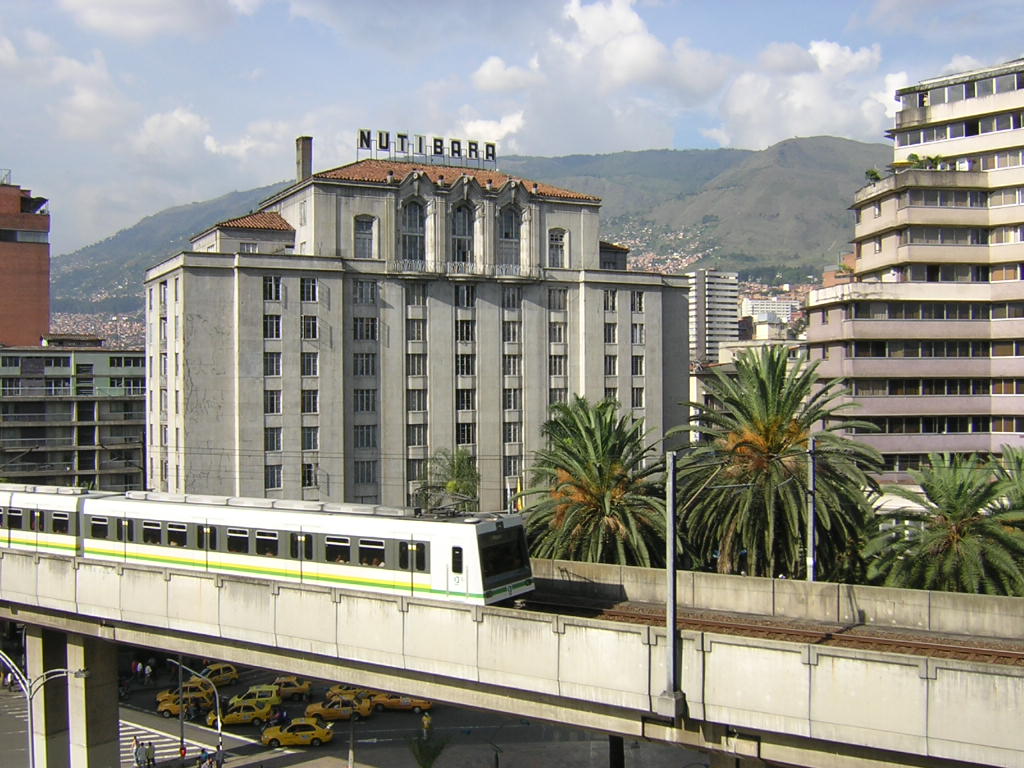
Hotel Nutibara
Ninety thousand bags of cement, shipped from the United States to a city ringed by mountains with no deepwater port. That was just one of the logistical puzzles that Paul Revere Williams solved while designing Hotel Nutibara, a twelve-story art deco landmark that opened on July 18, 1945, in the center of Medellin. Williams was an extraordinary choice for the commission: an African American architect from Los Angeles who had designed homes for Frank Sinatra and Lucille Ball, the first Black member of the American Institute of Architects, and a man who had learned to draw upside down so that white clients sitting across the desk from him would not have to sit beside him. His Colombian hotel would become one of his most ambitious projects -- and one of Medellin's most enduring landmarks.
A City Builds Its Welcome
The idea was born in 1936, when Medellin had only 150,000 inhabitants and an appetite for modernity. The Assembly of Antioquia authorized the governor, Alberto Jaramillo Sanchez, to promote a grand hotel worthy of the city's ambitions. The existing Hotel Europa was considered insufficient -- the city's elites wanted something grander, something that announced Medellin's arrival on the international stage. Construction began in April 1938, requiring the demolition of several older buildings. For four years, Williams and his team worked through a thicket of engineering challenges. Building materials familiar in California were unavailable in the Andes. Solutions had to be improvised, imported, or invented. The result was a reinforced concrete structure sheathed in terrazzo, its American art deco lines softened by tropical context.
Walls of Glass and Banks of Orchids
What makes the Nutibara feel alive, even eight decades on, is the way Williams dissolved the boundary between building and garden. Walls of glass formed near-invisible barriers between the lobby and the extensive grounds outside, where three plant-filled patios overflowed with azaleas, thousands of orchids, tropical bougainvillea, and -- in a purely Colombian flourish -- banks of coffee plants used as ornamental greenery. The hotel's name honored the indigenous cacique Nutibara, one of the most powerful chiefs in the pre-Columbian Antioquia region, and six of its lounges carry names drawn from Amerindian cultures: Bochica, Tairona, Quimbaya, Katio, Bachue, and Nutabe. It was a building designed by an American that chose, in its naming and spirit, to acknowledge the land it stood on.
The Guest Book
From the day it opened, Hotel Nutibara drew a remarkable roster of guests. Colombian presidents Jorge Eliecer Gaitan, Alfonso Lopez Michelsen, Mariano Ospina Perez, and Belisario Betancur all stayed here. So did the painter Debora Arango, the novelist Gabriel Garcia Marquez, the footballer Pele, the salsa legend Willie Colon, and the Mexican ranchera singer Chavela Vargas. Artists who performed in Medellin during the 1960s, 70s, and 80s would specifically request the Nutibara, describing it as a jewel. The hotel's restaurant, La Orquidea, became a gathering place for the city's intellectual and artistic circles, while the Plazuela Nutibara outside served as an informal open-air art school where sculptor José Horacio Betancur and teacher Rafael Saenz brought their students.
Art Deco in the Tropics
Luis Fernando Gonzalez Escobar, director of the School of Habitat at the National University of Colombia in Medellin, has called the Nutibara an example of the modernist architecture that predated the full modern movement in the city. Williams brought American art deco to a landscape where it had no precedent and made it feel native. The hotel sits today in the dense center of Medellin, next to the Parque Berrio metro station, within walking distance of the Museum of Antioquia, the Palace of Culture, the Metropolitan Cathedral, and the Basilica of Our Lady of Candelaria. The surrounding city has grown enormously since 1945, but the Nutibara remains, its terrazzo facades and glass-walled lobbies still holding the light of a grander era.
From the Air
Located at 6.252N, 75.567W in the heart of downtown Medellin, adjacent to Parque Berrio. The hotel is a twelve-story structure amid the dense urban core of the Aburra Valley floor. Recommended viewing altitude: 3,000-5,000 feet AGL. Olaya Herrera Airport (SKMD) is approximately 1.5 nautical miles south-southwest, making it the closest airport. Jose Maria Cordova International (SKRG) is about 18 nautical miles southeast in Rionegro. The downtown location places it near the Medellin River and surrounded by mid-rise commercial buildings.