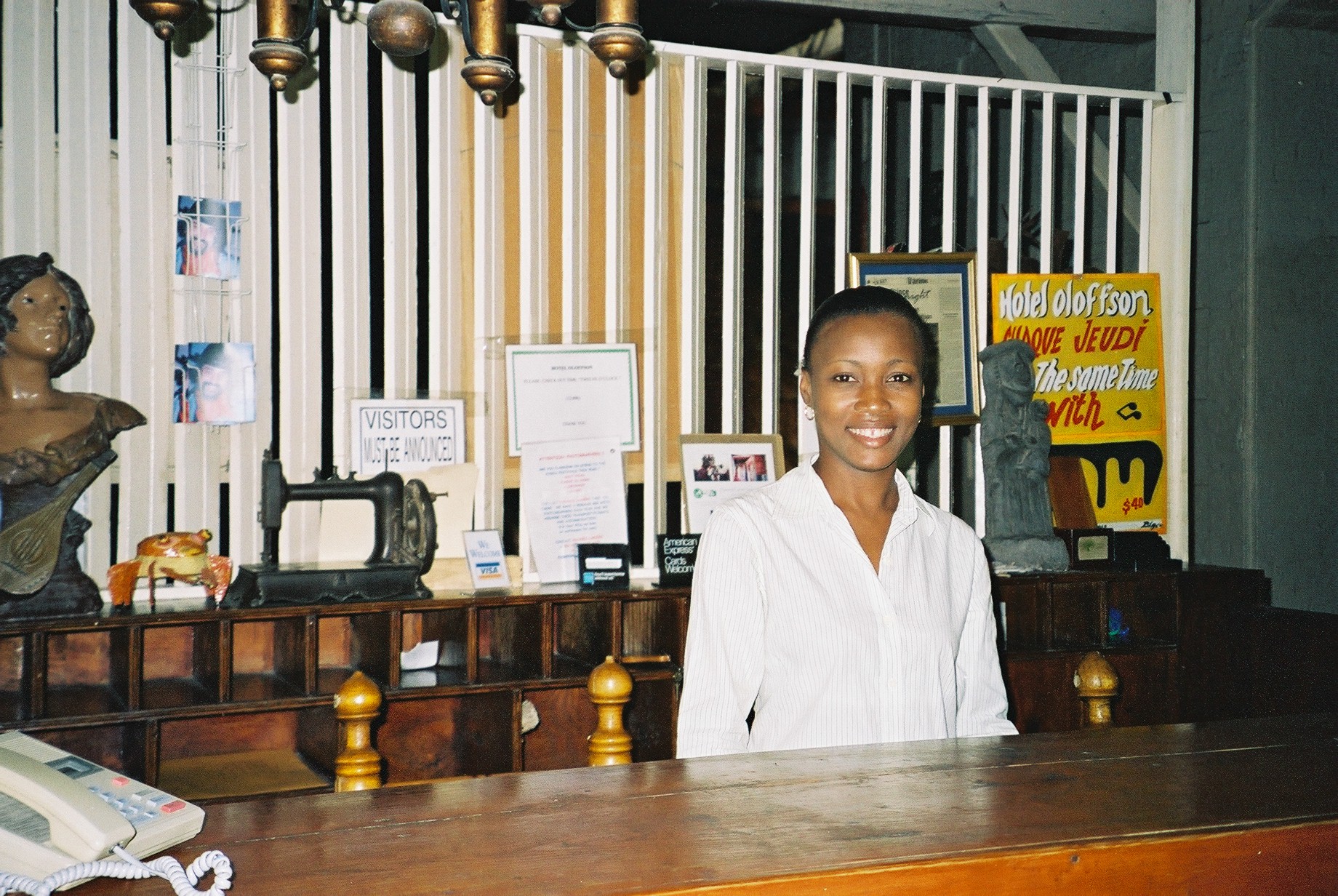
Hotel Oloffson
Graham Greene compared it to a Charles Addams cartoon from The New Yorker -- all towers and balconies and wooden fretwork looming against the tropical night. The Hotel Oloffson was never a normal hotel. Built as a private mansion for the family of Haitian President Tiresias Simon Sam in the late nineteenth century, it became a military hospital under American occupation, then a bohemian landmark that drew writers, rock stars, and spies to its lush gardens in central Port-au-Prince. For decades, the Oloffson was shorthand for a certain kind of Caribbean experience: equal parts beauty, danger, and decay.
A Presidential Mansion Becomes a Hospital
The Sam family commissioned the mansion in the gingerbread style -- a distinctly Haitian architectural tradition of ornate wooden latticework, turrets, and spires set within tropical gardens. Tiresias Simon Sam served as president of Haiti from 1896 to 1902, and the house reflected his family's status in Port-au-Prince society. The Sams occupied it until 1915, when their cousin Vilbrun Guillaume Sam became the fifth president in five years. His tenure lasted a mere five months before an angry mob executed him. In the resulting chaos, President Woodrow Wilson ordered U.S. Marines to seize Port-au-Prince, beginning an occupation that would last nearly two decades. The Sam family leased their mansion to the Marine Corps, which converted it into a military hospital. The gingerbread house that had hosted presidential receptions now held wounded soldiers.
The Greenwich Village of the Tropics
When the building reopened as a hotel in 1935, it became a magnet for the international creative class. Ernest Hemingway stayed. Mick Jagger stayed. Graham Greene set scenes from The Comedians within its walls. The journalist and socialite Aubelin Jolicoeur -- often described as the inspiration for Greene's character Petit Pierre -- held court in the lobby from the 1950s through the 1970s, writing about celebrity guests and greeting new arrivals at the airport. Historian Georges Corvington later said the hotel could not be separated from Jolicoeur's personality: he animated the place. The nickname stuck: this was the Greenwich Village of the Tropics, a place where intellectuals, artists, and what one writer called 'the criminally inclined' mingled under the fretwork ceilings.
Surviving the Earthquake
On January 12, 2010, Port-au-Prince was devastated by a magnitude 7.0 earthquake. A wall at the front of the Oloffson collapsed, killing a passerby. Several neighboring buildings fell entirely. But the gingerbread house itself -- more than a century old, built of wood rather than concrete -- remained largely standing. Owner Richard Morse became one of the first voices out of the disaster zone, posting updates on Twitter while his guests sat in the driveway. 'No serious damage here at the Oloffson but many large buildings nearby have collapsed,' he wrote that night. In the days that followed, the hotel became a de facto media headquarters, one of the only functional buildings left in a shattered city. The worldwide press corps decamped to its grounds, filing stories from the same gardens where Hemingway once drank.
The Long Decline
The Oloffson outlasted the earthquake, but it could not outlast the unraveling of Haiti itself. By 2018, the hotel's website had gone dark. As gang warfare consumed Port-au-Prince, Richard Morse relocated to the United States in October 2022, leaving a skeleton staff of three behind. The hotel stopped accepting guests around July 2024 -- the security situation had become untenable. Soon the remaining staff fled as well. On July 6, 2025, the abandoned Hotel Oloffson was destroyed by arson. Who set the fire and why remains unknown; at the time, Port-au-Prince was under the control of warring gangs. Kurt Vonnegut had placed the hotel in his novel Deadeye Dick. Anthony Bourdain featured it on No Reservations. Bob Shacochis wove it through The Woman Who Lost Her Soul. In the end, the literary landmark burned the way the country around it had been burning for years -- without anyone able to stop it.
From the Air
Located at 18.529N, 72.338W in central Port-au-Prince, Haiti. The hotel site sits in the dense urban core south of Toussaint Louverture International Airport (MTPP/PAP), approximately 4 nm from the field. From altitude, look for the dense residential area south of the Champs de Mars. Best viewed below 5,000 ft AGL. Be aware of highly restricted operations at Port-au-Prince; airspace may be closed due to ongoing security concerns.