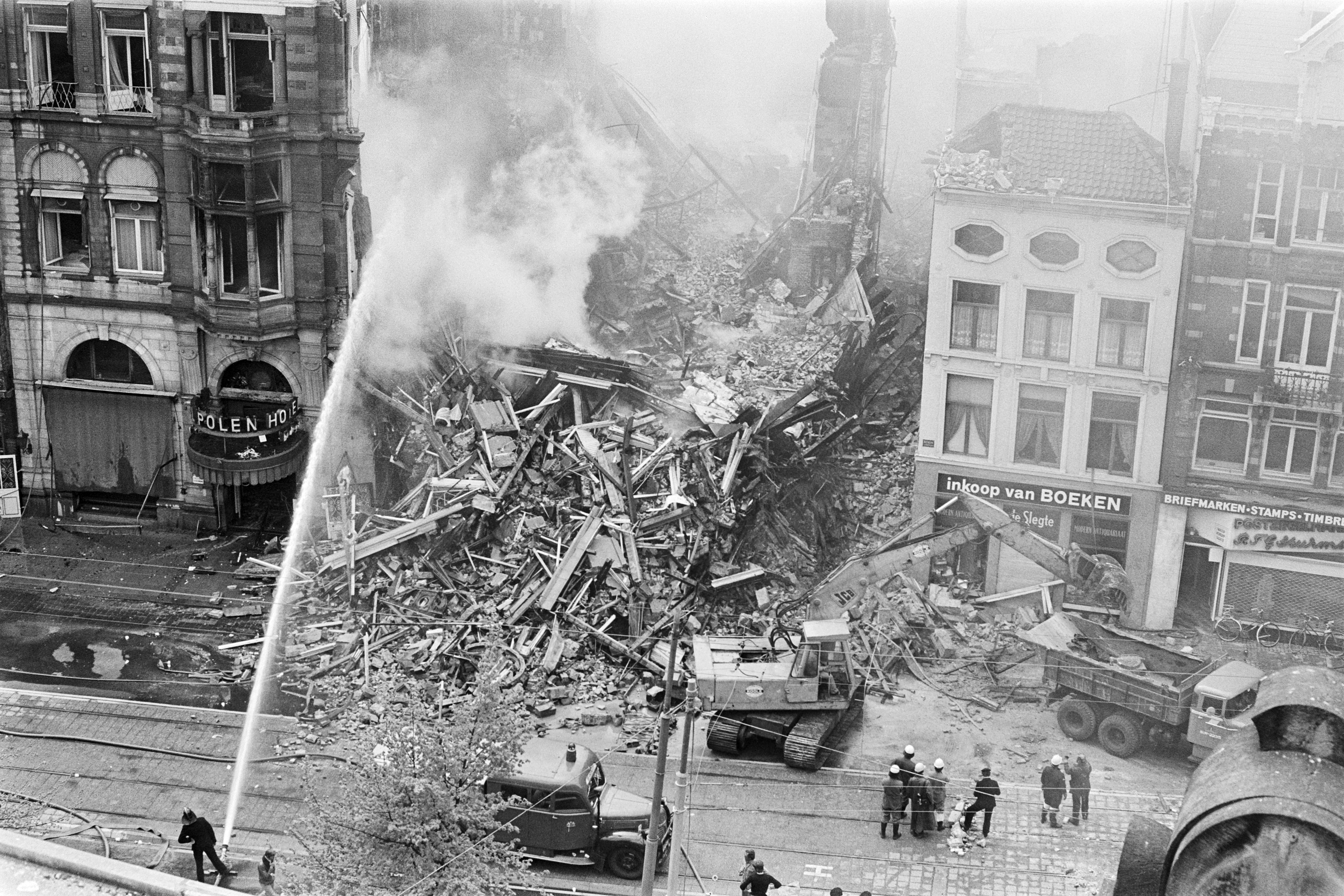
Hotel Polen Fire
They were on the kind of trip people save up for. A cheap package out of Stockholm or Oslo, a few nights in Amsterdam, the canals and the museums and the cafes and home again by the weekend. Most of them were Swedes. The Hotel Polen sat between the Kalverstraat and the Rokin in the centre of the city, five storeys of timber wrapped around a courtyard, ninety-four rooms, an inn for centuries on this exact patch of ground. On the night of Sunday 8 May 1977, around a hundred people went to bed in it. By breakfast time on Monday, thirty-three of them were dead. The cause of the fire is still officially unknown.
A Building Made of Tinder
The Hotel Polen was old in the way that Amsterdam's centre is old: it had grown out of an earlier business, the Poolsche Koffiehuis, which had been pouring drinks here since the late eighteenth century. In 1891 the coffee house took on the adjacent space and remade itself as a hotel. The walls and floors and even the load-bearing beams were wood. There were ninety-four rooms but only ten fire extinguishers and eleven hoses. The escape routes were not all marked. The building was not on a direct line to the fire brigade. The fire department had inspected the place in February 1976 and again in early 1977 and had written to management both times listing severe safety defects. The letter went into a file. The defects stayed where they were.
Sunday Night, Monday Morning
Smoke appeared in the freight elevator shaft around 6:20 a.m. The kitchen staff had been laying tables for breakfast. The night porter, against instructions, did not call the brigade. He poured buckets of water down the shaft instead. By the time he understood he could not put it out, the phone at the front desk was already inside the fire. He ran into the street, stopped the driver of a passing laundry truck, and sent him to the Hotel Krasnapolsky to make the call. The wooden building took the fire the way dry tinder takes a match. Guests on the upper floors woke into smoke and could not get down. They went to the windows. Some of them waited. Some of them jumped.
On the Rokin
The first large engine arrived at 6:42. By then there were bodies on the pavement. Firefighters tried to open a life net in the Papenbroekssteeg, the narrow alley between the Rokin and the Kalverstraat, but the alley was too tight for the net to spread. On the Rokin side, every window held a person screaming. Crews did not know whom to reach for first. Time bled away as people threw their luggage into the net before themselves, and the falling cases hurt the people who jumped after. Just before seven, the Kalverstraat wing collapsed. Burning debris dropped onto the engine parked there; the crew barely got clear. The book shop next door burned out. Fires sparked in buildings across the street and were beaten down quickly. When the smoke thinned, almost nothing of the hotel was left.
Who They Were
Of the thirty-three dead, thirty-two were tourists, seventeen of them Swedish. The thirty-third was a resident in the apartment above the book shop. Eighteen bodies were recovered, charred, from the debris. Thirteen people died from jumping or were left severely injured by it. One of the dead was Walter Kraft, the celebrated German organist and composer who had served for decades at St. Mary's Church in Lübeck. Two guests from the United States walked out unhurt. Fifty-seven people were injured in all, twenty-one of them seriously. They had come for a holiday. Most of them were young. The Swedish papers covered the fire for weeks and never quite stopped. In Norway and Sweden, families would remember for the rest of their lives where they had been when the call came.
What Stands There Now
Investigators never pinned down the cause. The most accepted theory is that a fire had been smouldering in the furniture store Inden on the ground floor; when the elevator shaft was opened in the morning, oxygen rushed in and the fire bloomed. A second theory blamed burglars covering tracks, but no evidence ever supported it. The Hotel Polen was not rebuilt. In its place stands the Rokin Plaza, a 1980s office block that now houses retail. In 1986, the Polish-born artist Ania Bien made a photographic installation about the fire and exhibited it at the San Francisco Museum of Modern Art and at the Amsterdams Historisch Museum. The names of the dead are not on the building. Walk down the Rokin at breakfast time and there is no marker that asks you to stop.
From the Air
The former site of the Hotel Polen sits at 52.3721°N, 4.8926°E in central Amsterdam, between the Kalverstraat and the Rokin, a short walk south of Dam Square and across the canal from the present Madame Tussauds. Best viewed at low altitude. Nearest major airport is Amsterdam Schiphol (EHAM), about 14 km southwest.